The boys’ pact to share everything
In the WoodsThe boys’ pact to share everything is the childhood code that binds Jonathan Devlin, Cathal Mills, and Shane, then turns their loyalty into a justification for crossing another person’s boundaries. Remembered by Jonathan during questioning, the pact begins as an answer to isolation: three boys with troubled family lives make one another their closest allies. Its motto, borrowed from The Three Musketeers, promises mutual protection; its later application to Sandra Scully reveals how a rule meant to hold the boys together can erase the perspective of anyone beyond them.
Origins and Terms
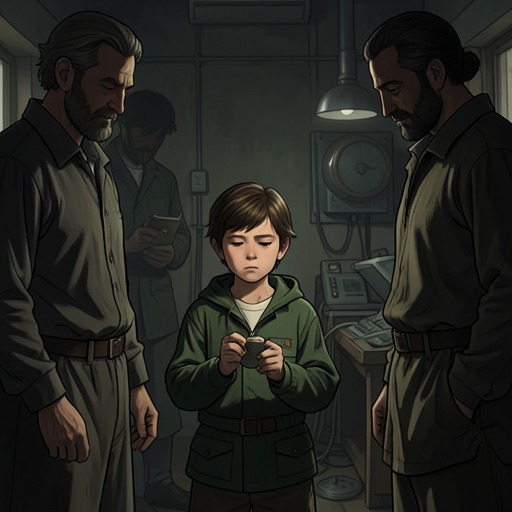
Jonathan recalls that the three boys grew up closer than brothers. Shane had never known his father, Cathal Mills’s father was unreliable, and Jonathan’s parents drank. He presents these circumstances not as an excuse for what followed but as the setting in which their friendship became unusually important. At about ten, they made a blood-brothers pact, a childhood ritual that made their bond feel formal and lasting.
The group’s motto came from watching The Three Musketeers on television. Cathal Mills proposed “all for one and one for all” as their rule: each would stand by the others because, as Jonathan recalls it, they felt nobody else was on their side. The phrase carries both affection and a practical promise of solidarity. But it also defines a closed circle. The boys’ sense that they had only one another makes their internal rule feel more authoritative than the claims of people outside it.
Jonathan sets this intense loyalty against the conditions of their adolescence in early-1980s Ireland. When they left school, work was scarce; college was beyond their means, and the likely alternatives seemed to be emigration or unemployment. With little to do or anticipate, the three friends had each other and little else. Jonathan recognizes the bond as powerful, but also dangerous: belonging becomes the measure by which they judge choices that affect other people.
Sandra and the Expansion of the Rule
The pact acquires a new meaning when Cathal Mills begins going out with Sandra Scully. Jonathan says he was in love with her, and that he was astonished when Cathal told him she also wanted to be with him. The boys had dated girls before, but none had previously had a serious girlfriend. Instead of treating this relationship as something requiring a different kind of care, Jonathan explains that they understood it through their existing habit of sharing everything.
That interpretation was not applied equally to all three friends. Jonathan describes a previous girlfriend of his going out with Cathal Mills without objection, but Shane was not part of the arrangement involving Sandra. When Shane discovered what was happening, he felt betrayed. He was also attached to Sandra, Jonathan believes, but the deeper injury was his sense that his friends had broken their collective code by leaving him out. Their rows continued for weeks; sometimes Shane would not speak to them. The pact that was supposed to prevent abandonment had become the measure by which abandonment was felt.
Cathal Mills then proposed that Sandra could bring the group back together. He argued that if all three were with the same girl, their friendship would receive a final seal, stronger than their childhood ritual. Jonathan says he doubted the idea but was worn down by Cathal’s insistence, while Shane supported it. The plan treated Sandra’s participation as a device for repairing a conflict among the boys. When asked whether they considered her opinion, Jonathan admits that they should have. Their shared world had made other people seem less real, even though he says he loved Sandra. He offers this as an explanation, not an excuse.
Rupture and Wider Resonances
The pact’s central contradiction is that loyalty among the boys produces disloyalty toward someone they claim to love. It offers safety against a difficult outside world, yet its demand that everyone share everything converts intimacy into a group entitlement. Shane’s exclusion shows that the rule does not guarantee equal belonging even within the circle; Sandra’s treatment shows more starkly who bears the consequences when the boys make their bond the governing principle.
Other childhood episodes in the novel provide a contrast, rather than another instance of this particular pact. In Adam Ryan’s recollection, Adam, Peter, and Jamie imagine hiding in Knocknaree wood to prevent Jamie from being sent away to boarding school. Their plan includes moving between hiding places and taking turns keeping watch; Adam joins after Jamie appeals to him not to let the adults decide her fate. That episode depicts children devising a shared strategy under pressure, but it does not establish that they follow Jonathan’s group’s rule or share its history.
The contrast matters because the novel does not treat children’s shared beliefs as proof that they understand every consequence. Cassie Maddox recalls that, as a child, she did not recognize an adult’s inappropriate approach as sexual until years later. Jessica Devlin, meanwhile, initially says that a man frightened Katy, then falters when asked for details; Rosalind Devlin tries to prompt her, and Detective Ryan insists on hearing Jessica’s account directly rather than relying on Rosalind’s version. These scenes distinguish what adults infer from what a child can actually explain. In Jonathan’s recollection, the boys’ confidence in their own rule likewise does not make their judgment sound: the code gives them a way to describe their conduct to one another, but not a right to decide for Sandra.
Meaning of the Pact
The pact survives in Jonathan’s account as a memory of genuine closeness and as evidence of how that closeness became distorted. Its origin lies in the boys’ need for dependable allies; its later force lies in the unquestioned assumption that a friend’s loyalty can be extended into another person’s relationships. The motto promises that no boy will stand alone, but the story exposes the cost of making that promise absolute. Once solidarity becomes more important than Sandra’s independent wishes, the bond between the boys is no longer simply protective: it is also the means by which they excuse a serious failure of responsibility.