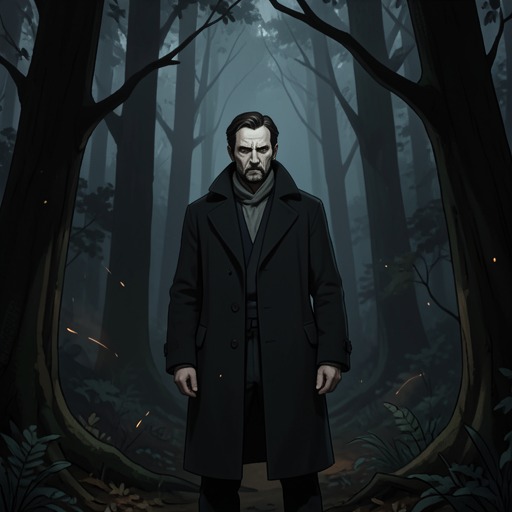
The unexplained laughter in Knocknaree Wood
In the WoodsThe unexplained laughter in Knocknaree Wood is an unresolved encounter with a voice heard after Sandra Scully is raped there. Recalled years later through both Sandra’s account and Jonathan Devlin’s uncertain memory, the sound turns a moment of assault and shock into a second mystery: a presence in the trees that none of the adults can identify, but that may have witnessed more than they knew.
The sound after the assault
In Sandra’s account, the event follows the rape by Cathal Mills. When it is over, Cathal calls her his girl and kisses her while she is shaking, trying to straighten her clothes, and struggling to compose herself. The sound comes from only a few yards away in the trees. Sandra describes it first by comparison to an enormous bird flapping its wings, then stresses that she is sure it was a voiced call. The distinction matters: what initially sounds like an animal noise is already difficult to classify.
Cathal throws a stone toward the shadows and blames children who have been playing in the wood. The sound continues. Sandra and the others cannot see its source; they jump, yell, and then sit screaming, too frightened to approach. It seems to move away into the wood and sounds, to Sandra, at least as large as a person. She also reports a strong animal smell, like goats or the smell of a zoo. Neither the sound nor the smell supplies a clear explanation; together they make the unseen presence feel physical without making it identifiable.
Two accounts, one uncertain memory
Sandra’s account reaches Rob Ryan through Cassie Maddox, who raises the possibility that a wild animal might have been in the wood. Rob is taken aback and asks whether the people in the clearing could have been making the noises themselves. His memory offers no confirmation: he recalls running hard, hearing his own rasping breath, and meeting the other children at the edge of the wood, all of them panting and aware that something was terribly wrong. He doubts they would have returned to the clearing to make flapping sounds or produce an animal smell, but cannot use his recollection to settle what happened.
When Rob asks Jonathan about the sound, Jonathan initially says that the wood was full of birds and foxes and that, in the state he was in, he would not have noticed one more or less. His recollection of the aftermath conveys how little confidence he can place in his perceptions. He describes himself shaking and unable to see straight, Sandra gasping as if she could not breathe, and Shane lying on the grass, staring up at the trees and twitching. Cathal, meanwhile, begins laughing and staggers around the clearing. Jonathan tells him to stop, and for a moment the two men grapple: Jonathan grabs Cathal, who catches him by the T-shirt.
Then Jonathan remembers that someone was still laughing. He insists that the sound did not come from one of them: it was away in the trees, growing louder into what he remembers as a huge voice. Sandra and Shane scream, and Jonathan admits he may have screamed too. The recollection is not a neat correction of Sandra’s report. It is a second, disturbed account, emerging only after Jonathan has first said he remembers nothing and then paused to retrieve something he had forgotten.
The unseen witness
Jonathan recalls Cathal shouting about children, but says that the voice did not sound like a child. Children from the estate, perhaps ten or twelve years old, sometimes played in the wood, spied on the adults, and threw things before running away. The sound Jonathan remembers, however, seemed more like a young man’s voice. No one went to investigate. The witnesses were in shock, the laughter became too much for them, and Jonathan remembers being frozen in place. When it stopped and seemed to move into the wood, they left as quickly as they could.
That possibility unsettles Rob for a reason beyond the sound itself. He recognizes that someone in the wood might have seen the rape and might also have seen the children. He nearly asks Jonathan whether the adults were afraid those children would tell someone, and what they might have done to prevent it, but holds back to preserve the interrogation and build a stronger case. Jonathan says he does not know who the laugher was. He recalls that Cathal later wanted to find out who had been there and how much that person had seen. The encounter thus opens a line of inquiry about a potential witness without identifying one.
Aftermath and narrative uncertainty
Jonathan says the group left the clearing; Cathal struck Shane across the back of the head when Shane continued screaming. Jonathan went home, took some of his father’s alcohol, and got drunk. He cannot say what the others did. These concrete actions establish the terror’s immediate aftermath, but do not establish whether the voice was human, animal, or a product of frightened perception.
The event remains suspended between explanations. Sandra’s animal comparison, the reported smell, and the sound’s movement through the trees support the possibility of an animal; Jonathan’s memory of a voice like a young man’s supports the possibility of another person. His and Sandra’s shock leaves room for imagination to have shaped what they heard, while Rob’s fragmented recollection cannot verify either account. The laughter’s importance lies partly in that unresolved status: it turns an assault witnessed by its participants into a scene with a possible unseen observer, whose presence might connect the adults’ violence to the children in the wood.