Adrienne Ward
Insatiable Box Set: Books 1-4Adrienne Ward is the central human figure in the story and the decisive agent of its transformation from a flight through the wilderness into a struggle over werewolf kinship, law, reproduction, and consent. She begins by abandoning Paul and an unwanted marriage obligation, but her escape carries her into the territory of Wilder and the Samsa family, where she is simultaneously endangered, desired, protected, constrained, and eventually incorporated into a werewolf household. Her importance lies not only in becoming the mother of the pack’s future pups, but in forcing a hidden society to negotiate with a human woman who refuses to accept its customs without question.
Identity and Flight
Adrienne leaves Paul on a Friday night, driving east on I-80 from outside Lake Tahoe while the full moon shines above her. The journey is an act of emotional and practical liberation: she is happy to be free from the marriage obligation and from Paul’s emotional and sexual neglect, and she refuses to answer his calls even while speaking angrily to the phone in her purse. Her confidence is tested almost immediately. Snow, forest, elevation, and a slippery road turn what should have been a two-hour drive from Sacramento, California, into three hours, and her inadequate tires make the route increasingly dangerous.
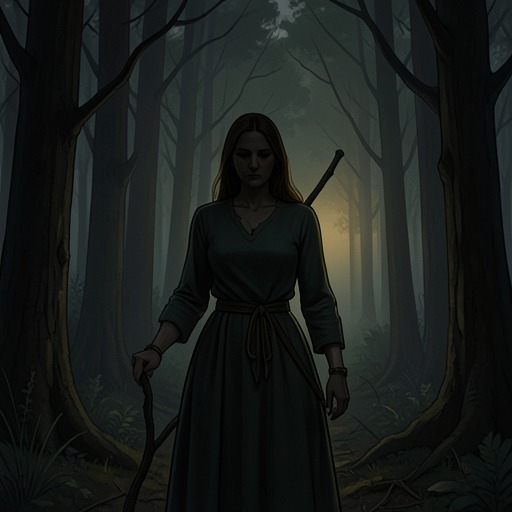
The car disappears into the snowy wilderness, leaving Adrienne to survive without the protection of ordinary society. Exhausted, hungry, and thirsty, she makes a bed from leaves and pine limbs beneath a tree, endures insects and the distant sound of a wolf, and wakes with bites on her arms and legs. Her survival knowledge is limited but sufficient to make her look for fresh water and assess the danger of predators. She sees a distant ranch enclosed by a huge white fence and backed by mountains and pine trees, yet hesitates to approach because the ranch may be vacant and its dogs may protect livestock from wolves. The rushing water she hears finally directs her away from the immediate choice between starvation and the unknown ranch.
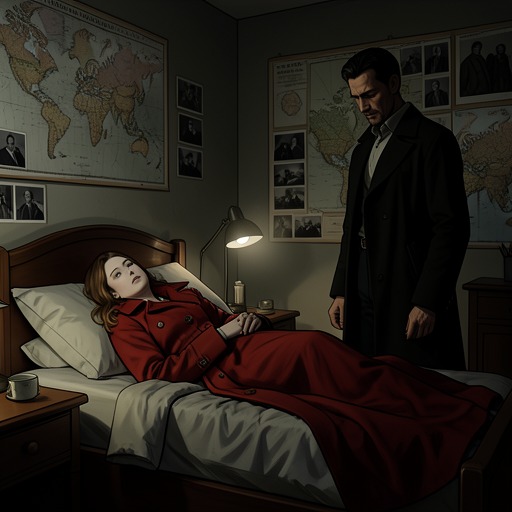
Adrienne’s disappearance becomes a public mystery rather than a rescue narrative. A newspaper reports that local resident Adrienne Ward is presumed dead after a month of searching, with her car recovered but her body missing. She reads the report while living in Wilder’s cave and responds with bitter disbelief at the failure of human authorities to track a living person into the woods. The presumed death separates her from her former identity: the human world has already classified her as lost, while the werewolf world is beginning to define her as a mate and potential mother.
Discovery of the Werewolf World
Adrienne’s encounter with Wilder reverses her understanding of the wilderness. Wilder explains that he must soon mate and that, because the snow has isolated the area, she is the only female nearby. When she challenges the apparent lack of choice in his language, he reveals that he is a werewolf. The revelation is not presented as a distant legend but as a bodily fact: Adrienne witnesses Wilder change between human and wolf forms inside the cave, while his animal instinct interferes with his effort to control the transformation.
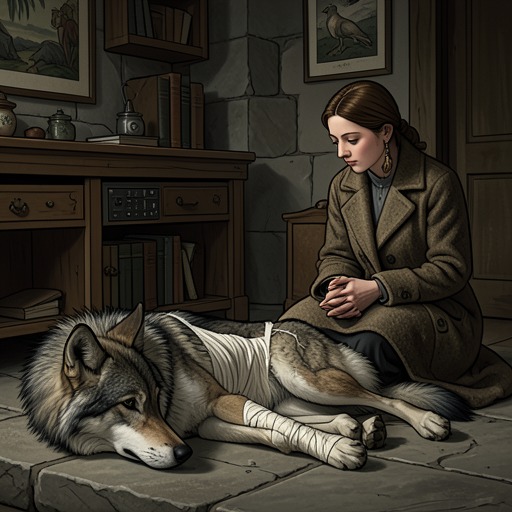
The cave becomes both refuge and threshold. Wilder carries the unconscious Adrienne through the snow in his jaws as he would carry a wolf pup after fighting a bear that tears into his already wounded arm. Later, he changes into a large white wolf and lies beside her to keep her warm, using his thick fur to protect her from frostbite. His attempts to comfort her are inseparable from the terror of his physical difference. Adrienne screams when she sees him change, and Wilder covers her mouth because the sound could call wolves to a cave known to few people. Protection, secrecy, and possession therefore arrive together; the place that preserves her life also becomes the setting in which her freedom is repeatedly disputed.
Wilder’s interest in Adrienne is connected to a crisis larger than personal attraction. He has never found a compatible female werewolf, and most werefemales are sterile. Because Wilder and his brothers are triplet Alphas who have sworn to remain together and govern their inherited territory equally, the female he chooses must be able to bear the brothers’ pups. The brothers’ pact provides that they will accept Wilder’s choice and mate with her; if Wilder dies, the next brother would take her and marry her. Adrienne is thus drawn into a reproductive and fraternal system that predates her, even though her arrival exposes that system to a human understanding of individual choice.
Resistance, Pregnancy, and Choice
Adrienne does not passively accept the identity imposed on her. When Wilder claims that imprinting makes her his until he no longer wants her, she answers that she will leave him as soon as the snow recedes. She rejects the possibility that pregnancy will bind her permanently and initially does not even understand what Wilder means when he speaks of her carrying his pup. His insistence that she cannot leave while pregnant, and that she could not take the child because an enemy clan might assassinate his heir, makes the conflict explicit: Wilder describes the arrangement as protection, while Adrienne experiences the same rules as confinement.
The pregnancy itself challenges both human and werewolf definitions of the body. Wilder identifies a visible bump and treats it as proof that she carries his pup, while Adrienne insists that human pregnancy does not show so quickly and attributes the change to the smoked meat she has been eating. Her disbelief is intensified by the memory of human medical authority. She recalls being taken to a hospital, hearing a doctor tell her parents and Paul that she could never have children, and being instructed by Paul never to speak of the matter again before he proposed marriage for June. The werewolf body overturns that diagnosis, but the reversal does not erase the violence of the earlier shame or the uncertainty of entering a reproductive order she did not choose.
Wilder’s reproductive program also reveals the political stakes of Adrienne’s presence. He had formed a council to address the clan’s breeding shortage and had refused to kidnap human women because he feared that abductions would cause humans to hunt down and destroy the werewolves. Instead, he tried to attract women through money and access to himself and his handsome brothers. Adrienne is the first woman whose fertility and relationship to Wilder appear to solve the crisis, but the solution remains ethically unstable because desire, pack custom, and physical power continually threaten to outrun consent.
The brothers do not respond to Adrienne in the same way. Drayton tells her that the brothers will not mate with her unless she wants them to, even while warning that her scent is driving Lycell’s instincts. Lycell is more openly menacing: he threatens to take and defile her, send her home with a pup humans would reject, and tell Wilder that she escaped. Adrienne answers him defiantly even though she knows she could not win a physical confrontation, and her nausea interrupts the encounter. The contrast establishes the range of power within the Samsa household while making Adrienne’s verbal refusal a recurring form of resistance.
Recasting the Samsa Family
Adrienne’s attitude toward the brothers changes through conflict rather than simple submission. The cave, once the place where she first found Wilder, later becomes a shared emotional landmark associated with her happiness with both Wilder and Lycell. She recognizes that Lycell’s refusal to yield to her and her own willingness to stand up to him have created an attraction based on stubbornness and mutual provocation. She eventually declares that she will claim all three brothers as her own and bear the pups they desire, converting a structure first presented to her as an obligation into a family arrangement she actively names and accepts.
Her demand for recognition is precise. When Wilder begs for forgiveness, she refuses to let him address her merely as a female and insists on her full human name, Adrienne Ward. She also demands marriage, not just the werewolf equivalent of mating. Her decisive request is to marry Wilder, Lycell, and Drayton together, and she explains that Lycell changed her mind. The demand forces the brothers to translate their shared-mate custom into a human marital form rather than treating human marriage as irrelevant.
This choice produces conflict inside and beyond the family. Wilder asserts that he is the Alpha male and that Adrienne is his mate, while Lycell argues that because she is carrying his pups, he should be the one to marry her. Drayton proposes that Adrienne should decide whom she prefers and that the chosen husband should determine the next steps for the pack. The dispute shows the tension between Alpha authority, biological paternity, fraternal equality, and Adrienne’s own decision. When Ramsey protests that a human woman has been allowed to dictate werewolf laws after Wilder returns his daughter, Wilder answers that Ramsey has no authority over him and defends Adrienne against accusations of dishonor.
Adrienne’s influence extends to other marriages. When she enters a council discussion concerning the proposed marriage of Drayton, Mena, Robert, and herself, the three brothers immediately sense her presence through her smell, which calms and captivates them. She tells Drayton that she does not blame him for leaving and acknowledges that Wilder did what he thought best for the pack. Mena’s experience provides a contrast to Adrienne’s: werewolf females are described as living to serve male pack authority and deriving their value from bearing pups, whereas Mena has come to value her marriage to Robert and the greater independence represented by Adrienne’s human refusal. Adrienne therefore becomes a model of female agency even while she is absorbed into a system built around reproduction.
Conflict, Captivity, and Competing Laws
Adrienne’s position remains precarious because several legal and moral orders claim authority over her. Human law has already failed to protect or locate her, declaring her presumed dead. Samsa authority treats her as Wilder’s mate and the bearer of an heir. Werewolf custom governs marriage, inheritance, pack loyalty, and punishment, while rival groups interpret her existence as a political threat. Bane’s abduction makes the conflict literal: he ties Adrienne’s hands, ankles, and waist to a crude chair in a cave and tells her that if a wild animal enters, she will be unable to flee. He refuses to gag her only because he wants her screams to summon him, turning the wilderness itself into an instrument of captivity.
Bane’s fixation does not replace Adrienne’s attachment to Wilder, but it complicates her emotional understanding of the situation. She conceals from Wilder that she has developed confusing feelings about Bane, recognizing that the confusion arises not simply from what Bane did, but from what he did not do. The story consequently refuses to make her inner life a simple map of obedience and rejection. Adrienne can embrace the werewolves’ laws and still fail to understand their hunting practices, their inherited rules, or the boundary between protection and domination.
Wilder interprets Bane’s kidnapping through werewolf law. Bane has taken an Alpha’s mate, and Wilder therefore believes that punishment is required. As head of a pack extending from the Americas to Russia, Wilder sees enforcement as his responsibility. The pursuit becomes a contest between two figures governed by single purposes: Bane wants to mate with Adrienne, while Wilder must hunt the pursuer. Adrienne’s body is the immediate stake, but the larger issue is which legal order will define her status and who may claim the right to protect, punish, or possess her.
Change, Family, and Ending
Adrienne’s final transformation is social as much as biological. She begins as a woman trying to escape Paul and the institution of an unwanted marriage, then becomes a presumed-dead human survivor, Wilder’s imprinted mate, a pregnancy-bearing outsider, and finally a recognized partner in the Samsa family. Her reunion with Wilder after carrying his newborn is marked by his overwhelming response: he takes the child from her, smiles increasingly broadly, embraces her with tears in his eyes, and announces that he has a son. The scene confirms that Adrienne has not merely supplied a successor; she has become the emotional center through which Wilder understands fatherhood.
Adrienne later states that she is content with the life she has chosen: satisfying the brothers’ sexual needs, bearing their children, and helping the pack grow. The conclusion presents her as the source of a human imprint of love and of the werewolves’ brood, while Wilder, Lycell, and Drayton possess wealth, power, and the family system they expected to preserve. Yet her contentment remains meaningful precisely because it follows repeated acts of refusal. She does not simply become what the pack requires; she makes the brothers acknowledge her name, her marriage terms, and her authority to decide.
Adrienne’s ending therefore contains both incorporation and revision. She accepts the werewolves’ laws without fully understanding them, but her presence changes how those laws operate. The brothers’ shared arrangement becomes a marriage shaped by her choice, Mena’s position becomes more valued through comparison with Adrienne’s independence, and the pack’s reproductive future depends on a human woman who entered their world as an escapee rather than a recruit. Her decisive role is to expose the instability beneath the Samsa order: a society that fears human persecution, depends on fertile human women, and claims to protect mates must eventually confront the will of the woman it needs most.