Adrienne Ward–Lycell relationship
Insatiable Box Set: Books 1-4The Adrienne Ward–Lycell relationship develops from Lycell’s presumptive claim over Adrienne into a bond shaped by danger, resistance, and the possibility of shared family life. Its central tension is present from the beginning: Lycell’s growing attachment makes him willing to fight for her, but his early expectations treat her choice as subordinate to his brothers’ plans and the family’s need for pups.
Claim, Resistance, and Unequal Terms
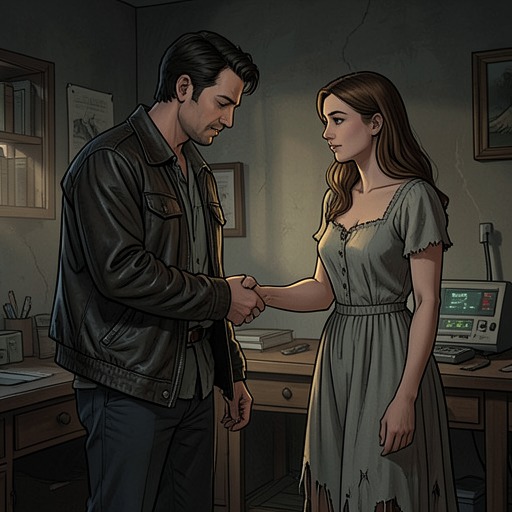
Lycell first approaches Adrienne not as a partner who might be freely chosen, but as a woman he expects eventually to possess. At Wilder’s ranch, he circles her, handles strands of her hair, and looks her over with the assessing attention of a hunter. He tells her that she is to become his mate after she gives birth to Wilder’s pup, adding that he will be less gentle than his brothers. Adrienne answers by asserting that she is Wilder’s mate and that Lycell must leave the room. The encounter makes the relationship’s initial imbalance explicit: Lycell treats future access to Adrienne as settled, while she invokes her present bond with Wilder to refuse him.
Lycell’s expectation is not presented as an isolated fantasy. The brothers’ plans place Adrienne inside a family arrangement in which Wilder’s first pup is followed by Lycell’s turn and then Drayton’s. Lycell thinks about her capacity to bear the brothers’ children and imagines that she will grow accustomed to his demands. His calculations reduce her to both a prospective mate and the means of continuing the family line. At the same time, the arrangement depends on Wilder’s decision to share her, rather than on Adrienne having already agreed to Lycell’s claim.
Adrienne’s fear is sharpened by her circumstances in the cave. Wilder has told her that she is, or will be, pregnant with his pup and insists that leaving with the child would be dangerous. Although he says she can come and go, his warning that she cannot take the pup makes that freedom conditional. Adrienne describes herself as a captive audience and fears a life in a cave as a sexual slave to the werewolves. She is also afraid of what will happen when the brothers learn that she believes herself unable to have children. Her attraction to Wilder coexists with alarm at the prospect of being claimed by three men; Lycell enters a relationship already burdened by that fear.
The ranch encounters expose how little Lycell initially understands Adrienne’s boundaries. He says he does not knock where a female is concerned and claims he could take her if he wanted. Adrienne backs toward the wall, searching for something to cover herself, and directly refuses the idea that he can simply take her. Lycell nevertheless repeats that she will be his mate after Wilder’s pup is born. When Wilder arrives and backs Adrienne’s refusal, Lycell bows his head: until he has a pack or pups of his own, he cannot intrude on Wilder’s mate, and the decision to share her belongs to Wilder. The moment checks Lycell’s advance, but it does not yet resolve the larger question of Adrienne’s own consent.
From Antagonism to a Protective Bond
The change in Lycell and Adrienne’s relationship does not begin with an easy reconciliation. After a frightening encounter with an intruder at the ranch, Adrienne blames Lycell for what has happened and tells him that the intruder warned her he would use her up and leave her unwanted. Lycell acknowledges fault without claiming he can undo events, asks whether she was harmed, and tries to close the distance between them; Adrienne steps away. Her accusation names the danger she sees in his appetite and possessiveness, while his response is an early attempt to meet her not as an assumed mate but as someone whose fear and judgment matter.
When Adrienne says she dislikes him and calls him difficult to like, Lycell softens. He admits that he thought she did not like him and says he did not mean to make her miserable. He touches her face; looking into his brown eyes calms her, and she begins to see someone she might love and care for rather than only the man who made her shudder. In his arms she feels secure and loved. His promise to do what he can to make her want him and his brothers offers a different posture from his earlier certainty that she would eventually be his. Adrienne still insists that Lycell himself is the problem, so this moment marks a change in feeling, not the disappearance of their conflict.
That emerging bond is tested when a hostile black werewolf holds Adrienne captive. Lycell arrives in wolf form, pounces on the captor, and lands in the fire beside her; despite the singed fur and pain, he gets up and attacks again. The enemy says his quarrel is with Wilder, but Lycell answers that an attack on his brother makes it his own fight too. His Alpha howl declares that he will meet the enemy as an equal, and he defeats the werewolf. The rescue is not simply an assertion of strength: Lycell’s fear that he might lose Adrienne overwhelms him, and that dread drives his fight. He understands their bond as something that ties him to her and to a future in which she might bear his pups, but his protective action is also rooted in the prospect of never seeing her again.
Afterward, Adrienne remembers the cave as both a refuge for herself and her pups and the place where she found Lycell. She had not expected to feel anything for him beyond indignation and outrage; what draws them together, in her account, is their stubbornness and her willingness to stand up to him. The reversal is significant but not simple: the same force that once made their encounters confrontational becomes part of their attraction. Adrienne comes to imagine claiming the three Samsa brothers as her own and having their pups, while Lycell’s attachment grows out of a relationship that began with entitlement and had to pass through her resistance before it could be remembered as love.
Negotiating a Shared Future
The prospect of a relationship with Lycell is shaped by a history Adrienne has not been able to speak about. A year earlier, two or perhaps three of Paul’s fraternity brothers entered her bedroom while Paul was passed out in another room. Her parents and Paul wanted the assault kept quiet; after she woke in the hospital, a doctor told her she could never have children, and Paul proposed that they marry that June. The book places this history behind Adrienne’s fear of being treated as a body for sexual access and reproduction. Lycell’s early assumption that she would eventually become his mate therefore meets not only her present refusal but a prior experience of sexual violence, silencing, and decisions made around her.
That pattern resurfaces when Wilder proposes that Adrienne’s children be given to Mena and Drayton because Mena is sterile. Adrienne objects that a mother should not surrender her children unless forced to, and asks whether Wilder planned the arrangement deliberately. He admits that he could not bear to share Adrienne and thought she did not want Lycell, so he acted to control the outcome. Adrienne withdraws her hand from his and tells him to stop deciding everyone’s lives for them; she insists that he speak with Lycell and Drayton and find out whether they want to be with her. Though the immediate dispute is with Wilder, its stakes include Lycell: Adrienne makes clear that a shared relationship cannot be treated simply as a family plan imposed by the brothers.
By the ending, Adrienne describes herself as having understood what mating with the brothers would involve: meeting their sexual needs and bearing children to grow their pack. She says she is content and happy with a life that includes children and three men who love her profoundly. The conclusion recasts Lycell’s place in the relationship as part of a chosen shared household, but it does not erase the coercive assumptions that preceded that settlement. The movement from Lycell’s claim that Adrienne would be his to her insistence that the brothers be asked what they want—and that her own wishes matter—gives the relationship its central change.
Care and Continuing Expectation
After Lycell defeats Adrienne’s captor, he takes the newborn pups from her and identifies them as male. His response combines tenderness with anticipation: his heart softens as he watches Adrienne wash, while he imagines having pups of his own with her. The rescue has made the possibility of losing Adrienne terrifying to him, yet even in this moment of relief his vision of their bond remains tied to future reproduction. Protection and desire are not separate strands in Lycell’s attachment; they meet in his hope that she will remain with him and bear his children.
The relationship’s emotional turn therefore does not amount to a complete break with its original terms. Lycell’s fear for Adrienne and his tenderness toward her are genuine developments, but his expectation of a shared future still reflects the Samsa brothers’ reproductive plans. Adrienne’s later recollection of the cave as a refuge where she found Lycell gives their connection a meaning beyond his initial claim, while the story leaves the tension visible: intimacy grows through mutual attraction and the experience of danger, even as family continuity continues to shape what Lycell expects from her.