Adrienne and Wilder’s estrangement
Insatiable Box Set: Books 1-4Adrienne and Wilder’s estrangement is a rupture between mates that turns his language of protection into a source of fear and distrust. After Wilder assumes that Bane has sexually assaulted Adrienne, his accusations make her feel judged and controlled rather than safe; she insists that she has the right to refuse, rejects his apology, and says she may leave once Drayton’s pups are born. Their bond remains powerful, but affection alone cannot undo the injury or restore her confidence in him.
Origins of the Rupture
The conflict reaches back to Adrienne’s assault by men connected to Paul. A year before the events she recalls, Paul’s fraternity brothers came to the apartment drunk while Paul was unconscious in another room. Two or perhaps three men entered Adrienne’s bedroom. She could not remember their faces or names, but their voices stayed with her. Afterward, Paul and her parents discouraged an investigation, fearing the consequences for the men’s wealthy and influential families. Paul eventually took her to the hospital and arranged to marry her; the doctor told Adrienne and her family that she would never be able to have children. Paul then insisted that the assault should not be discussed again.
That history is not a distant disclosure detached from her relationship with Wilder. On the way to see her parents, Adrienne is tense because she has been away for almost a year and remains hurt that they helped suppress the investigation. She believes that other people made decisions about her future without considering her feelings, including the plan for her to marry Paul. The perceived betrayal shapes what she needs from intimacy: to be heard and to retain a say in what happens to her.
At a hotel, Adrienne recognizes one of her attackers by his voice when a group of men leave the elevator on the fifth floor. She tells Drayton that the voice belongs to a man who raped her. Later, she explains to Wilder and Lycell that she identified the man and told Drayton who he was. Wilder asks why she did not tell him; Adrienne answers that he had left her and was distant when he returned. The disclosure thus becomes entangled with an earlier gap in trust: when she recognized a danger tied to her past, Wilder was not the person she felt able to confide in.
Matehood, Protection, and Control
Wilder’s claims over Adrienne predate the later accusation. In the cave, he tells her that she can come and go, but argues that she cannot take a child who would be in danger from the Ari Kara clan, which might target his heir. His asserted concern for the unborn child therefore arrives alongside a restriction on Adrienne’s choices. At the ranch, Lycell says that after Adrienne gives birth to Wilder’s pup, she will be his as well; Adrienne responds by declaring herself Wilder’s mate and ordering Lycell to leave. Wilder’s authority over whether she is shared with his brothers is treated as a family decision, while Adrienne’s own position is still being negotiated around her.
That tension also surfaces in the brothers’ discussion of marriage. Drayton argues that Adrienne should decide whom she wants to marry, but Wilder declares that he is the Alpha, that she is his mate, and that he will marry her. Ramsey later accuses Wilder of breaking a promise about Mena and objects to a human woman influencing werewolf law. Wilder answers by defending his authority and insisting that he did not defile Ramsey’s daughter. These exchanges show how the pack’s rules and rank structure surround Adrienne’s relationship: Wilder presents himself as responsible for her and for the pack, but those claims do not settle what Adrienne wants.
Bane and the Breaking Point
The immediate crisis follows Adrienne’s abduction by Bane. When Wilder finds her, he assumes that Bane has ravished her and treats her pregnancy as evidence that she has yielded to him. Adrienne says she is pregnant with Drayton’s child, not Bane’s, and condemns Wilder’s reaction: she says she should have let Bane kill her before he touched her. Her words make the stakes unmistakable. In her eyes, Wilder’s jealousy has turned protection into a demand that she preserve herself for him, even at the cost of her life.
Wilder asks her to forget and forgive what he said, explaining that he was upset and out of his mind with worry. Adrienne refuses both requests. She says that after she has Drayton’s pups, she thinks she wants to leave. Wilder invokes their children and marriage, but Adrienne replies that the children are no longer children: she can close her eyes and wake to find them grown, and she does not know whether she wants this life. Her disorientation over the werewolves’ rapid growth compounds the strain of living within a family whose rhythms and laws she does not fully understand.
Adrienne then makes her terms explicit. She applauds the self-control Wilder and the others have shown, but will not let them dictate what she can or cannot do; she will decide for herself. She intends to stay long enough to see Lycell and Drayton safely through their difficulties, after which the choice is hers. She calls her life a nightmare and says Wilder has become too possessive. Although Wilder protests that she cannot leave them, Adrienne feels captive, and thinks that even being with Bane was less restrictive than living with the Samsa brothers. The comparison is not an endorsement of Bane; it measures how thoroughly the family’s claims have come to feel like confinement.
Apology Without Reconciliation
During their flight, Wilder tells Adrienne that he still cares for her and would want her even if there were nothing left of her, so long as she could be with him in his arms. The tenderness briefly recalls the werewolf she first knew in his cave, but Adrienne cannot remove his earlier words from her mind. When he reaches for her hand, she pulls away and says she will never care for him again. Her withdrawal is deliberate and physical as well as verbal: Wilder reaches; Adrienne refuses contact.
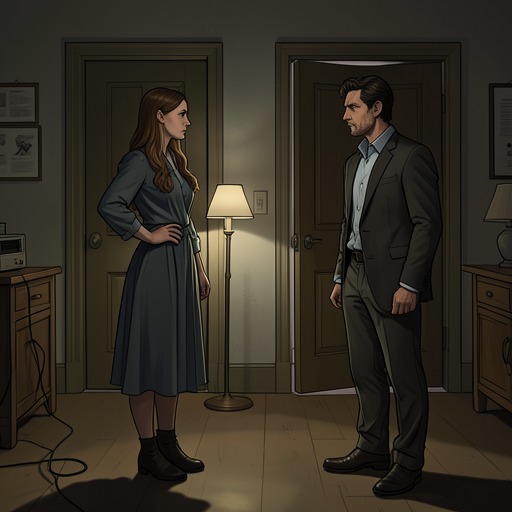
The estrangement sharpens again when Wilder questions whether she stood naked before Bane or let him touch her. Adrienne challenges him to consider what he would do if she said yes, asking whether he would kill her. Wilder catches her arm as she turns toward the shower and apologizes, admitting that he needs reassurance that she is still his. Adrienne rejects the distinction he is trying to make between himself and Bane: she says he is behaving like Bane, or worse, and that she had not known this side of him. Wilder is left confronting his own insensitivity and the possibility that his conduct has exposed the very animalistic possessiveness he believes he must control.
Their conflict is therefore not resolved by Wilder’s remorse. Adrienne’s earlier warning that he must respect her right to say no, or be no better than the men who raped her, gives the rupture its clearest ethical line. Wilder later reflects that werewolf law has been ingrained in him since childhood and that, as head of a pack extending from the Americas to Russia, he must enforce it. He sees Bane’s kidnapping of an Alpha’s mate as an offense demanding punishment. But the law that obliges him to protect Adrienne also informs his sense of possession, while Adrienne does not fully understand or accept the laws governing werewolves. She can recognize the claim of protection without surrendering her own choice.
An Unresolved Separation
The evidence leaves Adrienne and Wilder estranged rather than reconciled. Wilder says he would rather die than make her unhappy and wants to become the man she wants, yet his apologies coexist with suspicion, possessive language, and a continuing insistence that she belongs to him. Adrienne, meanwhile, remains emotionally affected by his tenderness but does not retract her refusal to forgive him or her intention to decide her future. She is also confused by her response to Bane, whose failure to touch her has unsettled her expectations and complicated her feelings; that confusion does not erase the harm Wilder’s accusation has done.
The relationship’s crisis is consequently more than a lovers’ quarrel. Adrienne’s past taught her what happens when others silence her and arrange her life in her supposed best interest. Now Wilder’s worry, mate-bond, family obligations, and werewolf law all press against her demand to choose. The decisive question is not whether Wilder feels love, but whether he can make that love compatible with her freedom to refuse, remain, or leave. At this point, Adrienne does not believe that he has.