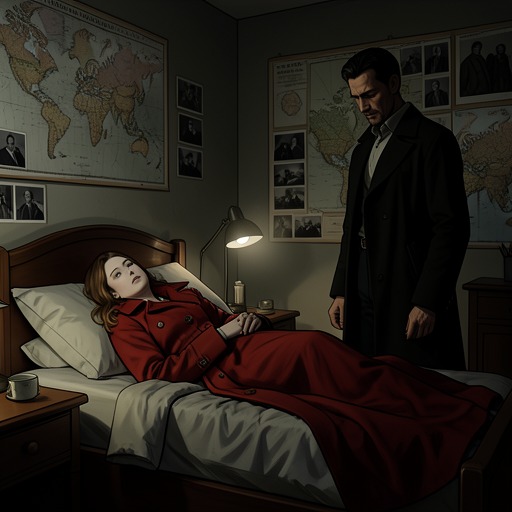
Adrienne leaves Paul and their engagement
Insatiable Box Set: Books 1-4Adrienne leaves Paul and their engagement in the dead of night, turning an inward recognition of a mistaken commitment into a physical break with the life her mother, her studies, and social expectation have arranged for her. The departure begins as an assertion of freedom, but the snowy road quickly makes that freedom precarious: her old Honda fails, the forest closes around her, and the escape becomes a wilderness ordeal rather than a simple journey home.
Causes and Background
Adrienne’s doubts concern more than the approaching wedding or the prospect of a honeymoon in Hawaii. She recognizes that shared interests in hiking, camping, bicycling, and reading have not created the intimacy she expects from marriage. Her sexual relationship with Paul is especially inadequate: he has treated abstinence until marriage as advisable, while Adrienne has discovered that he is sexually available only about once a month, if that. The mismatch makes the engagement appear less like a chosen partnership than an arrangement sustained by habit and parental expectation.
Paul entered Adrienne’s life in high school, after she used a provocative senior-class prank as a pretext to secure a prom date. They continued dating through college, and her mother reinforced the conventional expectation that two people with similar interests were supposed to marry. Adrienne increasingly rejects that logic. For her, compatibility cannot be reduced to matching books, hobbies, or a timetable imposed by family; desire and mutual responsiveness also matter. The engagement therefore becomes a symbol of a life that looks acceptable from outside while leaving her dissatisfied within it.
The decision also carries a concealed burden. Later, Adrienne recalls that Paul’s fraternity brothers raped her and that Paul, together with her parents, treated the assault as a secret to be contained. Her departure consequently breaks not only from a sexually cold fiancé but from a network that demanded silence after violence. What first appears to be an impulsive refusal of marriage is also an escape from the denial surrounding the earlier assault.
The Flight Through Snow
Adrienne waits until Paul is asleep, wearing pajamas patterned with colored sailboats, then quietly places her few clothes in an overnight bag. She slips out of the apartment without wedding invitations having been sent, believing that little public damage has yet been done and that Paul may not even notice her absence until Sunday. The smallness of the bag and the secrecy of her movements make the separation intimate and furtive: she does not stage a confrontation; she removes herself from the shared space before he can stop her.
Her old Honda groans when she turns the key. She nevertheless drives east toward home, leaving the apartment and the engagement behind. The full moon gives the escape a momentary emblem of renewal, and Adrienne drives with the music loud, humming and swaying because she feels released from the obligation of marrying Paul. Yet the same night that promises a new life exposes her to danger. She is alone on I-80, traveling through heavy snow near Lake Tahoe, and the route south toward the lake becomes difficult to identify among forests and darkness.
A journey expected to take two hours from Sacramento, California, stretches to three. The road rises to roughly six thousand feet, the surface is slippery, and Adrienne has neither good tires nor snow tires. Snow fills and slows the windshield wipers while the forest blocks her view of signs and turnoffs. The material conditions of the escape steadily strip away its romantic appearance: the car, the weather, the elevation, and the unlit highway all become active obstacles.
Crash and Wilderness Ordeal
The car leaves the road, and Adrienne struggles to get out. When the driver’s-side window will not lower far enough, she removes a shoe and strikes it, dislodging it from its gears without fully opening it. She finally climbs over the steering wheel and out through the raised front window onto the hood, then lowers herself to the ground. The damaged vehicle is no longer a transparent means of escape but an obstruction whose broken mechanisms force her to improvise physically.
Once outside, she sees a pool of blood and panics. She cannot find a route back to the highway through the dense forest, and she realizes that she has left her phone behind. When she turns back, the car tumbles and sinks deep into the earth, destroying the immediate possibility of using it or retrieving it. Adrienne responds by trying to impose a plan on the crisis: she follows Indian trails, tells herself that the large moon provides enough light, and hopes that a nearby house or the interstate will offer a way out.
The weather and her clothing make the consequences severe. She is wearing a skirt over exercise pants, a jean jacket over a cotton shirt, and whatever protection layering provides is not enough for the falling temperature. She shivers, loses track of how long she has walked, and fears that she will die in the wilderness. After roughly three hours of exhaustion and hunger, she gathers leaves and pine limbs into a bed beneath a tree, covers herself with leaves, and lies down while insects, large ants, and the distant growling and calling of a wolf keep the night threatening. The choice to leave Paul has therefore shifted from emotional risk to immediate questions of survival.
Later Reverberations and Pursuit
The escape remains a defining point in Adrienne’s later self-understanding. She eventually regards leaving Paul in the broken-down car as a reckless act, consistent with her stubborn refusal to let men dictate what she should or should not do. At the same time, she recognizes it as the best thing that happened to her because it led to meeting Wilder and agreeing to live and marry into the Samsa family. The event thus contains a double reversal: the decision is dangerous because it is made in the middle of the night under hazardous conditions, but it also opens the path to the family and relationships that become central to her life.
The earlier assault continues to surface after Adrienne has left Paul. At the Hilton in Lake Tahoe, she hears one of the men involved and identifies him to Drayton as a rapist. This later recognition clarifies what Paul and her parents had concealed and gives the departure a broader meaning: Adrienne did not merely abandon an unsatisfying engagement; she moved away from a silence that had protected the people around her rather than her.
The pattern of flight and danger recurs in the later pursuit associated with Bane. While returning toward the Samsa compound with Mena, Adrienne sees a large white Ford pickup barreling behind them and worries that they are being followed; she distinguishes it from Lycell’s newer silver truck and tells Mena not to turn around so their awareness will not be revealed. In another captivity sequence, Adrienne takes food, a coat, and the truck keys after Bane leaves, then attempts to escape through the hotel lobby while fearing that he will detect and punish her. These later escapes echo the first departure from Paul: each begins with a woman making a quiet, bodily decision to leave before an opposing man can prevent her, but each also places her in an exposed environment where freedom depends on secrecy, timing, and endurance.
Narrative Significance
Adrienne’s departure is the story’s first decisive value shift. Marriage, initially presented as an expected future, becomes a form of confinement; freedom briefly becomes exhilarating, then turns into exposure to cold, isolation, mechanical failure, and possible death. The event joins romantic refusal to survival narrative and makes the road itself a threshold between the socially approved life Adrienne is abandoning and the dangerous, unforeseen life she will enter.
Its importance also lies in the contrast between intention and result. Adrienne leaves because Paul’s abstinence, emotional coldness, and the imposed logic of their engagement have become intolerable, but she cannot control the consequences of choosing escape. The moon suggests a new beginning while the snow erases signs, the Honda fails, and the forest removes ordinary safeguards. By surviving the ordeal and continuing into a life centered on Wilder and the Samsa family, Adrienne’s apparently impulsive decision becomes the origin point of her later agency, attachments, and conflicts.