Adrienne rescues Wilder
Insatiable Box Set: Books 1-4Adrienne rescues Wilder when she finds him collapsed beside her in the cave, presenting the action as both an immediate struggle for survival and the first decisive reversal in their relationship. She has entered the cave because hunger, exhaustion, snow, and the threat of wild animals have left her with few alternatives. The white wolf initially appears to be another danger, yet his injuries make him dependent on the human stranger who has every reason to fear him. By choosing to care for him rather than abandon him, Adrienne converts a scene of mutual vulnerability into an act of deliberate rescue.
Discovery in the Cave
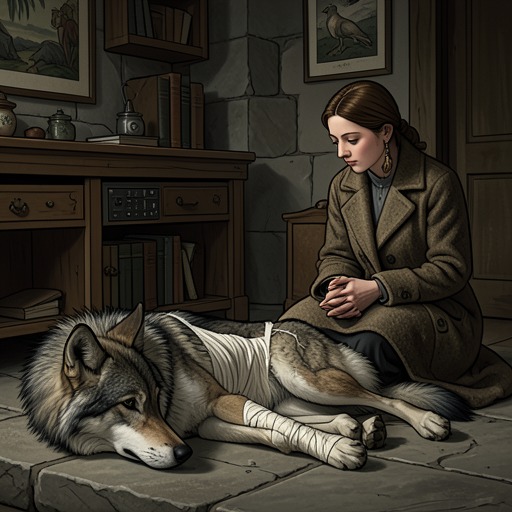
Adrienne wakes stiff and uneasy on the cave floor after the embers have gone dark. Hoarse breathing close to her face makes her afraid to move or even breathe. When she reaches out, however, her hand finds warm fur and a heartbeat rather than the dead bear rug on which she had fallen asleep. She rises with her stick and sees a large white wolf stretched near her feet, using the cold cave for warmth. The animal does not move when she pokes him, and the blood seeping from his shoulder, hind leg, and front paws explains his immobility. He is a male lone wolf, extraordinarily large, with a body extending more than six feet and blue eyes that Adrienne compares to a fresh-water lake.
The details of the animal complicate Adrienne’s fear. His size, sharp teeth, and wolf nature make him potentially lethal, but his wounds have placed him beyond immediate predation. Adrienne recognizes that he would likely have eaten her if he had been able to do so, yet she responds to his helplessness with pity rather than calculation. She strokes his fur, which has become sickly pink where blood has soaked it, and he answers her touch with a soft moan. When he briefly opens his eyes, the sadness in them makes the injured creature seem almost human to her. That perception does not erase the danger, but it changes what the wolf means within the scene: he is no longer simply a possible predator, but a suffering being whose survival has become entangled with hers.
Water, Medicine, and Sustenance
Adrienne’s response becomes practical as soon as compassion has displaced panic. She rushes to the waterfall, cups water in her hands, and carries it back to the wolf, repeating the journey until his tongue responds and his chest begins to rise and fall more steadily. With daylight entering the cave, she discovers that the shelter is not an empty den but an organized dwelling containing cups, plates, spoons, matches, medicines, and a first-aid kit. The presence of antibiotics, pain pills, and iodine gives her the means to intervene, while the preserved meat in the smokehouse gives both of them a chance to survive. She eats smoked meat herself after remembering that she has gone two days without food, then immediately turns back to the wolf because his condition remains precarious. Her care is therefore not sentimental alone: she is hungry, frightened, and aware that an injured predator could still become dangerous, but she continues because leaving him untreated would mean abandoning a living creature whose fate has become part of her own.
The wolf resists her first attempts to feed him. He rejects a breast of duck by pushing it away with his nose, and Adrienne manages to get water and pills down his throat even though he refuses solid food. She then offers venison, reasoning that wolves prefer deer, and succeeds in getting him to eat a piece. Her language toward him shifts between irritation and nursing care; she calls him temperamental and complains that she is not his babysitter, yet drops meat into his mouth and keeps trying when he cannot manage the tough pieces. The contrast makes the rescue distinctive. Adrienne does not become fearless, nor does the wolf become harmless; instead, their relationship is built through repeated, laborious acts in which her exasperation coexists with persistence.
Medical treatment follows the same improvised pattern. Adrienne lights a fire, pours iodine over the wolf’s wounds, and wraps the infected leg with bandages from the first-aid kit. He flinches and moans under the treatment, then opens his eyes as though he understands her before closing them again in apparent trust. When forcing pieces of venison into his mouth still proves ineffective, she devises a more suitable form of nourishment: she lights the iron stove, fills a kettle, cuts the meat into tiny pieces, cooks it, and ladles the resulting soup into his mouth with a large spoon. The rescue thus proceeds through observation and adaptation rather than specialized knowledge. She reads his refusal as evidence that he cannot handle solid meat, changes the method, and converts the cave’s domestic equipment into a makeshift infirmary.
The cave’s furnishings deepen the significance of the encounter. Adrienne discovers bedrooms, handmade chairs and tables, a meeting room with a large table and eight chairs, books, a cedar chest filled with men’s clothing, and even a wedding dress hidden beneath jeans and a red lumberjack shirt. These objects reveal that the wolf’s refuge belongs to a humanlike social world rather than to an ordinary animal habitat, although Adrienne does not yet understand the identity of its occupants. Heavy snow outside persuades her to remain another night, and the shelter’s warmth and supplies make continued care possible even as she knows she cannot stay there forever. After hours of coaxing and feeding the wolf, she reads beside him until exhaustion overtakes her, falling asleep near the creature she has kept alive.
The Rescue’s Reversal and Aftermath
Adrienne’s treatment of the injured wolf becomes the first reversal in a relationship that will later be defined by recognition, dependence, and danger. At this stage, she understands him only as an enormous, wounded white animal, while the narrative has already attached human qualities to him through his apparent understanding, his response to safety, and the domestic cave surrounding him. Her decision to preserve his life establishes a reciprocal pattern: she supplies water, warmth, medicine, and food when he cannot seek them himself, and he survives long enough for the encounter to continue beyond the immediate crisis. The rescue therefore does more than prevent an animal’s death. It places Adrienne inside a hidden household and makes her an active participant in the fate of the being who will later be known as Wilder, even though the full meaning of that identity remains concealed from her during the cave’s first night.
Significance of the Rescue
The rescue establishes a pattern that governs Adrienne’s later relationship with Wilder: care begins before knowledge, and dependence precedes recognition. Adrienne does not yet know that the white wolf is Wilder, a werewolf, or the Alpha whose hidden household surrounds her with signs of an organized social world. She knows only that an immense predator has been reduced by blood loss and injury to a creature unable to protect itself. Her response is consequently an ethical choice made under pressure. Hunger, exposure, and fear could have justified abandoning him, while his teeth and size make the danger unmistakable; nevertheless, she gives him water, warmth, medicine, and food, adjusting each intervention when the previous one fails. The scene’s importance lies in this reversal of expected roles. The human fugitive becomes the caregiver, while the future Alpha becomes the helpless patient. Later evidence makes that reversal more consequential: Wilder claims Adrienne as his mate, insists that she is not his prey or captive, and defines his obligation to protect her and their child through werewolf law. The bond therefore begins not with his authority over her, but with her sustained effort to keep him alive. When Wilder later reaches Adrienne in time to confront the bear threatening her, he repays that earlier care by risking his life, fighting the bear despite his own wounds, and carrying her back toward the cave as he would carry a wolf pup. Adrienne’s rescue is thus the first exchange in a recurring economy of protection, in which human and wolf identities remain divided but each becomes responsible for the other’s survival.