Adrienne’s wilderness ordeal
Insatiable Box Set: Books 1-4Adrienne’s wilderness ordeal is the decisive survival passage that follows her flight from Paul and turns a reckless escape into the threshold of a new life. Driving alone at night toward Lake Tahoe, she is caught in heavy mountain snow, loses her car, and spends the night exposed to cold, hunger, insects, and the sounds of predators. Her movement through the wilderness is not merely an interruption before the romance with Wilder; it establishes the pattern by which danger, isolation, and her refusal to surrender repeatedly force her into unfamiliar forms of dependence and discovery.
Causes and Setting
Adrienne leaves Paul after enduring his emotional coldness and the consequences of his attempt, together with her parents, to keep the sexual assault committed by his frat brothers secret. The decision is both an escape from an oppressive relationship and an act of personal defiance. She drives east on the I-80 toward Lake Tahoe, believing that freedom lies in putting distance between herself and the marriage obligation she no longer accepts.
The journey becomes dangerous because the route is being traveled at night, at roughly six thousand feet in the mountains, while snow is still falling heavily. Adrienne’s tires are inadequate and she has no snow tires; a drive expected to take two hours from Sacramento, California stretches to three. The forest on both sides of the road, the slippery surface, poor visibility, and snow-clogged windshield wipers turn the car into an increasingly fragile shelter. The landscape is not passive scenery: weather, elevation, darkness, and isolation remove the ordinary protections of transport and communication.
The Vehicle’s Destruction and the First Night
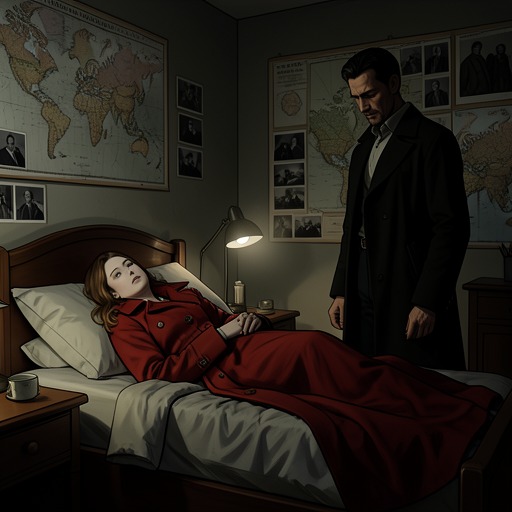
Adrienne misses a roadside sign while traveling too fast on the unlit highway. After the car is damaged, she tries to escape through the driver’s side, but the window will not lower far enough. She removes a shoe and strikes the glass, dislodging it from its gears without creating a usable opening. With no safer route available, she climbs over the steering wheel and out through the raised front area, lowering herself onto the hood before sliding to the ground.
The apparent accident becomes a more radical severing from civilization when she turns back and sees a pool of blood, then watches the car tumble and sink deep into the earth. She has also left her phone inside, so the vehicle’s disappearance removes both transportation and the possibility of calling for help. Her immediate response is panic, followed by a forced act of self-command: she decides to walk toward what she hopes is a nearby house and persuades herself that the moon will provide enough light to continue.
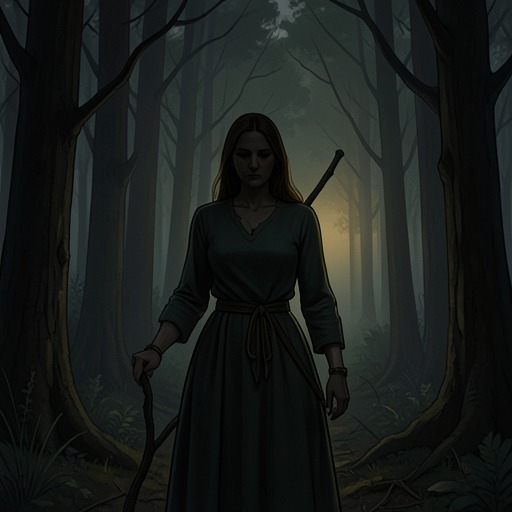
Adrienne spends approximately three hours moving through dense forest and Indian trails. She is not dressed for the season, wearing a skirt over exercise pants, a jean jacket, and a cotton shirt, although layering gives her some protection. As the temperature drops, she shivers and fears that she will die in the wilderness. When the snow finally stops, the cold remains severe. Her fatigue is compounded by uncertainty about where she is and how long she has been walking, making the ordeal a bodily experience before it becomes a rational problem of navigation.
Unable to find shelter, she gathers leaves and pine branches to make a bed beneath a tree and covers herself with the leaves. The choice leaves her vulnerable to large ants, which occupy much of the night, while distant wolf calls and growls keep her alert. She wakes alive but with insect bites on her arms and legs, hungry and thirsty. The episode turns survival into a sequence of small calculations rather than a single dramatic victory: she must remain alive long enough to locate water, shelter, and food.
Water, Predators, and the Unknown Ranch
In daylight Adrienne sees a large ranch in the distance, enclosed by a huge white fence that stretches for miles and set against a mountain range. The house is partly concealed by tall pine trees. Reaching it could take days without food, and she worries that the property may be vacant or guarded by dogs protecting livestock from wolves. She also understands that water is essential, but that water sources attract predators. The ranch therefore represents possible rescue and possible danger at the same time.
A mountain blocks one route, while crossing acres of ranch land seems equally uncertain. Adrienne changes direction only after hearing rushing water. The sound gives her a concrete objective, and she adopts a narrow survival principle: take one day at a time. The phrase marks a shift from imagining the whole wilderness as an unsurvivable expanse to managing the next immediate necessity. Her relief at still being alive does not erase hunger, but it gives her enough resolve to continue.
The route also brings her close to the animals that govern the wilderness. A large white wolf darts across the trail, its paws bleeding, and a loud cry makes her hands shake. Adrienne runs despite recognizing that she cannot outrun a wolf; she then wonders whether the animal belongs to a pack and whether its injury gives her any advantage. Exhaustion forces her back to walking. The encounter makes the boundary between helpless traveler and hunted prey painfully clear.
When the lake finally appears, Adrienne does not rush directly to it. She knows that water holes may conceal snakes, wolves, and mountain lions, so she hides behind a large boulder for half the day while the sun lowers behind the mountains. Only then does she dash to the shore, where a small stream meets the lake, and drink sparkling fresh water from her cupped hand. The act is both practical and restorative: after the loss of the car, the missing phone, the cold, and the hunger, water gives her a renewed physical foothold.
The Waterfall Cave and the White Wolf
While drinking, Adrienne sees a waterfall in the distance and, on top of the cliff, the magnificent white wolf. It raises its head and howls, making the hair on her body rise. The animal is therefore associated with both threat and orientation: it is the creature she fears near the water, but its presence also directs her attention toward the waterfall and the shelter hidden behind it.
Adrienne recalls that caves in the region were once associated with Indigenous inhabitants and with legends of werewolves whose families have lived among humans as respectable citizens. She dismisses the thought rather than accepting it as an explanation of what she has seen. Her skepticism preserves her ordinary understanding even as the environment begins to contradict it. The wilderness presents folklore not as a distant story but as a possibility occupying the same physical space as the lake, the forest, and the cave.
She reaches the waterfall carrying a stick, prepared to resist whatever may be inside. The falling water conceals a cave. She considers the danger of entering a bear’s den, especially one containing a mother and cubs, but judges the cave safer than sleeping in the open. Once inside, she moves cautiously through another chamber and discovers embers from a recently used fire. The embers prove that a man has occupied the cave and transform it from an animal refuge into evidence of human presence.
Exhaustion finally defeats caution. Adrienne collapses onto a large black bear rug before the failing fire. The detail completes the ordeal’s progression from open-road freedom to exposure, from exposure to improvised shelter, and from shelter to an inhabited space whose owner remains unknown. Her escape from Paul has not brought immediate independence in any simple sense; it has carried her to the threshold of Wilder’s world, where survival will soon depend on recognizing what kind of presence she has found.
Later Repetitions of the Ordeal
The wilderness ordeal becomes a pattern that later experiences repeat in altered forms. After Adrienne and Mena return toward the Samsa compound, Adrienne sees a large old white Ford pickup barreling behind them and realizes that they may be followed. The earlier landscape taught her to read vehicles, distance, and pursuit as immediate threats, so she warns Mena not to turn around and reveal their awareness.
Bane later confines Adrienne in a suite, removes the telephone cords, and declares that he intends to take her into the Alaskan wilderness, where he believes isolation will leave her no choice but to accept him or be exposed to other wild werewolves. His threat deliberately echoes the conditions of her first ordeal: separation from help, hostile terrain, and the use of wilderness as a mechanism of control. This time, however, Adrienne acts before the landscape can fully close around her. She dresses quickly, takes food and a coat, finds the truck keys, and leaves while trembling with fear that Bane will detect and punish her.
The contrast is significant. In the first ordeal, a damaged car and a vanishing phone leave Adrienne stranded without preparation. In the later escape, captivity has recreated the same isolation deliberately, but Adrienne uses the practical knowledge acquired through earlier suffering—movement, timing, concealment, and the search for transport—to create an opening. The wilderness remains dangerous, yet it no longer belongs entirely to the forces pursuing her.
Narrative Significance
Adrienne’s wilderness ordeal functions as an inverted threshold crossing. She chooses to leave a human relationship, but the road removes the last structures that make choice feel secure: the car disappears, the phone is lost, the weather erases visibility, and the forest replaces the highway. Her survival depends on a succession of embodied decisions—climbing out of the vehicle, walking despite cold, making a bed, hiding from predators, waiting for darkness to lessen, drinking only after assessing the lake, and entering the waterfall cave with a stick in hand.
The episode also joins trauma to discovery. Adrienne’s earlier sexual assault has been suppressed by Paul and her parents, but her flight turns that concealed injury into the immediate danger of the road. Much later, when she hears one of the men who raped her speaking in a hotel, the past returns through his voice, confirming that the wilderness did not erase the violence she fled. Instead, it separated her from the people who demanded silence and placed her in circumstances where her own perceptions and decisions became indispensable.
Most importantly, the ordeal prepares the novel’s central movement from ordinary human society into hidden werewolf society. Adrienne initially treats werewolf legends as something to dismiss, yet the white wolf, the cave, the embers, and the unseen man behind the shelter all gather around that rejected possibility. Her survival trek is therefore both ordeal and revelation: she escapes one form of human control only to encounter a world governed by different laws, bodies, loyalties, and dangers, while preserving the stubborn agency that allowed her to survive the forest in the first place.