Anchorage
Insatiable Box Set: Books 1-4Anchorage is the northern destination that gives Bane’s flight with Adrienne its most ominous direction. It is not presented as a settled refuge or a fully described city, but as a name on a map, a measured distance, and the threshold of the Alaskan wilderness. For Adrienne, the journey toward it means increasing isolation from Wilder and the Samsa family; for Bane, it is part of a plan to remove her beyond ordinary rescue and force her into dependence.
A Destination Created by Pursuit
Anchorage enters the action when Bane makes Adrienne look for a map in the truck’s compartment and asks how far the journey is. Her inability to read the map leaves the destination in Bane’s control, while the question establishes the practical reality of the escape: the old truck is moving north, and the distance still has to be crossed before Adrienne can reach safety. The location therefore functions first as a direction imposed on a captive rather than as a place she has chosen.
Bane later states that Anchorage is approximately one hundred miles away and proposes stopping at a hotel there. His indulgent tone contrasts with Adrienne’s demand to be taken home, exposing the unequal meanings of the destination. To Bane, Anchorage is a convenient staging point in his flight; to Adrienne, it is another delay between herself, Wilder, and the return to the Samsa compound. Her counteroffer—that she would tell Wilder Bane had not intended to harm her and would ask Wilder to reinstate him as Alpha—shows that even while being transported toward Anchorage, she continues trying to convert the destination into a route back to her family and Bane’s former political position.
The Northern Route
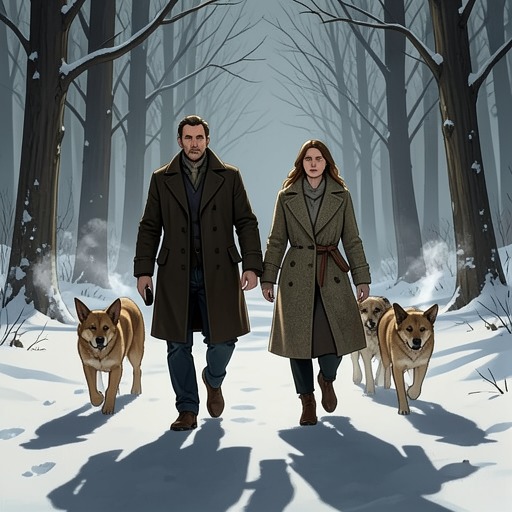
The movement toward Anchorage is part of Bane’s northward strategy. Wilder follows Adrienne’s scent for hours through snow, shifting into his white-furred wolf form for speed, warmth, and camouflage. From the direction of Bane’s travel, Wilder realizes that Alaska is the destination and recalls rumors that Bane has been building a compound there. The discovery changes the pursuit from a search for a nearby hiding place into a race against a planned northern retreat.
The route is made dangerous by distance, weather, and the landscape itself. Wilder understands that only werewolves born and remaining in Alaska could easily traverse its harsh winters, and he had previously dismissed the possibility that Bane would seek such an existence. That mistaken assumption gives the journey its decisive reversal: the rumored Alaskan compound is real enough to shape Bane’s escape, and Anchorage becomes the recognizable point beyond which Adrienne may disappear into a more inaccessible territory.
From Roadside Control to Wilderness Threat
Anchorage also marks the point at which Bane’s stated intentions become more explicit. He tells Adrienne that, if Wilder does not arrive, he will take her into the Alaskan wilderness, where she will have no choice but to accept him or the other wild werewolves. The destination is thus connected not merely with travel but with the threatened removal of all meaningful alternatives. Anchorage and the wilderness beyond it form a continuum of coercion: a hotel may provide a temporary stop, while the far north promises concealment and the destruction of Adrienne’s ability to summon help.
Adrienne’s response keeps the meaning of Anchorage contested. She refuses to regard it as home, rejects Bane’s claim over her, and insists that the only outcome that would make her happy is being taken back. Her resistance matters because the physical journey does not produce psychological surrender. Even when Bane controls the truck, the map, and the route, Adrienne continues to define the destination as evidence of captivity rather than consent.
Relation to the Wider Plot
The northern destination belongs to a recurring geography of vulnerability in Adrienne’s story. Earlier, she leaves Paul alone at night and drives toward Lake Tahoe through heavy snow, a high mountain road, and poor visibility; the journey ends with her car tumbling into the earth and her being stranded in the forest. Later, after surviving that wilderness ordeal and joining the Samsa family, she again finds herself in danger on a road, this time recognizing a large white Ford pickup following her and Mena toward home. In both episodes, roads that should connect Adrienne with freedom instead expose her to isolation, surveillance, and physical danger.
Anchorage intensifies that pattern by extending the threatening road beyond the familiar territories of California and the Samsa compound. The location is repeatedly evoked through distance and direction rather than through civic detail, making it function as a narrative boundary. Wilder’s pursuit, Bane’s preparations, the frozen rivers, and the rumored compound all converge on the possibility that Adrienne may be carried beyond the reach of the laws and relationships that protect her. Anchorage consequently stands for the moment when flight threatens to become permanent removal.
Narrative Significance
As a location, Anchorage is significant because it concentrates the book’s opposing forces: Bane’s possessive objective, Adrienne’s refusal, and Wilder’s relentless pursuit. It is the destination Bane names when he tries to turn geography into power, but it is also the destination that allows Wilder to recognize the pattern of the chase and continue tracking north. The city remains less important as a social setting than as a threshold between a precarious road escape and the deeper Alaskan wilderness.
The result is a charged contrast between apparent progress and actual danger. Every mile toward Anchorage may bring Bane closer to his compound, yet it also gives Wilder a clearer sense of where to search. The location therefore does not resolve the conflict; it sharpens it. Anchorage is the far-northern point at which captivity, concealment, and rescue become inseparable, and where Adrienne’s continued resistance prevents Bane’s destination from becoming her consent.