Bane
Insatiable Box Set: Books 1-4Bane is the Oregon pack’s Alpha, a former companion of Wilder, Lycell, and Drayton, and the central antagonist of the Samsa brothers’ struggle to preserve their family, territory, and breeding future. His defining importance lies in the way he turns kinship grievance into pack warfare: after Lycell kills his brother, Bane inherits leadership, builds an alliance with Alaska, and attacks the Samsas through Adrienne, the human mate on whom their increasingly infertile werewolf society depends.
Identity and Rise to Power
Bane and the Samsa triplets once trained and lived together, and whatever friendship or deference existed between them disappeared when Lycell killed Bane’s brother. The death made Bane the Alpha of the Oregon pack and gave his rivalry with the Samsas both a personal cause and a political vocabulary. He vowed revenge, but the revenge was delayed by the weakness of his own pack: its young werefemales could not breed, leaving the group diminished even as Bane sought greater authority.
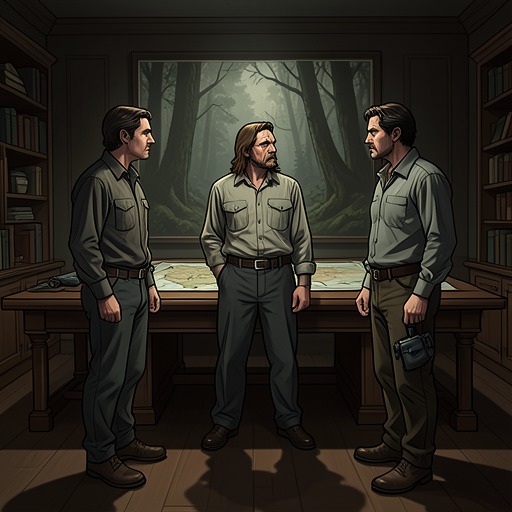
Bane’s earlier connection to the Samsas makes his later hostility more consequential than an ordinary territorial dispute. He knows their abilities, their habits, and the limits of Wilder’s authority. When Lycell killed Bane’s older brother, Wilder went to the compound to make peace and found that Bane no longer offered the respect he once had. On a later visit, Wilder brought Hunter and Devin and avoided immediate danger, recognizing that Bane’s betas might have killed him had he arrived alone. The encounter reveals that Bane’s power is not merely physical; he is patient enough to convert resentment into coordinated action.
Political Strategy and Conflict with the Samsas
Bane’s pack becomes rich and therefore stronger, while he uses wealth to turn most Alaska packs against the Samsas. The Oregon and Alaska packs eventually merge, creating an alliance Wilder considers dangerous to both werewolves and humans. Wilder’s position as head Alpha has become increasingly difficult because he has gone too long without expanding his pack or fathering pups, and none of the Samsa brothers has secured a marriage alliance. Bane exploits this demographic and political weakness rather than challenging Wilder only in a single fight.
The Samsa brothers’ response is shaped by the same kinship system that Bane seeks to break. Wilder, Lycell, and Drayton are inseparable Alpha triplets who control their inherited territory equally, and their pact permits Wilder’s chosen female to become the shared mate of all three. Their household therefore combines brotherhood, marriage, succession, and reproduction. Bane understands that Adrienne is not simply a woman desired by competing males: she is the prospective mother of the pups on whom the Samsa pack’s survival depends. By taking her, he can injure the family’s emotional center, interrupt its breeding strategy, and force its Alphas into a rescue that exposes them to ambush.
Bane’s plan is explicitly collective. He arranges for betas to attack the Samsas and take Adrienne, hoping to destroy the brothers when they come after their human female. He wants the other Alphas to recognize a model of rule based on brutality, possession, and refusal to grant quarter. His ambition is therefore larger than revenge for his brother. He wants to redefine Alpha behavior and demonstrate that the strongest leader is the one who takes what he wants and compels submission.
Adrienne as Captive and Intended Mate
Bane’s treatment of Adrienne exposes the contradiction at the center of his character. He initially intends to use her as bait and has planned to kill her, but her pregnancy activates the hunters’ law that a female must not be killed, especially when she is pregnant. The rule does not make him humane; it changes the form of his control. Adrienne remains bound to a crude chair in a cave, with her hands, ankles, and waist tied, while Bane tells her that a wild animal might consume her if he failed to return. The threat makes the surrounding wilderness part of his system of punishment.
He takes her north in a rusty Chevrolet truck with remnants of red paint still visible, announcing that they are headed for Alaska to test her werewolves. When she refuses, he orders her into the truck and frames obedience as the only alternative to force. His authority rests on the assumption that a human woman must yield to a werewolf Alpha, and her resistance therefore feels to him like an insult and a mockery of his status.
Bane’s attitude toward human females is also shaped by the fertility crisis affecting his pack. He had opposed bringing human women into werewolf society because he considered them inferior to werewolf unions, yet the sterility of the werefemales leaves him without pups. Adrienne’s pregnancy changes his position in practice, even if it does not resolve his prejudice. He begins to see her as a potential mate who could bear his pups, and his desire becomes entangled with the political value of her fertility and with the fact that she already carries the Samsas’ children.
His conduct toward Adrienne remains possessive rather than protective. He is accustomed to giving werefemales raw meat after satisfying himself and does not understand why Adrienne needs fruit and vegetables during pregnancy. When she asks whether he cares if she lives or dies, he responds that he does not care about the Samsas’ pups but cares about her. Adrienne rejects that distinction because the pups are part of her; for her, refusing the children means refusing her. The exchange briefly forces Bane to confront the limits of treating her as a separate object from her family and pregnancy, although he cannot express his feelings openly or translate them into respect for her choice.
Bane’s uncle confirms that Bane’s conduct belongs to an older pattern of abducting human females for mating. When Bane asks for food and to borrow the truck, his uncle demands the woman in exchange, treating Adrienne as property rather than a person. Bane’s stern reaction suggests possessiveness even within his own family, but the scene does not convert that possessiveness into consent or freedom for Adrienne.
Rivalry, Desire, and the Laws of the Wild
Bane’s pursuit of Adrienne continues after she escapes and reunites with Wilder. From a snow-covered mountain, he hears her sexual cries and recognizes her voice even at a great distance, imagining that Wilder possesses everything he wants and needs. The sound draws him down the mountain, turning pursuit into an involuntary mixture of jealousy, sexual desire, and territorial fixation. His longing is presented as stronger in a werewolf than in a human, but it remains organized by the same single purpose that governs his politics: to mate with Adrienne and make her his.
The contrast between Bane and Wilder is sharpened by their competing interpretations of law. Wilder believes that Bane has kidnapped an Alpha’s mate and must be punished under werewolf law. Because Bane has taken Adrienne, Wilder understands the conflict as a hunt in which he must pursue the pursuer: he must kill or be killed. Bane, by contrast, invokes the laws of the wild to justify abandoning Adrienne if she cannot walk and to threaten her with death by exposure or animals. The same language of instinct and hierarchy thus produces opposite claims—Wilder’s obligation to protect a mate and Bane’s assertion that weakness forfeits protection.
Bane’s conduct also collides with the laws Wilder has established against mistreating human women. Wilder refuses to capture human females for breeding because he fears that such kidnappings would lead humans to hunt down and destroy the werewolves. Bane deliberately violates that restraint, presenting the abduction of Adrienne as both a strategic attack and a public lesson in how an Alpha should treat women. His challenge is consequently legal and cultural as well as military: he contests the Samsa version of secrecy, protection, shared mating, and negotiated integration with humans.
Narrative Role and Significance
Bane functions as the shadow of the Samsa family’s reproductive and political order. The Samsas respond to infertility by making Adrienne central to a shared family arrangement, while Bane responds to the same crisis through capture and domination. Their common concern is the survival of werewolf packs, but their methods create a moral and institutional opposition. The Samsas claim that Adrienne may leave, even while restricting what happens to her pregnancy; Bane removes the practical possibility of departure and treats her body as the means of restoring his pack.
His antagonism is intensified by the history between the two Alpha groups. Lycell’s killing of Bane’s brother gives Bane a credible grievance, yet Bane expands that grievance into a plan to capture all the Samsas and make Adrienne his own. The result is an escalation from brotherly feud to inter-pack war, with Alaska and Oregon aligned against the Samsas and with human safety implicated in the conflict.
Bane’s ending position in the supplied arc is one of continued pursuit rather than reconciliation. He hears Adrienne with Wilder, follows the sound, and remains fixed on the belief that she should belong to him. His failure to accept her attachment to Wilder reveals the limit of his transformation: he can recognize Adrienne’s value, become captivated by her, and even claim to care about her, but he cannot relinquish the coercive Alpha logic through which he understands intimacy. Bane therefore embodies the danger of a social order that treats fertility, marriage, and female protection as matters of possession. His rivalry with Wilder is a contest not only for Adrienne, but for the kind of law and kinship that will govern the werewolf world.