Drayton kills the blond beta werewolf
Insatiable Box Set: Books 1-4Drayton kills the blond beta werewolf in a confrontation that begins as an attempt to locate Bane and ends as a decisive act of pack justice. The blond werewolf had participated in Adrienne’s kidnapping, openly taunted Wilder about Bane’s plans for her, and refused to reveal where Bane had taken her. Drayton’s intervention prevents the standoff from becoming a wider battle while making clear that the Samsa brothers’ pursuit is not merely a private rescue effort: it is also an enforcement of the laws governing mates, authority, and violence among werewolves.
The Confrontation at Bane’s Pack
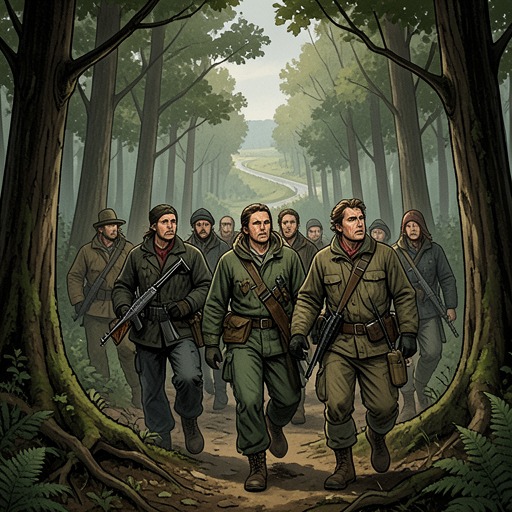
Wilder approaches the gathered wolves while Hunter, Devin, and Drayton accompany him. The Samsa brothers disguise their scents with those of the forest, allowing them to pass through the surrounding territory without being detected. Wilder’s opening demand is direct: he wants to know where Bane is. The blond werewolf, who had helped kidnap Adrienne, steps forward in human form and displays little respect for Wilder, despite Wilder’s status as the greatest Alpha of his kind.
The blond wolf’s appearance and manner emphasize his youth and inexperience. He is taller than Wilder, carries himself with an inflated confidence, and appears eager to provoke a confrontation. He identifies Wilder by name and says that he had hoped they would meet. Wilder, however, remains focused on the missing Adrienne. He has not found Bane’s scent, but he can still sense Adrienne from an extraordinary distance because she is his one true mate. That bond gives the encounter its urgency: every exchange is measured against the possibility that Bane is taking her farther away.
The blond wolf confirms that Bane has left with Adrienne after the kidnapping. He then refuses Wilder’s repeated demand for Bane’s location. Wilder orders Hunter and Devin to move back, recognizing that their anger could provoke the entire pack and compromise the rescue. His restraint contrasts with the blond wolf’s deliberate obscenity. The beta werewolf threatens that Bane intends to impregnate Adrienne and adds that he himself will have his turn afterward. The statement converts the search into an immediate personal and legal crisis, attacking Wilder’s claim to Adrienne while boasting of the kidnapping in front of her family and pack.
Drayton’s Attack and the Killing
Wilder tries not to accept the provocation. He understands that arguing with the blond wolf will not reveal Bane’s whereabouts, and he wants to preserve the possibility of continuing the pursuit. Drayton reacts differently. He takes his marriage to Adrienne seriously and feels responsible for having failed to protect her, especially after allowing her to leave when he understood the danger. Guilt and anger therefore shape his decision to act.
Before Wilder can change form, Drayton shifts into a large, fierce wolf. The surrounding wolves immediately lower themselves in fear. Drayton attacks first, aiming for the blond wolf’s neck and tearing a large piece from his shoulder. The blond wolf is left bleeding heavily, but he continues to fight. In wolf form he has gray fur rather than the blond hair of his human body, and his eyes burn black as he confronts Drayton with equally prominent fangs.
The fight becomes a contest of speed, strength, and tactical control. The blond wolf circles Drayton, bleeding from the arm and searching for an opening, but no advantage appears. Drayton follows the scent of blood, overturns him, grips his fur in his teeth, and catches him near the jugular and shoulder. When the blond wolf begins to stagger, Drayton attacks decisively, using his hands and teeth to snap the werewolf’s neck. He then turns toward the watching pack with blood streaming through his fur, while the surrounding wolves remain bowed on the ground after witnessing the violence.
Authority, Law, and Consequence
The killing is not presented as an uncontrolled outburst alone. Drayton’s anger is personal, but it is also connected to the order Wilder is trying to maintain. Wilder has been taught that werewolf law must be enforced across a vast pack extending from the Americas to Russia. The same code makes Bane’s abduction of an Alpha’s mate a punishable offense, and the blond wolf’s participation in that abduction makes him part of the violation. His refusal to submit, his contempt for Wilder’s authority, and his explicit threat against Adrienne turn the encounter into a challenge to the entire Samsa order.
The scene also distinguishes Drayton’s force from Wilder’s control. Wilder remains deliberate, holding back Hunter and Devin and refusing to be drawn into a premature general fight. Drayton supplies the violence Wilder is unwilling to unleash in that moment. The brothers thus operate as complementary figures: Wilder preserves the mission and the hierarchy, while Drayton answers an intolerable insult and punishes the immediate aggressor. The blond beta’s death clears the path for the continuing pursuit of Bane and Adrienne, but it does not resolve the larger conflict. Bane remains at large, Adrienne remains in danger, and the killing intensifies the stakes of the brothers’ northward hunt.
The Killing as Pack Justice
The blond beta werewolf’s death carries a wider legal meaning because the confrontation occurs within a society governed by inherited werewolf law rather than by the human standards Adrienne knows. Wilder has been taught that these laws are internalized across generations, and, as head of a pack extending from the Americas to Russia, he is responsible for enforcing them. Bane’s abduction of Wilder’s mate is therefore not simply a private injury. It is an offense against Alpha authority, the mate bond, and the order that binds rival werewolves to recognized limits. The blond wolf deepens the violation by admitting his role in the kidnapping, refusing to identify Bane, and threatening sexual possession of Adrienne as though she were a prize to be passed among males. His defiance makes the encounter a direct challenge to the authority Wilder represents.
The scene also exposes a conflict between overlapping moral systems. Adrienne has difficulty understanding both human law and werewolf law: she does not fully accept the werewolves’ reliance on hunting, their inherited rules, or their insistence that a mate must be protected according to pack custom. Yet the Samsa brothers interpret Bane’s conduct through that framework. Their response is shaped by a code that treats the taking of another Alpha’s mate as an offense demanding punishment, while the blond wolf treats the same captive woman as an object of anticipated access. The difference is crucial. The brothers’ rescue mission claims to restore an existing order, but that order still defines Adrienne through mating, protection, marriage, pregnancy, and inheritance. Her position is therefore central to the law being enforced while her own understanding of that law remains incomplete.
Wilder’s conduct separates formal authority from immediate retaliation. At the gathering, he recognizes that Hunter and Devin’s anger could provoke the entire pack, so he orders them to withdraw while Drayton remains beside him. He refuses to let the blond wolf’s insults dictate the timing of the rescue, because a general fight would delay the search and might make Adrienne even harder to recover. Drayton’s action does not erase that restraint; it operates alongside it. He responds to the beta’s provocation through physical force, while Wilder preserves the larger objective of finding Bane. The division reveals the brothers’ internal structure: Alpha authority depends not only on the leader’s ability to dominate but also on the ability of allied kin to act when the leader’s mission requires controlled violence.
Drayton’s motive is intensified by his marriage to Adrienne. He believes that he failed to protect her and that he should not have allowed her to leave after recognizing the danger surrounding her. His guilt turns the blond wolf’s words into more than an insult directed at Wilder. The threat confirms that Adrienne is being treated as vulnerable property by men who helped place her in captivity, and Drayton answers as a husband who sees his own failure reflected in her danger. His violence consequently has both emotional and institutional force: it is an expression of remorse, a defense of Adrienne, and an enforcement of the pack’s prohibition against violating another werewolf’s mate.
The consequences remain deliberately incomplete. The blond beta’s death frightens the surrounding wolves and demonstrates the lethal authority of the Samsa brothers, but it does not end the pursuit. Bane has already taken Adrienne away, Lycell is absent after being attacked by a black bear, and Wilder must continue north rather than remain to celebrate the victory or mourn the cost. He eventually shifts into wolf form to travel more quickly through the snow, using his white fur as camouflage and following Adrienne’s scent along frozen riverbanks. The killing therefore functions as a hinge in the rescue sequence: it prevents the hostile pack from immediately forcing a broader battle, yet it also confirms that the conflict has passed beyond negotiation. Bane’s pursuit of Adrienne has activated the law of retaliation, and Wilder’s determination to hunt him is framed as a choice between killing and being killed.
The killing also exposes the limits of the legal order it claims to defend. Adrienne is treated as the center of a dispute over mating rights, protection, marriage, pregnancy, and inheritance, yet her own understanding of werewolf law remains incomplete. Wilder tells her that she may leave him, but that she cannot take the child because the Ari Kara clan might discover the pregnancy and assassinate his heir. In that framework, her safety is secured through male authority and territorial control rather than through an independent human legal process. The blond beta’s threat is therefore especially revealing: he does not merely oppose Wilder; he imagines Adrienne as a captive body that can be transferred from Bane to himself. Drayton’s attack answers that degradation, but it does not dissolve the system that makes her status a matter of pack law.