Full-Moon Mating Heat
Insatiable Box Set: Books 1-4Full-Moon Mating Heat is the recurring state of heightened sexual urgency that the novel associates with the full moon. Its importance lies not only in the intensity of the werewolves’ desire but in the way that desire is used to test the boundary between instinct and choice. The males describe heat as a force that must be satisfied; Adrienne repeatedly treats that claim as no excuse to override her decisions.
Nature and Context
The heat is presented as a bodily and seasonal pressure rather than a detached rule of werewolf society. Wilder says that the pack must mate when the full moon arrives, and Lycell identifies himself as being in heat. Drayton, too, feels the pull strongly enough to roam the grounds through the night, unable to settle while Adrienne is nearby. The recurring pattern gives the moon a practical role in the characters’ intimate lives: its approach intensifies desire and brings private tensions into the open.
The urgency also appears against the larger background of werewolf fertility concerns. Wilder has explained that most female werewolves are sterile and that he will not capture human women to replenish the packs. He and his brothers have instead relied on a planned arrangement involving a chosen fertile female, and Wilder has convened a council to address the clan’s declining breeding. That population crisis helps explain why mating is treated as both a personal act and a matter of pack continuity. It does not, however, make every individual demand a freely chosen one.
The Heat as a Claim of Compulsion
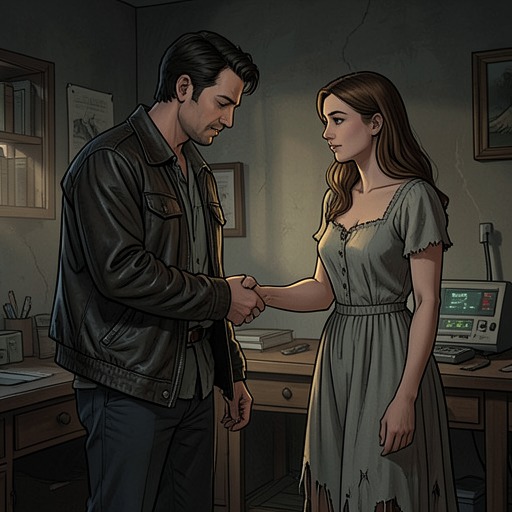
During Adrienne’s honeymoon with Drayton, Wilder objects that the full moon means the brothers must mate with her. Adrienne answers that they can control their urges, then turns to her meal rather than accepting the moon as a command. The disagreement exposes a central conflict in the concept: the males present heat as an exceptional condition that creates an obligation, while Adrienne distinguishes desire from permission.
Lycell makes the claim more confrontational. He tells Adrienne that he is in heat and frames finding comfort elsewhere as the alternative if she will not be with him. Drayton watches, angry, while trying to resist what he understands as the wolf inside him. Adrienne identifies Drayton as her husband and kisses him again, making her chosen relationship visible in the very moment Lycell asserts possessiveness. The scene connects heat not just to physical need but to competition over access to Adrienne and over the terms of the brothers’ shared arrangement.
Restraint, Refusal, and Consequences
The novel also shows the heat through what a character does to avoid acting on it. After Adrienne denies him, Drayton spends the night pacing the grounds and thinking about her. The dogs in the kennel become agitated and bark as he circles outside. He considers going to her, but recognizes that if she refuses, he may not be able to control himself; he fears that taking her against her will would destroy her trust and their relationship. His decision to remain away makes restraint an action, not an absence of desire.
Adrienne deliberately challenges the idea that the moon removes responsibility. She tells Drayton to prove how much control he has under the full moon, then hears Lycell’s piercing howl from down the hall. The howl marks the strain of the heat, but it also follows her refusal rather than replacing it. Drayton continues to roam through the night, overwhelmed by her scent and his own desire, yet fearful of crossing the boundary she has set. In this episode, the heat heightens the stakes of restraint: the urge is powerful, but its consequences depend on what the characters choose to do with it.
A Shared Instinct, Differently Experienced
Bane describes the full moon as a tide of attraction, comparing the pull between Earth and Moon to his attraction to Adrienne. He says that her scent makes it difficult for him to resist taking her, even while she is pregnant. Adrienne rejects his account of helplessness, telling him that harm would be a choice rather than an automatic effect of the moon. Bane also says he will not force her and claims that she would have to ask him. The exchange makes the moon’s pull part of their captor-and-captive conflict, while leaving the competing assertions of control unresolved in the scene.
Across these encounters, the heat does not function as a single, uniformly obeyed law. Wilder invokes it as a pack expectation; Lycell uses it to press a claim; Drayton experiences it as a danger he must manage; and Bane describes it as an attraction with a lunar force behind it. Adrienne’s responses—refusal, challenge, and insistence on control—keep the concept tied to agency. The full moon intensifies the werewolves’ appetites, but the narrative repeatedly asks whether instinct can absolve conduct, and gives Adrienne the clearest answer: desire may be powerful without becoming consent.