Human-werewolf family integration
Insatiable Box Set: Books 1-4Human-werewolf family integration is the attempt to make human partners, werewolf mates, and pack life part of one family structure. In Wilder’s plan, human relationships could help sustain dwindling packs without kidnapping women; in practice, the ideal is unsettled by mating laws, reproductive demands, inheritance, and the question of who has the authority to consent. Adrienne Ward’s movement from outsider to chosen wife and mother gives the concept its clearest personal form, while conflict over Mena and Robert shows how marriage can also become a tool of pack politics.
Origins in the Fertility Crisis
The project begins as a response to a population emergency. After a fever killed many werewolf females, the survivors were often sterile, and male werewolves began killing them. Wilder tried to prevent both the slaughter of females and conflict among the Alpha wolves. With Dr. Wells and his team working under a promise of secrecy, he sought a way to preserve the packs rather than let scarcity drive them toward violence.
His reproductive strategy assigned distinct roles within the pack. Males would mate with the one female able to conceive, while other females would nurture and protect the resulting pups as their own. A fertile female from another pack might also mate with its members if she agreed, allowing the arrangement to serve pack survival beyond Wilder’s own territory. The plan therefore treated parenthood as partly collective: biological maternity and the work of raising pups did not have to belong to the same female.
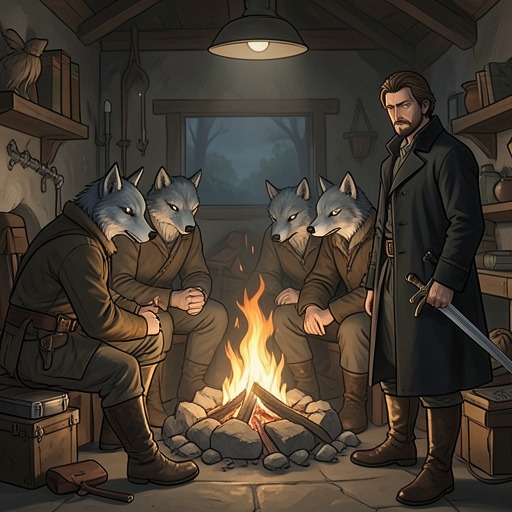
Wilder saw this model as potentially applicable to his own family if he found a mate. He wanted a family but had not found a compatible female werewolf; most werefemales were sterile, and a partner would have to accept his brothers as well as be fertile. Because Wilder, Lycell, and Drayton were Alpha triplets who had sworn to remain together and shared their inherited territory equally, he would not solve the problem by displacing one of them. Their pact made a shared partner central to the family structure he imagined.
Wilder’s Alternative to Abduction
Wilder’s policy was not simply to secure human females for reproduction. He refused to bring them into the packs by force, fearing that kidnappings would lead humans to hunt the werewolves down and destroy them. Instead, he established a council to consider the breeding crisis and hoped that money might allow him and his handsome brothers to meet women willing to join pack life. Some women went to live with other pack members; Wilder waited for a partner he regarded as the right choice. If she did not want all three brothers, his account allowed her to leave, although any pups fathered by one of them would remain with the pack.
The distinction between proposed choice and practical freedom is unstable in his relationship with Adrienne Ward. Snow leaves her the only female nearby when Wilder says that he will soon have to mate. After she learns that he is a werewolf, he tells her that she is not his prey or captive and may come and go, yet also says she cannot leave while pregnant or carrying his pup because the child could be in danger. He invokes the possibility that the Ari Kara clan might discover the heir and send an assassin. His protection of Adrienne is thus bound to restrictions on her movement and to a succession system in which the child’s safety is treated as a pack concern.
Wilder’s explanation also reveals the mismatch between human and werewolf understandings of intimacy. Adrienne objects that he speaks as though mating were compulsory and questions how he can expect her to accept the arrangement. Later, Drayton tells her that the brothers would not mate with her unless she wanted them to, yet he warns that her scent is affecting Lycell, who has never been with a female. The stated importance of consent sits beside expectations formed by pack custom, sexual urgency, and Adrienne’s dependence on the brothers’ protection.
Adrienne’s Choice and the Shared Household
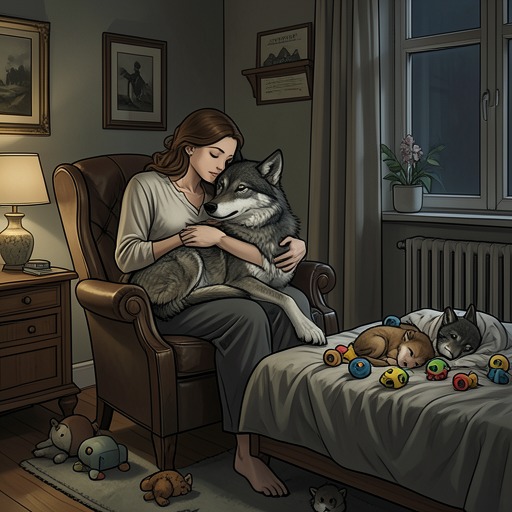
Adrienne does not remain only the object of Wilder’s reproductive plan. She names herself, insists that she wants marriage, and ultimately tells Wilder that she wants to marry him, Lycell, and Drayton. She says Lycell changed her mind about including the brothers. This decision makes shared marriage an expressed choice on her part, but it does not erase the conditions under which the proposal developed: Wilder had already described her as his mate, and his account tied her departure to pregnancy, the pup, and the danger facing his heir.
The brothers’ different positions also prevent the family arrangement from appearing as a simple agreement among equals. Wilder asserts that he is the pack’s Alpha and that Adrienne is his mate, insisting that he will marry her. Lycell counters that she is carrying his pups and that he should be the one to marry her. Drayton, by contrast, argues that Adrienne should decide whom she wishes to marry. These disagreements make the household both an intimate relationship and a dispute over authority, parentage, and pack leadership.
The tension extends to Mena, whose father, Ramsey, says Wilder promised she would marry one of the brothers before sending her back at Adrienne’s insistence. He accuses the Samsa brothers of allowing a human to dictate their laws. Wilder responds that Ramsey cannot dictate to him and says that Mena was not defiled. The conflict exposes how a human woman’s preferences can be presented either as an exercise of choice or as an affront to werewolf custom, depending on who is speaking and whose promise is at stake.
Marriage as Alliance and Public Life
The Mena dispute turns private relationships into a question of inter-pack peace. Wilder tells Drayton that he will have to mate with Mena, not because he loves her but because the arrangement is needed to keep the werewolves from war. He says the Samsa group is not strong enough to face the Alaska and Oregon packs. Drayton rejects the proposed match as loveless; the episode makes plain that a political mating can demand an intimate commitment for collective security.
A later proposal offers a different configuration. Drayton tells Wilder that Robert and Mena want to be married alongside him and Adrienne. Wilder approves Robert and Mena’s marriage and welcomes Robert’s continuing work as their doctor. He also links the couple’s safety to his effort to travel with his sons to Oregon and stop an uprising. The family network can therefore grow through a human marriage rather than through the earlier demand that Drayton mate with Mena. The shift does not make marriage apolitical; it shows that the form of the alliance remains negotiable.
Wilder’s ambitions beyond the household likewise connect integration to the human world. He plans to run for state senator and tells Adrienne that public office would let him affect changes in towns and states where werewolf packs live. His stated concern is that humans are cutting down forests and destroying animals in their territories. Adrienne worries that a campaign will expose the family and its way of life to outside scrutiny and keep Wilder away from home. He answers that Lycell and Drayton can care for her and the children, then asks her to consider what environmental destruction would mean for their future. She ultimately agrees to let him do what he thinks best for them all.
Limits and Significance
The hope of integration remains in conflict with exclusionary pack law. Ramsey condemns Wilder for preventing werewolves from marrying humans and claims that this policy will make them die out; he disparages the prospect of a pack ruled through its half-human descendants. The insult makes visible the boundary the family is trying to cross: human-werewolf children may be the future of the pack to Wilder, but to his opponents they signify a threat to werewolf identity and authority.
Nor does shared family life dissolve the difference between human law and werewolf custom. Wilder has been taught werewolf law since childhood and is responsible for enforcing it as the head of a far-reaching pack. Adrienne embraces aspects of werewolf life while remaining unable to understand all its rules, including its hunting practices and its inherited moral order. The family is thus formed across systems of law that do not assign the same meaning to mating, protection, marriage, or a person’s right to leave.
Human-werewolf family integration is consequently both a survival strategy and a contested social order. Collective care for pups, Adrienne’s stated choice of three husbands, Robert and Mena’s marriage, and Wilder’s public engagement all suggest routes toward coexistence. Yet the same narrative ties reproduction to pack strength, children to inheritance, marriage to political peace, and protection to restrictions on women. Integration changes who can count as family without making power disappear; its promise and its danger occupy the same household.