Hunter Samsa
Insatiable Box Set: Books 1-4Hunter Samsa is Wilder’s son and Adrienne’s child, introduced as the slightly taller twin brother of Devin. His significance lies in the tension surrounding his accelerated werewolf development: although he and Devin are still treated as young sons, their bodies have already reached the size of young men, forcing the Samsa family to confront the difference between physical maturity, emotional childhood, and the responsibilities imposed by werewolf law.
Identity and Introduction
Hunter is named by Wilder in honor of Wilder’s father, while Devin is named after Adrienne’s maternal grandfather. Wilder tells Adrienne that the twins are difficult to distinguish and that only their mother can reliably tell them apart. When Adrienne returns after being absent for a month, she expects to see children but instead finds two young men standing six feet tall; Hunter is identified as the taller of the two, by only an inch. Wilder presents their height as evidence of the werewolves’ rapid growth cycle, a biological fact that changes the meaning of childhood within the Samsa family.
Hunter’s first reunion with Adrienne is quieter than Devin’s. Devin runs to the door, calls her mother, and embraces her immediately, while Hunter remains at a distance, silent. His hesitation does not signify rejection: a small smile eventually breaks across his face, and he runs to embrace her. The contrast between the brothers gives Hunter a more reserved presence, but the scene confirms that he recognizes Adrienne as his mother and responds to her return with love.
Family Life and Werewolf Development
Hunter belongs to the blended human-werewolf household organized around Wilder, Adrienne, and their sons. Wilder identifies Adrienne as his mate and treats the children as heirs whose safety is connected to the political security of the pack. The family’s domestic intimacy is therefore inseparable from werewolf custom. Hunter and Devin are physically advanced for their age, yet Adrienne still sees their gestures and attachment as recognizably human. When Devin holds her hand and Hunter carries Adrienne’s bag, she points out their human qualities; Wilder responds with concern, fearing that their human inheritance may make them vulnerable in a dangerous werewolf world.
The twins’ development also places them within the broader reproductive and succession system of the Samsa family. Wilder’s claim that Adrienne is his mate and that the child would be his heir makes the children politically consequential from birth. Later, Wilder explains that Hunter and Devin will soon leave home and find mates of their own because that is the werewolves’ way and part of their laws. Their future is thus imagined not as an individual choice alone but as a continuation of pack reproduction, alliance, and hierarchy.
The Forest Attack and Hunter’s Responsibility
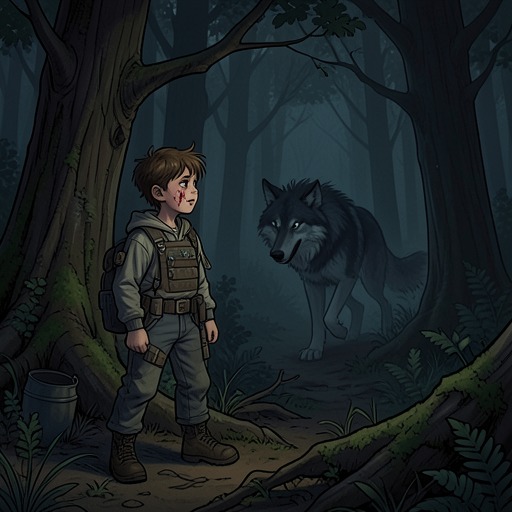
Hunter’s most consequential action occurs when he and Devin ride in the forest near the cave. A bear and her cub emerge and startle Devin’s horse, causing Devin to fall backward. Before Hunter can reach him, the bears attack. Hunter later reports the circumstances to Wilder, explaining that the animals appeared suddenly and that he was unable to intervene in time.
The attack exposes the danger created by the twins’ premature independence. Wilder reprimands them for wandering too far from home before he has taught them how to hunt and which animals must be avoided. He specifically warns that some animals are mortal enemies, including humans. Hunter is therefore not merely a witness to Devin’s injuries; he is part of the transition from protected childhood to dangerous instruction. His account allows Robert to treat Devin quickly, while his presence beside his injured brother shows the family’s dependence on sibling loyalty during emergencies.
Relationships and Emotional Position
Hunter’s closest relationship is with Devin, his twin brother. The two are repeatedly presented together, physically close and nearly indistinguishable, but the forest attack reveals their different temperaments and vulnerabilities. Hunter survives the encounter without the wounds suffered by Devin, yet he carries the knowledge that he could not reach his brother before the bears struck. The episode makes him both sibling companion and developing protector, even though he is not yet prepared for that responsibility.
Hunter’s relationship with Adrienne develops through recognition and reunion. Because she has been absent during a crucial period of the twins’ rapid growth, their meeting is also a confrontation with lost time. Adrienne sees the young men they have become, while Hunter encounters a mother whose return restores an emotional bond that the family had been trying to preserve in her absence. His initial silence and eventual embrace make the reunion a movement from uncertainty toward belonging.
With Wilder, Hunter occupies the position of son, student, and future werewolf subject. Wilder supplies the law, hunting knowledge, and warnings needed to survive, but his authority also reveals the limits of the family’s protective shelter. Hunter must learn the rules of a world in which food is hunted, predators defend territory, and the forest can turn suddenly against the inexperienced. Wilder’s teaching is therefore both parental care and preparation for pack life.
Change and Narrative Role
Hunter changes from a named but largely undefined child into a visible representative of the werewolves’ accelerated life cycle. His height, his reunion with Adrienne, and his participation in the forest incident establish that the Samsa children cannot remain children according to human expectations. Their bodies move quickly toward adulthood, while their judgment and knowledge still require instruction. This mismatch creates a recurring danger: the twins look capable before they are fully equipped to act independently.
Hunter also helps dramatize the conflict between human and werewolf systems. Adrienne understands motherhood through prolonged care and emotional presence, whereas werewolf custom anticipates that sons will soon separate from their mother and seek mates. Hunter’s future is consequently governed by a law that treats rapid growth and early independence as normal. Through him, the story makes the family’s hybrid identity concrete: he is a son who needs maternal affection, a young werewolf expected to learn predation and law, and a future participant in the pack’s reproductive and social order.