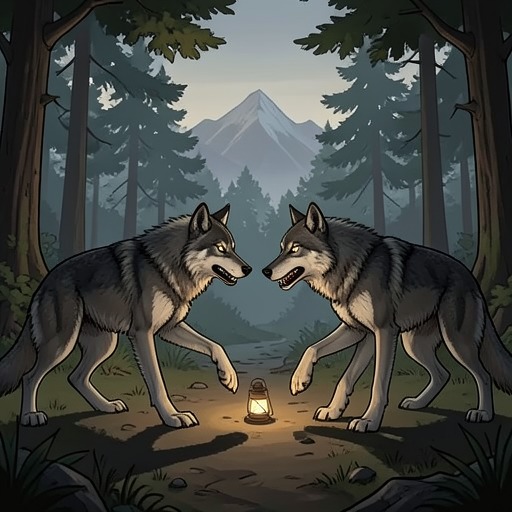
Lycell kills Bane's brother
Insatiable Box Set: Books 1-4Lycell kills Bane's brother during a violent incursion into Samsa territory, and the act becomes the decisive origin of Bane’s revenge against the Samsa family. What begins as a struggle over territory therefore develops into a succession crisis, a personal vendetta, and eventually a military threat to the entire Samsa pack.
Territorial Conflict and the Attack
Lycell’s killing of Bane’s brother is recalled as part of an earlier confrontation between the Samsa pack and young werewolves from the Oregon pack. The intruders crossed into the territory inherited by Wilder, Lycell, and Drayton, showing no respect for Alpha authority and pursuing a policy of killing anyone who challenged them. Bane, then an aggressive young werewolf rather than the established Alpha he would later become, pushed his brother to attack Lycell while Lycell was guarding the family’s land.
Lycell was still learning to transform and did not yet know how to conserve his strength. Four rogue werewolves surrounded him and prepared to tear out his throat. Bane demanded that he identify the Alpha and submit, while Lycell answered that his father was the only Alpha at that time and that he would one day rule the surrounding regions. The exchange makes the killing part of a contest over rank as well as a fight for survival: the Oregon attackers sought to impose authority through intimidation, while Lycell defended the legitimacy of his family’s territorial order.
Drayton’s Intervention and the Death
Drayton arrived while Lycell was surrounded and studied the attackers from higher ground, looking for their weakness. He then shifted into a grey wolf, leapt onto the largest of the four, and struck with a bite to the unprotected neck and a sweep of his extended claws. Two of the attackers were killed immediately, while the surviving brothers retreated. Their defeat was followed by punishment from Drayton’s father, who banished them into the Alaskan wilderness until they were old enough to swear allegiance to the Samsa pack.
The broader confrontation establishes the brothers’ shared martial identity. Wilder, Lycell, and Drayton are triplets equal in skill and strength, and their father had trained them to become Alphas who would control the territory of North America. Drayton’s rescue of Lycell also recalls the brothers’ lifelong bond: he had saved Lycell’s life before, when they were teenagers learning to hunt and defend their borders. Within that history of mutual protection, Lycell’s later killing of Bane’s brother becomes the violent act that permanently alters the balance between the families.
Retaliation, Succession, and Pack Politics
The killing did not end with the Oregon incursion. The death of Bane’s brother made Bane the Alpha of the Oregon pack, and he vowed to avenge the loss, although the deteriorating condition of his own pack prevented him from carrying out that promise immediately. The event therefore joined private grief to political succession: Bane inherited authority through the death while also inheriting an unresolved hostility toward Lycell and the Samsa family.
The Oregon pack’s weakness was tied to the wider werewolf fertility crisis. Its young werewolf females could not breed, leaving the pack unable to replace its numbers. The Samsa family faced a related problem, since most werewolf females were sterile and Wilder had refused to capture human women, fearing that such abductions would expose the clan to human hunters and eventual destruction. His refusal preserved the secrecy of the werewolf community but also limited its growth, making fertile human women politically consequential rather than merely personal partners.
Bane’s resentment gained new force when Drayton declined to marry the daughter of the Alaskan Alpha. Instead of securing an alliance through that expected marriage, Drayton remained aligned with the Samsas, while Bane eventually joined forces with the Alaskan werewolves. Their combined numbers became greater than those of the Samsa pack, and their money and influence could not prevent the two groups from planning an attack. Lycell’s act thus became the remembered grievance around which a broader inter-pack coalition formed: a brother’s death supplied the emotional motive, succession supplied the personal antagonist, and fertility and marriage politics supplied the military scale.
Consequences for Adrienne and the Samsa Succession
The old killing also shaped the later danger surrounding Adrienne. The Samsa brothers’ survival and the future of their pack depended on fertile human partners and the children they could produce, while Bane’s coalition understood that attacking Adrienne and the young Samsa offspring would strike at the family’s ability to continue. Wilder therefore treated Adrienne not only as his mate but as the mother of an heir whose existence could provoke assassination by the Ari Kara clan. His refusal to let her leave while pregnant reflected the collision between protection, possession, and inherited political danger: within his law, she could go, but the child could not safely accompany her. Lycell’s killing of Bane’s brother consequently remained active long after the original fight, reappearing whenever questions of mating, inheritance, reproduction, and pack survival were decided.
Lasting Significance
Lycell kills Bane's brother as an act of immediate territorial defense, but the narrative preserves its consequences as a chain rather than a closed episode. The death changes Bane's position within the Oregon pack, gives his hostility toward the Samsa family the force of a blood grievance, and helps transform a local confrontation into an inter-pack crisis. It also exposes the limits of every order competing in the story: the Samsa brothers' equal strength and shared rule cannot eliminate rivalry beyond their borders; werewolf customs concerning Alpha authority, marriage, and succession cannot be separated from reproductive scarcity; and the refusal to abduct human women protects secrecy while leaving the pack dependent on relationships that are politically and personally unstable. Later decisions about Adrienne, Drayton's proposed marriage to Mena, and the protection of the Samsa children all carry the pressure of this earlier killing. Lycell's violence therefore functions as both a rescue of his own life and the origin of a conflict that makes family continuity itself a military objective.