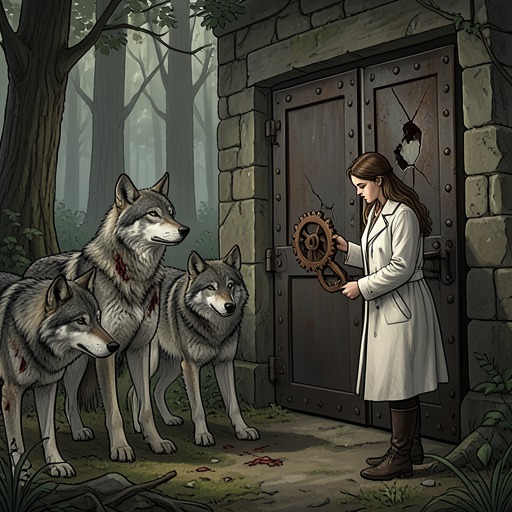
Mena
Insatiable Box Set: Books 1-4Mena is a human woman whose story links private love, reproductive medicine, and werewolf political order. Introduced as a nurse for the babies and a playmate for Lycell, she is initially treated less as an autonomous romantic subject than as a solution to the Samsa family’s alliance and fertility problems. Her presumed sterility makes her unsuitable as a breeder in a culture organized around pups, yet her family connection makes her valuable in negotiations. When an experimental drug restores her fertility and she becomes pregnant with Robert’s child, Mena becomes living evidence that the reproductive crisis may be reversible—and a target for forces determined to control fertile women.
Identity and Introduction
Mena first enters the domestic world of the Samsa family as a caregiver. Wilder identifies her as a nurse for the babies and a companion for Lycell, placing her inside the household through practical labor and intimate familiarity rather than through a completed marriage. Her presence is also dangerous because Lycell reacts strongly to the scent of a human female; Drayton warns Adrienne to be careful around him and explains that Lycell has never been able to remain calm around such a scent. Mena therefore occupies an unstable position from the beginning: she is useful, familiar, and socially admitted, but her humanity and sexuality remain subjects of werewolf control.
The wider werewolf system gives Mena’s introduction a political meaning. Wilder explains that most werewolf females are sterile and that his clan has refused to capture human women, both because he rejects that practice and because kidnapping would expose the clan to human hunters. The Samsa brothers instead attempt to build relationships through money and arranged association. Mena is caught within the compromise between those principles. She is not initially presented as the fertile woman who can solve the crisis; she is the daughter whose promised marriage may secure peace between packs, even though her presumed inability to bear pups makes that promise biologically and politically fragile.
Marriage Politics and Love for Robert
Mena’s father expects her to marry Lycell or Drayton, and Wilder tells Adrienne that he promised this union. The arrangement treats marriage as an obligation owed to a family and a pack rather than as a private choice. When Adrienne asks Wilder to send Mena away after choosing marriage to Wilder, Lycell, and Drayton, Wilder admits that the promise is difficult to undo because he gave Mena’s father his word. He also says that Mena is sterile and that Adrienne’s future pups were intended to be given to Mena and Lycell, revealing how the Samsa household separates biological motherhood from social parenthood.
The arrangement becomes a direct threat to peace when Mena’s father, Ramsey, accuses the Samsa brothers of dishonoring his daughter. He complains that no one will mate with her after Wilder returns her at Adrienne’s insistence and challenges the right of a human woman to dictate werewolf law. To prevent a war, Wilder tells Drayton that Drayton must mate with Mena, explicitly presenting the proposed marriage as a political duty rather than a romantic bond. Drayton resists because he does not love her, and Mena states the reciprocal truth: she does not love Drayton either.
Mena’s actual attachment is to Robert. When Drayton meets Mena and Robert, their concealed relationship becomes explicit: they are in love, want to marry each other, and ask Drayton to take them back to his ranch. Their relationship creates an alternative form of alliance, founded on mutual affection rather than paternal promise or pack diplomacy. Wilder recognizes their love because he compares it with his own love for Adrienne. He also sees Robert’s kindness and generosity in the care Robert gives to Devin, which helps him judge Robert as a trustworthy partner rather than merely a human outsider.
Wilder ultimately sanctions Mena and Robert’s marriage. He agrees that, after Drayton and Adrienne marry, Mena and Robert may do the same, and he offers Robert continued work as the family doctor. This decision transforms Mena’s position: she is no longer an unwanted or politically displaced bride waiting to be assigned to a Samsa brother. Her relationship with Robert receives formal recognition within the Samsa household, while Robert’s medical role binds the couple to the family through care as well as marriage.
Fertility, Pregnancy, and Caregiving
Mena’s presumed sterility changes when Robert gives her an experimental drug on which he has been working. She announces that she is pregnant, explaining that the treatment has made conception possible despite her former diagnosis. The pregnancy is important not only for Mena and Robert but for the entire werewolf population. Wilder’s clan has been weakened by widespread female sterility, and the Samsa reproductive strategy has depended on a rare fertile human woman, Adrienne, bearing pups for the brothers. Mena’s pregnancy suggests that fertility may be medically restored rather than obtained only through coercive or exceptional unions.
The pregnancy also changes Mena’s standing within the family. She returns from her honeymoon with Robert after Lycell calls him back to the ranch, and she shares the news with Adrienne while holding her stomach. Adrienne initially cannot understand how the pregnancy is possible because she believed Mena sterile; Mena’s answer identifies the experimental drug as the cause. The scene gives Mena control over the revelation and makes her body a source of hopeful news at a moment when the household is burdened by jealousy, danger, and political strain.
Mena participates in the care of Adrienne’s children as well. At the nursery, Robert examines the pups while Mena rocks one of Adrienne’s six babies. Drayton joins them, and the family discusses the danger of bringing outside nurses into Samsaville because the household’s secrets cannot safely be exposed. Mena’s role therefore combines future motherhood with present caregiving. She is not merely a prospective bearer of a child; she is already part of a domestic network responsible for protecting and raising the children whose existence defines the Samsa family’s political future.
Abduction and Pack Conflict
Mena’s pregnancy and family position do not protect her from violence. While traveling with Adrienne, she realizes that they may be followed. Adrienne accelerates the Mercedes to more than one hundred miles per hour, and Mena grips the seat so hard that her sharp nails tear the leather. Although they briefly lose sight of the pursuers and try to dismiss the danger as paranoia, the episode shows how quickly ordinary movement through human society becomes a flight from pack politics. Mena is not passive in the scene: she remains alert, shares the fear, and helps assess whether the threat has disappeared.
Bane’s followers eventually abduct Mena and Adrienne. The kidnappers declare that Mena will be sent to Alaska because her father is waiting for an answer and has promised support against the Samsa brothers. They claim that Mena will not be harmed, but they describe Adrienne as available for abuse, exposing the distinction their group draws between a politically protected hostage and a fertile woman treated as prey. The threat is especially grim because the kidnappers explain that fertile females have been scarce for years and are often passed among werewolves in attempts to impregnate them, after which their bodies and pups remain subject to continued exploitation.
Mena understands the danger of werewolves who are not restrained. She is forced into a truck with Adrienne, a blond werewolf, and two dark-haired men who appear to be brothers. Her warning that Adrienne’s husbands will never let the kidnappers rest if they kill her demonstrates that Mena understands the protective power of the Samsa bond even while she is being removed from it. Her captivity also makes the political bargain visible: Ramsey has effectively exchanged his daughter’s return for support against the Samsa family, turning Mena’s marriage and safety into instruments of inter-pack conflict.
Rescue Stakes and Narrative Significance
When Drayton, Hunter, and Devin reach the campsite after the rescue attempt has failed, they report that Wilder has gone after Adrienne alone. Mena is already gone, and Hunter explains that her father contracted Bane to send her back to Alaska in exchange for support against the Samsa brothers. Robert responds that Bane has his children and his wife, while Drayton states that Bane has his wife as well. Mena’s abduction thus expands beyond a dispute over an arranged marriage: it threatens a network of spouses, children, and inherited pack obligations.
Hunter promises Robert that he will go to Alaska to bring Mena and Robert’s family back if Robert cares for the wounded Samsa adults. The promise places Mena at the center of a new rescue obligation, even though Wilder’s immediate priority is Adrienne. She becomes one of the people whose recovery will determine whether the younger generation can act independently and whether the family can remain intact under pressure from Bane and the allied packs.
Mena’s character arc is consequently defined by a movement from assigned bride to chosen partner, from presumed sterile woman to pregnant mother, and from household caregiver to hostage in a war over fertility and authority. Her relationship with Robert challenges the werewolf assumption that marriage should be dictated by fathers, Alphas, or reproductive calculations. At the same time, her pregnancy confirms how deeply her body remains entangled in those calculations. Even after she gains a marriage based on love, fertility makes her vulnerable to the same systems of possession that govern the wider werewolf world. Through Mena, the narrative presents family not as a fixed biological fact but as a contested structure assembled through affection, medicine, caregiving, marriage, and the struggle to protect women and children from being treated as pack resources.