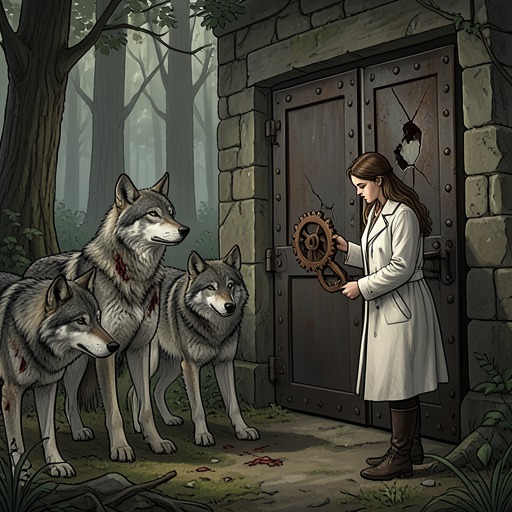
Robert
Insatiable Box Set: Books 1-4Robert is the doctor who turns medical expertise into a form of family protection within the werewolf world. He is not merely an outside professional: he lives in Ramsey’s territory, loves the land, becomes emotionally bound to Mena, and is eventually welcomed into the Samsa family’s domestic and political order. His work repeatedly places him at the point where bodies, reproduction, violence, and social law meet. Through emergency treatment, fertility research, and personal loyalty, Robert helps preserve both individual lives and the family’s attempt to rebuild its future.
Identity and Position
Robert is introduced as one of the doctors in Ramsey’s compound. He explains that he came to help and never left because he loves the land, placing him within the werewolf community even though the driver who transports Drayton is identified as human. His medical role therefore crosses the boundary between ordinary human institutions and the hidden werewolf society. He is trusted enough to work inside a hostile or politically complicated territory, and his presence suggests that the compound depends on specialized care that cannot be separated from its broader alliances.
His professional identity is inseparable from the Samsa family’s household. When Drayton is being sent away on family business, Robert’s attention turns toward Adrienne’s condition, and he wonders whether she has survived. Later, he is treated as a doctor who may remain at the ranch rather than as a temporary assistant. His authority comes from competence, but his place in the family is secured through care, affection, and consent to the marriages that restructure the household.
Medical Practice and Emergency Care
Robert’s most direct expression of character is his response to injury. When Devin is brought in after losing a dangerous amount of blood, Robert checks the pulse in his throat and immediately recognizes that there is no time to reach a hospital. He orders materials for a tourniquet, retrieves his medical bag and a first-aid kit, and uses a small piece of wood as part of the emergency treatment. He administers antibiotic and tetanus injections, cleans the wounds, and exposes two large puncture marks on Devin’s arm and leg so that the injuries can be treated properly. The scene presents him as decisive under pressure: medical judgment replaces panic, and improvised care becomes the only available bridge between violence and survival.
The same pattern appears when Lycell and Drayton return from the conflict. Robert has been working tirelessly to save Lycell’s life at a campsite, administering pain medication when Hunter, Devin, and the badly injured Drayton finally arrive. Drayton is limping, dragging his feet, and leaving a steady line of blood across the snow; Robert recognizes that he is in even worse condition than Lycell. He stops treating Lycell long enough to rush to Drayton, then directs the group toward the SUV and the hospital while calling his team. His care is therefore distributed according to changing medical urgency rather than simple emotional preference, even though both patients belong to the family he has come to serve.
Robert also functions as a medical interpreter. When Adrienne is found with a dangerously low pulse, a doctor calls for her to be taken to the hospital, and Wilder places her on the gurney while Lycell follows. The larger story repeatedly contrasts professional diagnosis with werewolf understandings of pregnancy, transformation, and bodily danger. Robert’s presence gives those conditions a clinical vocabulary, but the narrative does not allow medicine to control the whole meaning of the body: pregnancy remains at once a personal desire, a family necessity, and a political threat.
Fertility Research and the Population Crisis
Robert’s most consequential achievement is the experimental drug he develops for Mena. Mena reports that he has been giving her the drug on which he had been working and that she is now pregnant. The treatment changes her from a woman understood through infertility into a prospective mother, and it becomes evidence that the werewolves’ fertility crisis may be addressed through research rather than only through coercive mating customs or political marriage. Her pregnancy is expected to produce at least four children, making Robert’s work significant beyond the couple themselves: it offers a possible contribution to the repopulation of the werewolf community.
The treatment also exposes the limits and uncertainties of the research. Drayton wonders whether he may be infertile, whether the condition could be genetic, and whether his being the last-born of the triplets might matter. Because Robert’s serum has worked for Mena, Drayton considers consulting him, while recognizing that a treatment developed for a female patient may not apply to a male one. Robert’s medicine is thus promising but not magical. It opens a field of possibility without resolving the biological differences, risks, or unanswered questions that govern the family’s reproductive future.
Robert’s research carries an ethical tension. The experimental drug provides Mena with a desired pregnancy, but fertility is also treated by the surrounding society as a resource needed to secure descendants, alliances, and pack survival. Robert’s work can be read as care for Mena’s body and as service to a population crisis at the same time. The story gives him a role in expanding reproductive possibility, yet it places that possibility within a culture where women are often described as females, mates, mothers, or bearers of heirs. His contribution is most humane when it follows Mena’s expressed wishes rather than merely the community’s demand for children.
Love, Marriage, and Family Alliance
Robert and Mena openly resist the marriage arranged for her. Robert explains that they are in love, that they want to marry each other, and that Mena does not want to marry the man selected for her. They ask to be taken back to the Samsa ranch together. Robert’s declaration transforms his relationship with Mena from a private attachment into a challenge to the political system that has attempted to assign her as a bride. His love is not presented as separate from the werewolves’ social order; it must be negotiated through that order and eventually recognized by it.
Robert later returns for two stated reasons: Adrienne and Mena. He identifies Mena’s love for him as the reason she cannot accept the other marriage, and he reaches for her hand while explaining the situation. The gesture gives physical form to his alliance with her, while his words make her preference legible to the people who control the marriage arrangement. Robert is therefore both partner and advocate. He does not simply claim Mena; he presents her own desire as decisive.
The conflict is resolved when the Samsa family sanctions the relationship. Robert is told that when Drayton and Adrienne marry, he and Mena may marry as well, and he is invited to remain as the family’s doctor. This approval joins three kinds of belonging: romantic partnership, political incorporation, and professional service. Robert does not enter the Samsa household only through Mena; he becomes useful to its survival and is given a continuing place within its compound.
Narrative Role and Significance
Robert’s narrative importance lies in the way he links intimate attachment to collective survival. His medical bag, injections, tourniquet, pain medication, and fertility research are practical instruments, but each also marks a larger crisis: attacks threaten the bodies of the young, violence injures the family’s leaders, pregnancy exposes women to danger, and infertility threatens the future of the werewolf population. He responds to these pressures through treatment rather than domination, even while operating inside a society whose laws can define marriage and reproduction in coercive terms.
His relationship with Mena provides a counterpoint to the more possessive language used elsewhere in the werewolf community. Adrienne is told that she cannot leave while pregnant because the child may be an heir and a target; Lycell threatens to take and defile her; Wilder declares himself Alpha and asserts that she is his mate. Against these claims, Robert’s stated position is that Mena loves him and wants to marry him. His role does not erase the surrounding power structures, but it shows that family integration can also occur through mutual attachment, medical trust, and negotiated consent.
Robert ultimately represents a fragile bridge between human medicine and werewolf continuity. He treats injuries in snowbound camps, directs patients toward hospitals when necessary, researches fertility when ordinary reproduction fails, and accepts a place in the Samsa family without abandoning his professional identity. His story remains open rather than conclusively finished, but the evidence establishes him as physician, lover, prospective husband to Mena, ally of Adrienne, and essential caretaker in a household whose survival depends as much on healing as on strength.