Samsa double wedding
Insatiable Box Set: Books 1-4Samsa double wedding is the public ceremony through which two marriages are prepared and celebrated at once: Adrienne Ward marries Drayton, while Mena marries Robert. The event matters because it does more than mark romance. It is Wilder’s attempt to stabilize a household shaped by werewolf succession, shared-mate customs, human law, pregnancy, and inter-pack danger. By allowing both couples to marry, the ceremony turns relationships that had been governed by pack authority and reproductive necessity into publicly acknowledged family bonds.
Causes and Political Background
The double wedding grows out of a crisis in which private love repeatedly collides with werewolf law. Wilder states that Adrienne is his mate and that, as the Alpha male, he will marry her, while Lycell argues that his pregnancy with Adrienne’s pups gives him an equal claim. Adrienne ultimately refuses to be treated as an unnamed “female,” insists on her identity as Adrienne Ward, and declares that she wants to marry Wilder, Lycell, and Drayton. Her demand exposes the tension between her autonomy and the Samsa brothers’ established shared-mate arrangement.
The marriage plan also develops alongside the relationship between Mena and Robert. Mena’s father, Ramsey, objects that Wilder’s decision has dishonored his daughter and complains that a human woman is dictating werewolf law. His anger reveals the older system in which werefemale lives are controlled by male Alphas and marriage is arranged according to pack power. Mena, however, has fallen in love with Robert, a human doctor whose kindness and care for his son Devin distinguish him from the Alphas to whom she had previously been promised. Her choice therefore makes the second marriage a challenge to the inherited hierarchy as well as a personal union.
Wilder gives the two marriages institutional approval after recognizing Robert’s love for Mena. He sanctions their marriage, offers Robert the opportunity to remain as the family doctor, and links the ceremony to the expected recovery and travel of Devin. He then announces that the family can prepare for “two weddings,” presenting the double event as both a celebration and a practical consolidation of the household before Wilder leaves to confront unrest connected with the Oregon pack and the Alaska pack.
Planning and Stakes
The wedding takes place under an atmosphere of anticipation and danger. Saturday arrives with everyone on edge, and Wilder has particular reason to expect the worst because the ceremony is unfolding while the family faces political threats. Adrienne is eager for the day, but Drayton is overwhelmed by anxiety. He fidgets with his boutonniere, wonders why Adrienne chose him rather than Wilder or Lycell, and fears that nervousness will prevent him from fulfilling the role expected of him. His distress gives the event an intimate vulnerability beneath its public grandeur.
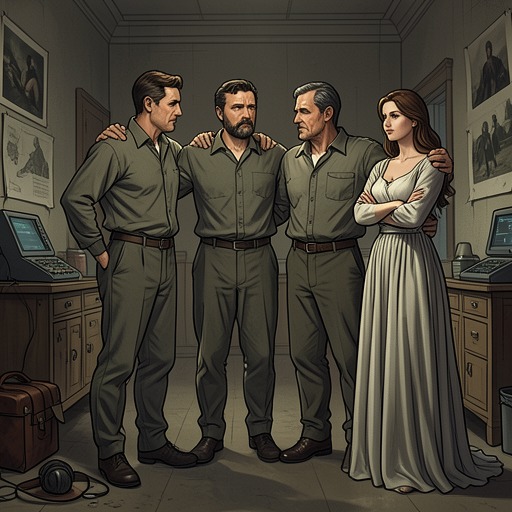
Lycell helps Drayton perform the ceremony, reassuring him that he need only stand upright and follow what they practiced. Robert stands beside him, while Lycell and Wilder occupy the outer positions. The arrangement visually places the human husband and the Samsa brothers within one ceremonial unit, even though their legal and cultural backgrounds differ. The gathering therefore embodies the family’s attempt to make several systems coexist rather than simply replacing one with another.
Ceremony and Setting
The ceremony is held outdoors on the Samsa ranch. The lawn is bordered by large pines and opens toward a mountain range to the north, with a large blue lake below the mountain. Five hundred guests wait for the brides, and rare tulips flown in from the Netherlands line the red carpet leading to the large gazebo Wilder built. Townspeople who admire the Samsas participate through the children’s procession: a four-year-old ring bearer waits with his mother, and a flower girl holds her mother’s hand while wearing a flowing silk dress given to her by Adrienne.
Adrienne and Mena enter together, escorted by Adrienne’s father, who walks with Adrienne on his right arm and Mena on his left. Adrienne wears a traditional white gown decorated with handmade silk butterflies, a veil held by a diamond tiara, and fresh-water pearls. Mena wears a lace gown fitted to her body, with handmade lace covering her back. The clothing gives both women a recognizable bridal identity while preserving their distinction: Adrienne’s dress emphasizes elaborate symbolic detail, whereas Mena’s emphasizes lace and form.
When Adrienne reaches the dais, she smiles toward Lycell and Wilder before taking her place beside Drayton. She and the others have written their vows, and Adrienne has included words for Wilder and Lycell rather than excluding the two men who remain her other loves within the Samsa arrangement. The vows consequently make the ceremony more complicated than an ordinary one-to-one marriage. Drayton occupies the formal place beside her, but Adrienne’s spoken commitment acknowledges the wider emotional and familial structure that the wedding is meant to contain.
Public Union and Aftermath
At the conclusion of the ceremony, Drayton kisses Adrienne in a long, heated embrace. Lycell lightly strikes him on the back before he breaks away, turning private passion into a moment of communal amusement. The guests clap, laugh, and comment that the couple must be in love. Their reaction supplies the social recognition that had been missing from the brothers’ earlier negotiations over Adrienne’s status.
The reception continues through the cutting of the wedding cake. Drayton places a piece in Adrienne’s mouth, then accepts a piece from her, while Lycell prepares to give a toast. These gestures translate the ceremony’s larger political purpose into domestic ritual: feeding, vows, kisses, family witnesses, and public celebration. The same household that had been organized around Alpha authority, fertility, and the protection of an heir now presents itself through the familiar language of marriage and shared celebration.
The double wedding’s larger consequence is the normalization of human-werewolf family integration. Adrienne’s insistence on marriage gives her a recognized voice within the arrangement, Mena’s union with Robert crosses the boundary between werewolf and human communities, and Wilder’s sanction transforms both relationships from disputed attachments into approved family alliances. The ceremony does not erase the tensions surrounding female autonomy, pack law, or the brothers’ shared claim to Adrienne, but it gives those tensions a formal structure in which affection, inheritance, political loyalty, and family continuity can coexist.