Shared werewolf mate system
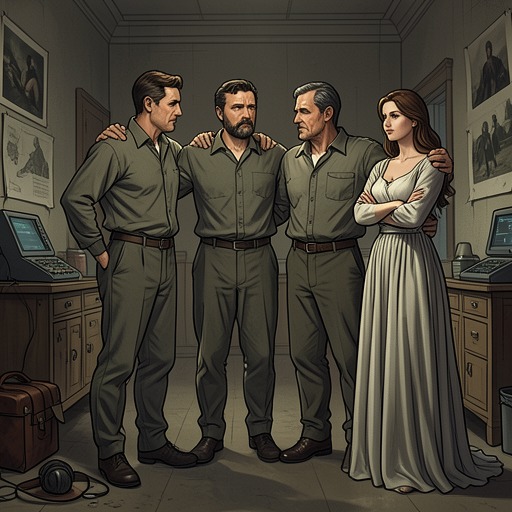
Insatiable Box Set: Books 1-4The Shared werewolf mate system is a reproductive and political arrangement that binds Adrienne Ward to the three Alpha brothers, Wilder, Lycell, and Drayton. Conceived as a way to preserve their dwindling clan without breaking the brothers’ pact of unity, it turns one woman’s fertility into a matter of shared family and pack governance. The story’s central tension lies in the gap between that collective design and Adrienne’s right to decide the terms of her own relationships.
Origins and Rationale
The arrangement grows out of two connected pressures: the brothers’ determination to remain together and a shortage of fertile female werewolves. Wilder wants a family but has not found a compatible female werewolf willing to accept his brothers as mates; most female werewolves, the narrative explains, are sterile. Because Wilder, Lycell, and Drayton are triplets and Alpha wolves, they regard themselves as inseparable. They share control of the territory inherited equally from their father and have sworn neither to force another out nor to destroy their bond over a mate. Their plan makes shared reproduction a solution to a problem that is at once intimate and political: a woman chosen by Wilder would also become the mother of the brothers’ pups and the means of sustaining their pack.
Consent and the Arrangement’s First Terms
The system is first presented to Adrienne Ward not as a settled marriage agreement but as Wilder’s explanation of what he believes must happen. He says that the snow has left her as the only female nearby and that he will soon have to mate. When she challenges his apparent lack of choice, he reveals that he is a werewolf. Later, he tells her that werewolves can sense when a female is fertile, a claim that makes his knowledge of her body part of the pack’s reproductive logic.
Wilder insists that Adrienne is neither prey nor captive and says she can come and go. But that freedom has a sharp limit: because she is pregnant, or may become pregnant, he says she cannot leave with the child. He warns that the Ari Kara clan might discover the heir and send someone to assassinate him. The arrangement thus joins protection to control from its outset. Wilder frames confinement as a safeguard for the pup, while Adrienne experiences the conditions as leaving her with little meaningful freedom to decide where she goes.
The stated plan also distinguishes between taking a woman and recruiting one. Wilder says he refused to capture human females because he feared that kidnappings would lead to the clan being hunted and destroyed. Instead, he established a council to address declining werewolf populations and hoped to attract women with money, allowing him and his brothers to meet potential mates. Some women chose to live with other pack members; Wilder waited for a particular partner. Under his proposed terms, she would mate with his brothers as well, but could leave if she did not want all three. Any pups she had with one of them, however, would remain. The language of choice is therefore real but bounded by a collective reproductive claim over the offspring.
Governance, Rivalry, and Adrienne's Choice
The brothers’ expectations of consent are neither uniform nor consistently honored. Drayton tells Adrienne that he and his brothers will not mate with her unless she wants them to, yet he also warns that her scent is difficult for Lycell to resist: Lycell has been with a female before and reacts strongly to the scent of a human woman. The warning places Adrienne’s presence inside a system governed not only by declared agreement but by the brothers’ assumptions about desire and restraint. Lycell makes the tension explicit when he threatens to take and defile her, then send her home with a pup her human family would reject. He uses the threat to intimidate her, not to describe a mutually agreed part of the arrangement.
Adrienne’s changing relationship with Lycell complicates the brothers’ initial plan without making her choice interchangeable with theirs. When she and Lycell look back at the cave where she had been with Wilder and her pups, she recognizes that her feelings for Lycell have shifted from indignation to attraction. She wants the brothers and their family, and asks when they will marry. Lycell answers that she can marry only one of them, even as he carries one of Wilder’s pups and she holds the other. He says the shared arrangement was Wilder’s idea and that, had he met Adrienne first, he would not have shared her. The exchange distinguishes a collective reproductive and household plan from a single legal marriage, while showing how each brother’s attachment presses against the pact.
That pressure becomes a direct dispute over who has authority to decide. Drayton reminds Wilder and Lycell that Wilder proposed having one female bear their pups, although the brothers initially doubted that the plan would work. He proposes that Adrienne choose whom she wants to marry and that her husband decide the next steps for the pack. Wilder counters that he is the pack’s Alpha, that Adrienne is his mate, and that he will marry her; Lycell argues that he should be the one because she is carrying his pups. Their positions make the system’s central contradiction visible: the brothers treat Adrienne’s reproductive role as shared, but each can still claim a distinct personal or political priority over her.
Adrienne asserts her authority in terms of both naming and choice. When Wilder asks what she wants, she demands an apology and insists that he use her name, Adrienne Ward, rather than call her merely a female. She then says she wants to marry Wilder, Lycell, and Drayton, crediting Lycell with changing her mind about becoming a mate to Wilder’s brothers; she also asks Wilder to send Mena away. Her declaration exceeds the one-husband limit Lycell has just stated, and the narrative does not collapse that conflict into a simple agreement. Instead, it places her expressed desire beside the brothers’ competing rules about mating, marriage, and pack authority.
The brothers eventually revise their governance to make their shared life more sustainable. Wilder acknowledges that living together while sharing a mate requires harmony, and agrees that they will share decision-making, with two council votes overriding one. He also concedes a special authority to Adrienne as the mother of their pack: she is to decide whom she wants to lie with and whom she wants to marry, although he maintains that she cannot marry all three. The compromise limits Wilder’s unilateral Alpha authority and gives Adrienne a defined choice, but it does not erase the difference between her power to choose a partner and the pack’s rules about the form that marriage may take.
The arrangement also meets resistance from outside the brothers’ household. Ramsey, Mena’s father, accuses Wilder of breaking a promise to marry Mena to one of the brothers and complains that Adrienne, a human woman, has been allowed to dictate werewolf laws. Wilder rejects Ramsey’s right to dictate to him and defends Adrienne as his mate, distinguishing his conduct toward Mena from the coercive treatment Ramsey implies. The confrontation shows that shared mating is not merely a private family compromise: it challenges existing expectations about who can arrange a woman’s marriage and whose authority governs the pack.
Law, Gender, and the Limits of the Pact
The shared-mate system sits within a wider werewolf order whose rules Adrienne accepts without fully understanding. Wilder has been taught those laws by his father and, as head of a pack extending across the Americas to Russia, is responsible for enforcing them. In that order, taking an Alpha’s mate is not simply a private betrayal: Bane’s abduction of Adrienne makes him a lawbreaker whom Wilder believes must be punished. The brothers’ pact therefore operates inside a hierarchy that protects mates while also treating mating and reproduction as matters of collective authority.
The gendered cost of that order is made clearer through Mena’s experience. She describes werefemales as living to serve the males of their pack, with their worth measured by whether they bear pups; her father had expected to arrange her marriage to Drayton, a more powerful Alpha. Her love for Robert and life as his wife mark a departure from that prescribed role. Adrienne’s refusal to obey Drayton when he says he will take her likewise astonishes Mena, who sees human women as independent and free. These contrasts expose the shared-mate system’s central instability: it grants Adrienne a stated right to choose, but that right has to be asserted against a culture that routinely assigns women’s partners and reproductive value from above.
The pact can thus be read neither as uncomplicated equality nor as a wholly fixed rule. Its terms shift when Adrienne names her own wishes and when Wilder yields authority to a council and recognizes her decision-making status, yet marriage remains restricted to one husband even while the brothers share her as a mate and organize the pack’s future around her. The arrangement preserves the brothers’ unity by making one woman central to their household and succession; at the same time, the story repeatedly tests whether that collective purpose can coexist with her individual consent. Its unresolved tension is the difference between being given a place in the pack’s law and having enough power to shape that law.