Single-female breeding strategy
Insatiable Box Set: Books 1-4The Single-female breeding strategy is Wilder’s population policy for werewolf packs in which female sterility has made ordinary reproduction precarious. A fertile female bears pups for multiple males, while other females help raise them; the arrangement is framed as a means of restoring pack numbers and preventing internecine violence. Its apparent practicality, however, carries a central tension: the welfare of the group can turn a woman’s fertility into a resource to be organized, even as the plan is said to depend on her agreement.
Origins in the fertility crisis
Wilder’s strategy grows out of a crisis he encountered while working to keep peace among werewolf packs. During a winter visit, a fever swept through a pack in Washington State. Many Werefemales died, and survivors became sterile. Male werewolves began slaughtering the remaining females, turning reproductive collapse into a cycle of violence. Wilder’s broader role had been to prevent Alphas from killing one another or the females in their packs; the crisis made clear that appeals to peace alone could not restore a dwindling population.
Wilder discovered that not every female was infertile. He brought in Dr. Wells and his team, paying them well to keep their work secret, and devised a system around the women who could still bear pups. Rather than treating each female as the exclusive mate of one male, the plan concentrated breeding around a single fertile female. Other females would nurture and protect the pups as their own. The arrangement therefore redistributed more than mating: it assigned the fertile woman the burden of gestation and made the wider female community responsible for the young.
The plan was not described as applying automatically to every pack. Other werewolves who needed to replenish their numbers could mate with the fertile female if she agreed; Wilder’s account says that she often did so for the good of her pack. Consent is thus part of the strategy’s stated operating principle, distinguishing the proposal from simply capturing women. At the same time, the collective urgency surrounding reproduction gives that consent a political weight: a woman’s decision affects not only herself but the survival prospects of an entire group.
From a pack policy to Wilder’s family plan
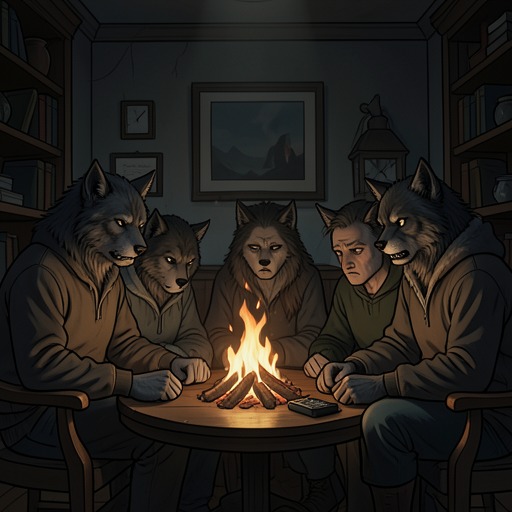
Wilder intends to adapt the same model to his own household. He and his brothers, Wilder Samsa, Drayton Samsa, and Lycell Samsa, are triplets and Alphas who have sworn to remain together and share the territory inherited from their father. Wilder wants a family, but has not found a compatible female werewolf; most Werefemales are sterile. The woman he chooses would also have to accept his brothers, and the brothers agree to trust his choice. If Wilder dies, the next brother in line would take the woman and marry her. In this family version of the strategy, reproduction, marriage, and succession are bound together.
The plan also explains Wilder’s resistance to bringing human women into the packs by force. He fears that kidnapping would expose the werewolves to human retaliation and possible destruction. Instead, he tries to attract women through money and the prospect of meeting the handsome Samsa brothers. At parties attended by women from several cities, Lycell’s notorious sexual appetite becomes part of the brothers’ reputation. Wilder later considers advertising in European newspapers for a bride, but the proposed notice describes a prosperous husband and a communal home with his brothers without plainly stating that the woman would have three husbands and bear their children. The recruitment campaign therefore offers an incomplete account of the arrangement it is meant to establish.
Adrienne and the limits of consent
Adrienne’s arrival turns Wilder’s general policy into an intimate and contested demand. In the wilderness, he explains that he will soon have to mate and that, because of the snow, she is the only female nearby. The statement presents mating as both an immediate biological necessity and a consequence of isolation. Adrienne challenges the apparent inevitability, asking why he has no self-control; she has not been given the information needed to understand the family arrangement before Wilder asserts his need.
Wilder’s later account makes clear that he sees a human woman as the only possible means of replenishing his own clan. He says he does not want simply to take Adrienne, but the surrounding circumstances complicate that assurance: she is dependent on him, his brothers expect her to accept them, and the pack’s customs make female refusal unfamiliar. Lycell warns that he could force himself on her and send her away carrying a pup, a threat that exposes how little protection the strategy’s language of family or population welfare can provide on its own. The contrast between the stated requirement of agreement and the threat of sexual coercion is central to the policy’s portrayal.
Wilder also tells Adrienne that she may leave if she does not want all three brothers, although any pups fathered by one of them would remain. This condition makes departure possible in principle while preserving the pack’s claim over offspring. Adrienne later insists on being addressed by her name and says that she wants to marry Wilder, Lycell, and Drayton. Her decision represents a change in her position, but the terms under which she reaches it remain shaped by dependence, pressure, and the brothers’ reproductive expectations. The narrative does not present her choice as proof that those pressures have vanished.
Political purpose and social cost
The strategy operates within a social order that measures female worth through reproduction. Mena’s account of werefemale life describes females as serving the males of their packs, dependent on the goodness of Alpha leaders, and valued for giving birth to pups. Against that background, a plan that saves a population can also reinforce the expectation that female bodies exist for population recovery. The shared work of nurturing pups broadens motherhood beyond the birth mother, but does not remove the unequal distribution of reproductive risk.
Wilder’s political decisions elsewhere show how readily mating becomes an instrument of pack security. Facing the possibility of war with the Oregon and Alaska packs, he tells Drayton that he must mate with Mena, explicitly setting peace above romantic love. He later sanctions Mena’s marriage to Robert, recognizing their relationship and offering Robert a place as the pack’s doctor. These arrangements are not identical to the Single-female breeding strategy, but they clarify the world in which it functions: partnerships can be expected to secure alliances, while personal attachment may redirect or resist those plans.
The strategy is therefore both a response to catastrophe and a source of conflict. It imagines cooperation among females as an alternative to killing and allows a dwindling pack to share responsibility for raising its young. Yet when Wilder transfers the model from a pack-level policy to his own family, its dependence on a single woman’s fertility becomes difficult to separate from pressure, secrecy, and control. Its significance lies in that unresolved contradiction: communal survival may require collective care, but the burden of making survival possible falls most heavily on the woman selected to bear the pups.