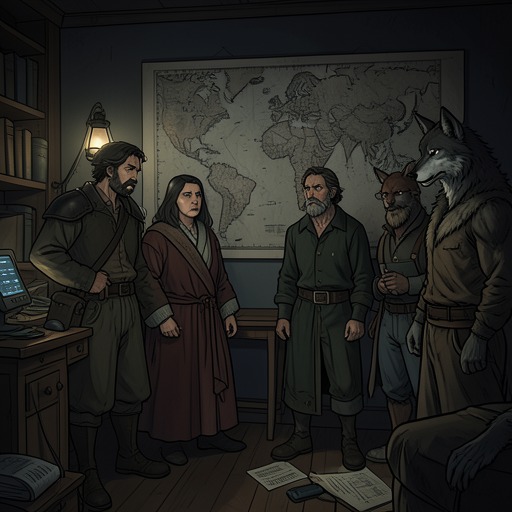
Werewolf Secrecy and Assimilation Code
Insatiable Box Set: Books 1-4The Werewolf Secrecy and Assimilation Code is the unwritten survival practice that allows werewolves to live within human society without revealing what they are. Shaped by generations of human hunting, it combines concealment with assimilation: packs disperse and remain small, while individual werewolves may become familiar, even prominent, members of human communities. The code preserves werewolf lives, but it also makes secrecy a condition of their social existence and influences the choices they make about territory, family, and reproduction.
Origins and Purpose
The practice arose from direct danger. Humans hunted wolves out of fear and because wolves competed with them for deer and elk. Werewolves could be mistaken for ordinary wolves and killed; large packs, meanwhile, risked drawing attention to the truth. The response was dispersal across the United States and the maintenance of small packs. Their concealment was not simply a matter of hiding in the wilderness: some werewolves integrated into human towns and became respectable citizens, sometimes holding positions such as businessman, mayor, or governor. In such communities, humans could not distinguish them from ordinary people.
The Samsa family history makes the pressures behind this arrangement especially clear. When the Alpha’s human mate gave birth to triplet pups, he sent the family to a rendezvous cave, where the parents could keep the pups safe and bring them food. As the sons grew, their father taught them to hunt. The family’s early separation and small-scale organization belonged to a wider effort to keep humans from discovering werewolves. Their father later became a respected member of society and was asked to run for governor of Nevada, a sign of how far assimilation could extend. Yet he retained his nature as a hunter and was eventually killed by a human. Respectability offered a way to live among humans, not immunity from human violence.
Practices of Concealment and Integration
The code operates through both collective organization and everyday discretion. Wilder and his brothers control territory across Nevada, Oregon, Washington, and Wyoming, as well as a small pack in Alaska. Their authority therefore spans a broad landscape, but their packs remain small in keeping with the historical need not to attract human attention. Wilder travels between packs, including visits to Oregon to hear their grievances; werewolf affairs continue across the territory even as the group’s public existence stays hidden.
Assimilation also depends on people who know the secret and keep it. The Samsa household’s cook and maid were sworn not to disclose that the father and sons were werewolves. The cook had helped deliver the triplets, and her long service made her part of the family’s hidden domestic world. She later brought her daughter into that work, teaching her how to prepare meals and to turn a blind eye to unusual signs, including large white wolves around the ranch. Their role shows that concealment is sustained not only by werewolves disguising themselves, but by trusted human staff who protect the boundary between private knowledge and public appearance.
Secrecy, Reproduction, and Human Contact
The code has consequences for mating and population policy. Wilder refuses to bring human women into the clan by capturing them because he fears that abductions would expose the werewolves and lead to their being hunted down and destroyed. Faced with widespread sterility among werewolf females and dwindling packs, he instead considers using money to attract women, allowing them to meet him and his brothers. This approach attempts to address the fertility crisis without abandoning the prohibition on forcible acquisition, although it still places human women within a reproductive plan designed to preserve the clan.
That plan rests on the Samsa brothers’ particular family arrangement. As triplet Alphas, Wilder, Drayton, and Lycell have vowed to remain together and share control of the territory they inherited; Wilder’s chosen mate is expected to be accepted by his brothers. Wilder’s discussion with Adrienne exposes the strain between a claim of personal choice and the demands of secrecy and succession. He tells her she may come and go, but argues that she cannot take a child away because the heir could be endangered if the werewolf world discovered his existence. The exchange presents concealment as both a collective safeguard and a constraint imposed on intimate decisions.
The Code’s Limits
The secrecy practice does not create a clean separation between human and werewolf worlds. Adrienne has read legends about werewolves integrated into human populations, yet initially dismisses the possibility that the stories explain what she encounters in the wilderness. The gap between public rumor and lived reality helps the werewolves remain unrecognized, but it also leaves humans without the knowledge to interpret their encounters accurately.
Nor does assimilation mean that werewolves cease to be animals or abandon their territorial lives. Wilder hunts, shifts into wolf form to travel through snow, and follows scent along a frozen river while pursuing Bane and Adrienne. Human social standing and animal capacities coexist rather than cancel each other out. The code’s central tension follows from that doubleness: werewolves can participate in human society, but their survival still depends on secrecy, pack discipline, and practices shaped by hunting, territory, and the threat of discovery.