Werewolf reproduction and pups
Insatiable Box Set: Books 1-4Werewolf reproduction and pups are not a private subplot but the organizing logic of the Samsa family’s future. Fertility determines the worth of potential mates, pregnancy becomes a source of protection and confinement, and children are treated simultaneously as beloved offspring, heirs, and the numerical strength of a werewolf pack. Through Adrienne Ward’s pregnancy and the brothers’ shared reproductive plan, the novel makes biological continuity inseparable from marriage, territory, succession, and inter-pack politics.
Fertility, Compatibility, and Pack Survival
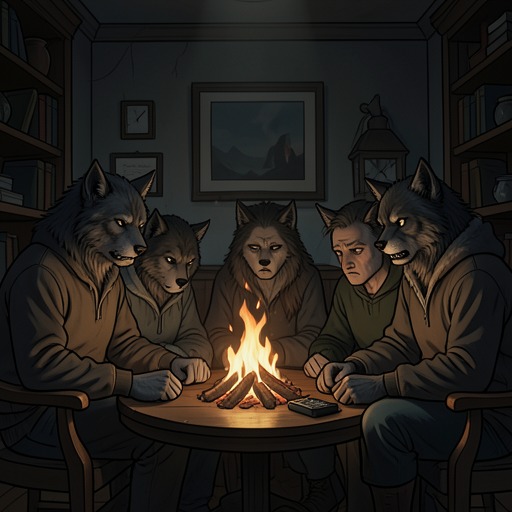
The reproductive crisis begins with the Samsa brothers’ unusual family structure. Wilder, Drayton Samsa, and Lycell Samsa are triplets, all Alpha wolves, and have sworn to remain together while ruling the territory inherited from their father equally. Wilder wants a family but has found no Werefemale compatible with him. The problem is not simply the absence of a suitable romantic partner: most Werefemales are sterile, and the brothers believe that a strong pack requires one fertile female capable of bearing all their pups. Because the brothers are inseparable, Wilder’s choice of mate must also serve as a decision about the future of the entire sibling unit.
The brothers therefore establish a reproductive succession arrangement around Wilder’s authority. They agree to accept whichever female Wilder selects and to mate with her, trusting him as the head Alpha. If Wilder dies, the next brother in line will take the woman and marry her. Reproduction is thus linked to inheritance: the mate is not only a companion but also the bearer of the next generation and a figure whose position must survive the death of an Alpha. The possibility that Wilder might die while wounded makes the succession rule immediately practical rather than theoretical.
Wilder’s policy is presented as an alternative to abduction. He has created a council to consider the declining birth rate among the clans and has refused to capture human females, fearing that the kidnapping of women would expose the werewolves and bring hunters against them. Instead, he and his handsome brothers attempt to attract human women with money and the promise of joining the pack. Some women leave to live with other pack members, but Wilder waits for a female he considers the right one. This policy appears less violent than forced capture, yet its underlying purpose remains reproductive: the women are sought because the werewolves need fertile bodies to replenish their clans.
Adrienne Ward’s Pregnancy and the Were-Child
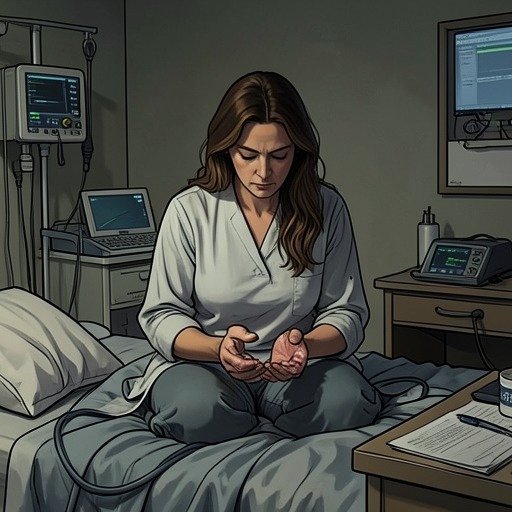
Wilder’s relationship with Adrienne changes when he identifies her as a reproductive solution as well as his mate. He tells her that he will soon have to mate and that, because snow has isolated the region, she is the only female available. When he reveals that he is a werewolf, the disclosure also clarifies the biological logic behind his urgency. He claims that werewolves know when a female is ready to conceive, and he interprets Adrienne’s body as evidence that she is carrying his were-child.
Adrienne does not initially accept this interpretation. She insists that she will leave Wilder and the pup, and she questions what he means by pregnancy. Wilder answers that she is carrying his were-child and that, after this child is born, she will carry his brothers’ pups until they have their own family and a large pack. The statement turns one pregnancy into a projected sequence of pregnancies. Adrienne’s body is imagined as the common reproductive center of the brothers’ household, while the children are assigned to the family before they are even born.
Wilder also claims that werewolves can determine when a female is ready to conceive, giving pack knowledge priority over Adrienne’s own uncertainty. He denies that she is a captive and says that she may come and go, but he simultaneously argues that pregnancy makes departure dangerous and that she cannot take the pup with her. He warns that the Ari Kara clan might discover the child and send someone to assassinate it because the child would be his heir. The child’s danger therefore becomes the reason for restricting Adrienne’s movement, while the unborn pup becomes a political target whose existence could alter the balance of power.
The reproductive arrangement is repeatedly framed through Adrienne’s resistance. Drayton tells her that she may have three or four pups at once, and later warns that she could have as many as six. Adrienne had read books in the cave describing werewolf reproduction but assumed they were nonsense; the revelation that the information applies directly to her makes the books an instrument of foreshadowing and delayed understanding. Her pregnancy is consequently not a single concealed fact but a series of discoveries that repeatedly expands the scale of what has been planned for her body.
The Planned Pack and the Birth of Pups
Wilder calculates reproduction in explicitly demographic terms. He estimates that if Adrienne bears two or three pups with each brother every seventy days, the brothers could establish their own packs. He imagines five pregnancies in a year, producing two pups for each brother and perhaps four for himself, and believes that a large pack—especially one filled with male pups—would be strong enough to prevent rivals from claiming or testing his territory. The arithmetic transforms intimacy into population planning. Each pregnancy is counted as a contribution to territorial defense, each pup as a future member of an armed social body.
At the same time, the calculations reveal Wilder’s emotional longing. He looks at Adrienne and plans for the first time not to remain a lone wolf. Reproduction promises him a mate, children, and a family, while the projected pack promises security and political strength. The desired household is therefore both domestic and militarized: the same pups who fulfill a personal dream also supply the numbers by which an Alpha measures survival.
The birth of Adrienne’s first children gives the reproductive plan a tangible form. She lies holding two infants, while Lycell Samsa recognizes that they will later turn and become werewolves. Wilder has prepared a large chest in the cave with clothes for Adrienne and the babies, along with blankets and milk bottles. The supplies show that he expected more than one child and had prepared for the practical demands of a multiple birth even while leaving Adrienne without full knowledge of what he anticipated. Lycell, initially bewildered by the labor and by his own half-human response to it, helps cut the cords, obtain water, and keep the mother and infants warm and clean.
The children are described as a mixed inheritance: half human and half wolf. Their bodies therefore extend the boundary between species rather than simply reproducing one side of it. Lycell’s bond with Adrienne is also projected into the future through her possible children. He believes that she will one day bear his pups and that the bond between them will keep her needing his protection. In this vision, reproduction completes the Samsa family’s transformation into a pack-family, but it also assumes that pregnancy will secure Adrienne’s continued attachment.
Marriage, Consent, and Political Reproduction
The reproductive system initially rests on an expectation that Adrienne will accept all three brothers. Wilder explains that the brothers have agreed to mate with the woman he chooses because they trust his judgment, and Drayton later makes clear that the household imagined its chosen human female as the mother of all their pups. Yet Adrienne’s responses expose the difference between the brothers’ internal customs and her understanding of consent. Lycell tells her that Wilder ordered her to remain until the child is born, and in a threatening confrontation he says that he could take and defile her before sending her home with a pup that human society would not accept. His threat reveals the coercive underside of the reproductive arrangement more starkly than Wilder’s language of choice.
Adrienne nevertheless eventually asserts a different form of agency. When Wilder kneels and asks for forgiveness, she demands an apology, insists that she be called by her name rather than merely “female,” and says that she wants to marry. Her request is not for Wilder alone: she asks to marry Wilder, Lycell, and Drayton. She attributes the change in her mind partly to Lycell and also demands that Mena be sent away. The decision turns the brothers’ reproductive expectation into a formally chosen shared relationship, although the earlier threats, hidden information, and unequal power continue to complicate the meaning of that choice.
Reproduction also intersects with political marriage beyond Adrienne. Wilder tells Drayton that he must mate with Mena, not because Drayton loves her, but because the union is necessary to prevent war. The Oregon and Alaska packs are too strong for the Samsa family to confront alone, so a reproductive or marital alliance is proposed as a means of preserving werewolf stability. Wilder later sanctions the marriage between Mena and Robert, recognizing their love and allowing them to marry when Drayton and Adrienne marry. Mena’s relationship demonstrates that the family’s reproductive politics can be redirected: a match originally imagined as an Alpha alliance becomes a marriage between Mena and a human doctor whom she loves.
Mena’s history also provides a contrast with the Samsa arrangement. Werefemales are described as living to serve male pack members, with their value measured by their ability to give birth and their marriages arranged by their fathers. Mena had been expected to marry a more powerful Alpha, but she falls in love with Robert, and her life changes when that relationship is recognized. Adrienne’s refusal to let Drayton decide where she will go likewise contrasts human female independence with the submissive status assigned to Werefemales. The reproductive order is therefore challenged from within by women who insist that marriage and bodily allegiance cannot be reduced to pack calculations.
Biological Continuity and Political Stakes
The concept of werewolf reproduction reaches beyond individual births because every pregnancy changes the distribution of power. Wilder’s anticipated pups are heirs who may be targeted by the Ari Kara clan; the brothers’ projected children are the numerical foundation of their own packs; and Drayton’s compulsory union with Mena is presented as a measure intended to prevent war. Reproduction supplies the answer to the werewolves’ declining population, but it also creates new claims over women, children, territory, and succession.
The narrative repeatedly places reproductive vulnerability beside predation. Adrienne first encounters a wounded white wolf while starving in the wilderness, and later Wilder stands between her and a female bear, risking his life to protect her. Lycell is attacked by a black bear while his attention is consumed by thoughts of Adrienne, and his injuries interrupt the rescue movement surrounding her. These encounters establish a world in which bodies are exposed to hunger, territorial defense, and violent selection. Against that background, the unborn pup is both fragile life and a coveted continuation of the pack.
Werewolf reproduction and pups thus carry a double significance. They express the Samsa brothers’ desire to end isolation and create a family, while also exposing a system that treats fertility as a scarce political resource and pregnancy as evidence of belonging. Adrienne’s children make human-werewolf kinship possible, but the path to that kinship is marked by concealment, reproductive pressure, threats from rival clans, and competing definitions of consent. The pups are the promise of continuity; they are also the means through which the novel shows how a threatened community can turn intimacy into governance.