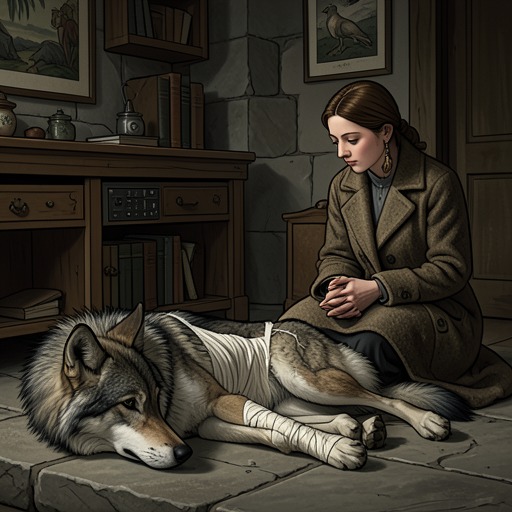
Werewolf transformation
Insatiable Box Set: Books 1-4Werewolf transformation is the ability of the werewolves to pass between human and wolf forms, but the novel does not treat that change as a simple disguise. It governs how they hunt and survive, makes their animal instincts visible within intimate and violent encounters, and marks the boundary between human society and a hidden werewolf population. Wilder’s shifts can be deliberate, yet the change may also become difficult to resist; through that tension, transformation becomes a bodily expression of the story’s recurring conflict between human choice and wolf nature.
Identity and Place in the Hidden World
Adrienne Ward has heard stories about families in the region who have lived among humans for centuries and become respectable citizens, including businessmen, mayors, and governors. In the wilderness, she initially dismisses the legends. Wilder’s revelation that he is a werewolf turns those stories into an explanation for the world she has entered: outwardly human lives can conceal another form and another social order, one that ordinary humans cannot readily distinguish from their own.
For Wilder, transformation belongs to a life divided between ranching, pack leadership, and the wild. He and his brothers control territory across Nevada, Oregon, Washington, and Wyoming, as well as a small pack in Alaska. When the moon is full, Wilder takes wolf form to hunt and maintain survival skills. He also ranges alone through the western states, visiting packs and hearing their grievances. The wolf form is therefore not only a secret identity or a threat; it is part of the practical work through which he sustains himself and exercises authority.
Control, Instinct, and the Body
The cave scenes establish that transformation can be purposeful while still carrying a force of its own. When Wilder finds Adrienne shaking from the cold, he changes into a wolf and lies beside her, using his thick fur to keep her warm and protect her from frostbite. When she wakes and screams at the sight of the large white wolf, his body begins changing toward human form. He tries to stop the change, but at this stage it proves impossible; his instincts take over, and he reverts to wolf form before changing into a man again. The sequence presents transformation as a bodily process that does not always obey conscious intention.
The sound of Adrienne’s scream affects Wilder differently from the howls of the females in his pack. Rather than provoking the same response, it has a calming effect and awakens a wish to protect her. He completes the change to human form and covers her mouth to keep her from calling other wolves to the cave. His shifting thus occurs within a relationship: the same animal nature that makes him dangerous also shapes his response to her, while his human form lets him speak and act to manage the immediate danger.
The instability between self-command and instinct becomes more threatening during intimacy. Wilder’s wolf nature begins to take hold, and he calms himself to control it. Later, however, his strength and the force of the wolf within him dominate the encounter; Adrienne feels that she cannot stop him once she has committed to him. The narration explicitly casts him as a dangerous predator and her as prey, making the transformation more than a physical change of appearance. It exposes the coercive danger in a world where a werewolf’s bodily urges and power can overwhelm a human partner’s ability to refuse.
Transformation in Conflict
The transformation is also a visible change in the balance of power during a confrontation. A black werewolf who has taken Adrienne captive turns toward her, his body changing until he stands on all fours. His dark fur appears, his face becomes a wolf’s head, and he bares his teeth and growls. Adrienne observes that his size and the strength of his shoulders and legs exceed those of Wilder or Drayton. The shift makes the captive’s physical danger unmistakable: the werewolf is no longer merely a man threatening her but a large predator moving toward her.
A brown wolf rushes into the clearing and attacks the black wolf from behind. The attacker lands in the fire, shakes off the flames, and charges again despite the pain and the smell of singed hair. Adrienne recognizes him as Lycell. His raised posture, snarl, and Alpha howl turn the confrontation into a challenge between werewolves, and the black wolf identifies the conflict as one with Wilder. Lycell answers that an attack on his brother makes it his fight too. In this scene, wolf form carries both physical force and social meaning: the bodies clash, but their conduct also expresses allegiance and Alpha standing.
Law, Kinship, and Human Choice
Werewolf customs give transformation consequences beyond individual encounters. Wilder tells Adrienne that werewolves can know when a female is fertile and that she is the only female nearby during the snow. After mating, he says that she is his mate and may come and go, but should not leave while pregnant because the pup would be in danger. He also fears that the Ari Kara clan might send someone to assassinate the child, who would be his heir. The law and politics attached to werewolf reproduction therefore shape Adrienne’s freedom, even though she is human and does not fully understand the rules governing her.
The brothers’ authority is contested through those customs. Wilder asserts that he is the Alpha male and will marry Adrienne; Lycell claims that she is carrying his pups and argues that this gives him a claim as well. When Ramsey accuses Wilder of breaking a promise concerning Mena and objects to a human woman influencing werewolf law, Wilder defends his authority and rejects Ramsey’s disrespect toward his mate. These disputes show that bodily transformation takes place within a hierarchy of Alphas, mates, heirs, and pack obligations; the wolf form is one part of an order that also assigns social claims to bodies and relationships.
Adrienne’s insistence on being addressed by her name and on choosing whom to marry offers a counterpoint to that order. Mena, raised under rules in which werefemales serve males and their value depends on bearing pups, recognizes Adrienne’s independence as unfamiliar. She has since become Robert’s wife, while Drayton loves Adrienne rather than becoming Mena’s assigned mate. The contrast shows that werewolf identity does not erase the differences between human and pack law, or the possibility of resisting the roles imposed by the latter.
Meaning and Limits of the Change
By the time Wilder leads a pack stretching from the Americas to Russia, he is responsible for enforcing laws learned from his father and internalized across generations. Those laws demand punishment when Bane kidnaps an Alpha’s mate. Wilder must hunt the pursuer who is hunting him, and the conflict is framed as a struggle in which he can kill or be killed. The story’s language of the hunter joins the reasoning man to the single-purpose wolf: Wilder can reason, but his pursuit of Bane is narrowed by the same predatory drive that defines Bane’s fixation on Adrienne.
Transformation consequently remains double-edged. It enables hunting, warmth, defense, and the exercise of pack power, but it can also make restraint precarious and expose the violence embedded in werewolf customs. The movement between forms does not settle the conflict between human and animal; it makes that conflict legible in bodies, relationships, and law. Adrienne’s effort to assert consent and choice matters precisely because the werewolves’ physical capacities and inherited rules can make those choices difficult to protect.