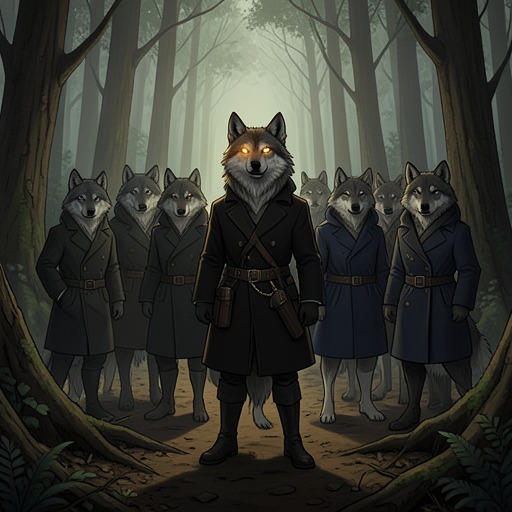
Wilder brings Adrienne back to the new forest home
Insatiable Box Set: Books 1-4Wilder brings Adrienne back to a new forest home after her captivity by Bane, but the return does not restore domestic security. He delivers her to an impressive cabin in a snowy clearing and calls it their home, while Adrienne, exhausted, hungry, pregnant, separated from her children, and angry at his jealousy, rejects the claim that a place built for her without her consent can become hers. The event therefore converts shelter into a contested symbol: for Wilder it is an offering and the physical form of a permanent bond; for Adrienne it is another decision made about her life by someone else.
Arrival at the Forest Cabin
Wilder slows the truck, leaves the main road, and drives into pitch-dark woods before reaching a gravel road lit by LED lamps. The lamps surround a large cabin standing in a clearing amid falling snow. Pine trees ring the property, and the quiet winter landscape is further emptied by the presence of a werewolf, whose scent keeps smaller animals away. Adrienne wakes as the truck hits a bump and sees the cabin, its redwood timber, second-floor balcony, and broad panoramic windows. The setting is secluded, substantial, and carefully prepared, yet its remoteness also recalls the wilderness from which she has repeatedly needed escape and rescue. Wilder greets the destination with the uncomplicated declaration that they are home. Adrienne answers that it is not her home. His next revelation explains the emotional and legal conflict at the center of the event: he built the cabin for the two of them, without consulting her, Drayton, or Lycell. The structure is thus both material proof of intention and evidence of unilateral authority. Its impressive scale cannot settle the question of belonging, because Wilder has constructed a future before Adrienne has agreed to inhabit it.
Adrienne’s Refusal and Material Vulnerability
Adrienne agrees to look around only because she is hungry and exposed to the cold, and she explicitly says that she is not staying. She has been away from her children for more than a week, has not eaten decent food, and now doubts the man or werewolf she once believed she loved. Her condition makes the apparent welcome materially coercive even though Wilder presents the cabin as protection. Hunger, pregnancy, snow, and exhaustion narrow her immediate choices; cooperation becomes a practical necessity rather than an acceptance of Wilder’s plan. The threshold dramatizes that refusal. Wilder opens the door and offers to carry her over it, imagining the gesture associated with a bride entering a husband’s house. Adrienne walks inside instead and reminds him that the custom belongs to married couples. She is married to Drayton, she says, and Wilder is not exactly a man or a husband. Her words wound Wilder because the cabin was meant to make his desired domestic role visible, while her response exposes the gap between his werewolf claim and her human understanding of marriage.
Matehood, Marriage, and Conflicting Law
Wilder answers that he is Adrienne’s true mate and therefore has more rights to her than Drayton or Lycell. His certainty rests on the werewolf system of matehood, reproduction, and protection. Earlier, he had told Adrienne that she could come and go and was not his captive, but also that pregnancy made departure dangerous: she could not take the pup with her because the Ari Kara clan might discover the child and assassinate it as his heir. The language of protection consequently carries a restriction. Adrienne is declared free in principle while her pregnancy, the child’s political value, and Wilder’s authority limit what leaving can mean. The cabin also follows an earlier dispute within the Samsa family. Wilder had asserted that he was the Alpha male and that Adrienne was his mate, so he would marry her. Lycell objected that Adrienne was carrying his pups and that he should be the one to marry her, while Drayton had proposed allowing Adrienne to choose whom she preferred. These competing claims show why the new home cannot be treated as a private romantic gesture alone. Adrienne’s body, marriage, children, succession, and protection are being interpreted through overlapping human and werewolf systems. Ramsey’s confrontation with Wilder makes the cultural conflict explicit. Ramsey accused the Samsa brothers of breaking a promise to his daughter and allowing a human female to dictate their laws. Wilder rejected Ramsey’s authority and defended Adrienne, insisting that she had not been defiled. In Wilder’s view, however, Adrienne remains subject to the werewolf order in which he must protect his mate and enforce inherited laws. Adrienne herself accepts some werewolf customs without fully understanding them: she does not comprehend their hunting practices, their morality, or the laws internalized through generations and taught to Wilder by his father. The forest home is therefore built at the intersection of protection, possession, family governance, and cultural translation.
The Unresolved Homecoming
Adrienne’s challenge to Wilder is not merely that he failed to ask permission. She reminds him that he once promised the brothers would share her equally and that he would not become jealous. She has taken her position as their mate seriously after that arrangement came to fruition, but Wilder now admits that his earlier promise belonged to a time before he loved her as he does now. His feelings have changed from a principle of shared partnership into a claim of emotional priority. The new cabin gives that change a permanent architecture, while Adrienne’s resistance prevents the architecture from becoming a settled household. Wilder’s attachment is inseparable from the danger surrounding Adrienne. Bane has abducted an Alpha’s mate and continues to desire Adrienne as his own mate; under the werewolves’ inherited law, Wilder must hunt the pursuer and risk being killed. He understands himself as both man and wolf, capable of reason but driven toward a single purpose. Bringing Adrienne to the secluded cabin is therefore part of a larger effort to secure her and prepare for conflict, not simply a peaceful return. Yet the more fiercely Wilder treats her as the center of his legal and biological obligations, the more sharply Adrienne experiences his certainty as jealousy and control. The event ends without reconciliation. Adrienne enters the cabin, but she does not consent to remain in it or accept Wilder’s definition of their relationship. She walks on in search of the kitchen because pregnancy and hunger have overcome her strength, while Wilder’s declaration of love and mate-right fails to erase her anger. The cabin stands as an unfinished promise: a home physically completed by Wilder but emotionally and politically unratified by Adrienne.
Narrative Significance
The episode reverses the expected meaning of rescue and return. After surviving Bane’s captivity, Adrienne reaches safety, but safety is not identical with freedom. Bane’s methods are openly brutal: he ties her hands, ankles, and waist to a crude chair and tells her that an attacking animal might eat her if he failed to return. Wilder’s forest home is radically different in physical purpose, yet Adrienne’s suspicion remains understandable because Wilder also makes decisions about her movement, pregnancy, marriage, and children without securing her agreement. The contrast distinguishes forms of domination without pretending that protection automatically satisfies autonomy. At the same time, the cabin gives material form to Wilder’s transformation. He had moved among packs without choosing a female, but after mating with Adrienne, seeing her return his love, and witnessing her give him sons while mating with his brothers for the family’s good, he believes he has found his one true love and lifelong mate. His building project is the concrete expression of that conviction. Its significance lies in the value shift it produces: what Wilder experiences as home, permanence, and devotion becomes for Adrienne another contested threshold where love must answer to consent, prior marriage, family law, and the right to choose a future.