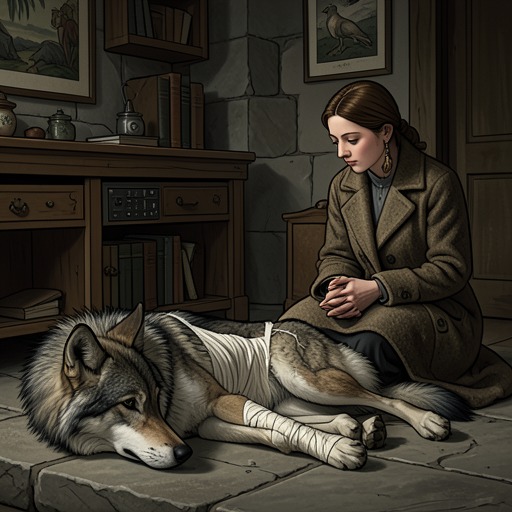
Wolfman
Insatiable Box Set: Books 1-4Werewolves are the novel’s central nonhuman society and its most consequential challenge to the boundary between person and beast. They can pass as respectable human citizens while retaining animal bodies, instincts, senses, diets, territories, and pack obligations. Their hidden existence makes Adrienne Ward’s first sight of a bloodied white wolf seem at first like a wilderness danger, but the encounter eventually reveals an organized people whose laws and reproductive crisis govern nearly every major relationship in the story.
Identity and Hidden Society
Werewolves are presented as beings who can integrate into human communities so completely that humans may mistake them for ordinary businessmen, mayors, governors, or other respectable citizens. Adrienne Ward remembers having read legends about families who had lived in the region for centuries and had entered human society without being recognized for what they were. She initially dismisses the idea as myth, even while a large white wolf crosses her path at extraordinary speed and cries nearby. The apparent folklore is therefore not an invented superstition within the story but a concealed social reality.
Their secrecy developed under direct pressure from human violence. Wilder recalls that humans hunted and destroyed wolves out of fear and because wolves competed with them for deer and elk. The contrast between the species’ motives is explicit: humans often killed for sport without eating what they killed, whereas wolves killed to survive. Because humans would hunt werewolves without knowing that they were more than ordinary wolves, the werewolf population could not safely maintain large packs. Families dispersed across the United States, kept their groups small, and entered human towns while concealing their nature.
The Samsa family embodies this adaptation. Wilder, Lycell Samsa, and Drayton Samsa were born as triplets into a werewolf pack, but their human mother and Alpha father raised them in a concealed cave and taught them to hunt. Their father was respected enough to be asked to run for governor of Nevada, yet his continued attachment to the hunt exposed him to human danger and ended in his death. Their mother, unable to live without him, died in the wilderness during the worst snowfall of the year. The brothers inherit not only territory but also the burden of preserving a people forced to appear human in order to survive.
Bodies, Transformation, and Animal Life
The werewolf body is defined by continual movement between human and wolf forms rather than by a stable division between the two. Wilder’s transformation is physically painful: his long, powerful hind legs become human legs, his forty-two teeth dissolve into human teeth, and his animal body becomes a naked human one. He tries to remain in one form whenever possible, but circumstances repeatedly force him to change. When Adrienne Ward is freezing, he returns to wolf form so that his thick fur can protect her from frostbite; when she wakes and screams at the sight of the white wolf, his body begins to change, but his animal instinct prevents the transformation from completing normally.
Transformation is also tied to work, survival, and social role. At the Samsa ranch, Wilder and his brothers spend much of their time in human form, entertaining guests and maintaining their human lives. Under the full moon, Wilder assumes wolf form to hunt and preserve the skills necessary for survival. He travels quickly as a wolf, hunts elk, deer, bear, and other animals, and describes himself as a lone wolf when outside his territory. The brothers control territory across Nevada, Oregon, Washington, and Wyoming, as well as a smaller pack in Alaska, making the werewolf body inseparable from geography and political authority.
Animal perception and behavior are not ornamental features of this society. Werewolves identify pregnancy through scent, recognize one another’s condition through smell, and respond to bodily signals that human medicine cannot explain. Drayton Samsa tells Adrienne Ward that she is carrying Wilder’s pups because he can smell both her pregnancy and Wilder’s presence on her. The werewolf body thus supplies its own knowledge system, one that repeatedly conflicts with human categories of consent, marriage, pregnancy, and morality.
The story also places werewolves within a wider multispecies environment. Wilder fights a female bear to protect Adrienne Ward, carrying her back to the cave in his jaws as he would carry a wolf pup. He hunts for meat, distinguishes sharply between preferred animals, and treats the cave as both den and household. Drayton Samsa favors rabbit, Wilder prefers deer and dislikes the smell of rabbit, while Lycell Samsa eats almost anything. Their food practices and animal capacities make the human household porous: the ranch’s cook and maid must ignore the large white wolves that move around it, while their labor helps the brothers maintain a human appearance.
Pack Law, Kinship, and Reproduction
Werewolf society is organized through Alpha hierarchy, territorial control, and an unusually collective model of mating. Wilder is the eldest and first-born Alpha of the Samsa brothers, while Lycell Samsa and Drayton Samsa are equally Alpha wolves. The brothers have sworn to remain together, govern their inherited territory equally, and neither destroy nor drive out another. Their pact makes the family a political unit as much as a biological one.
Wilder’s choice of a mate carries consequences for all three brothers. The brothers agree that whichever female Wilder selects will be accepted by the others because they trust his judgment as the head Alpha. The selected female is expected to mate with the brothers and bear their pups, preserving both the family’s unity and the pack’s future. If Wilder dies, the next brother in line would inherit the mate and marry her. This succession rule turns intimacy into an institution of inheritance, while the shared arrangement protects the brothers from the fragmentation that would follow if a mate belonged exclusively to one of them.
The system arises from a severe fertility crisis. Most werewolf females are sterile, and inbreeding has worsened the inability of the packs to reproduce. Wilder establishes a council to address the decline, but he refuses to kidnap or capture human females. He fears that abducting women would expose the werewolves to human pursuit and lead to the destruction of his clan. Instead, he and his attractive brothers attempt to meet women through the lure of money and allow them to choose whether to remain with the pack. Some women leave, while Wilder waits for a female he considers suitable and fertile.
Adrienne Ward becomes decisive because she is human, fertile, and perceived as capable of carrying the brothers’ children. Wilder tells her that she is free to come and go, but insists that she cannot take the child if she leaves because the Ari Kara clan might discover the pregnancy and assassinate the heir. The statement exposes the contradiction at the center of werewolf law: the werewolves distinguish between prey and captive, yet reproductive danger and inheritance allow them to restrict a mother’s movement and claim authority over her child.
The pregnancy reorganizes the Samsa household. When Wilder leaves supplies in a chest at the cave, he includes clothing for Adrienne Ward and the babies, bottles, and blankets because he has already concluded that she will have more than one child. Adrienne Ward ultimately gives birth to two infants, and Lycell Samsa, initially panicked by the labor, cuts the cords, fetches water and clean clothes, and helps keep the newborns warm. The infants appear human at birth but are expected later to transform into werewolves, making reproduction the literal production of a hybrid family and the continuation of the hidden people.
Human Law and Werewolf Authority
The novel repeatedly places human law beside werewolf law without allowing either system to become universally authoritative. Wilder declares that Adrienne Ward is his mate and that he will marry her, while Drayton Samsa argues that she should decide whom she wants to marry. Adrienne Ward eventually chooses a marriage to Wilder, Lycell Samsa, and Drayton Samsa, explaining that Lycell changed her mind, and she also demands that Mena be sent away. Her decision does not erase the pack’s structure, but it gives a human woman an acknowledged role in determining the form of the shared union.
The same conflict appears when Ramsey objects that Wilder has broken a promise concerning his daughter Mena and asks when the Samsa brothers began allowing a human woman to dictate their laws. Wilder answers through Alpha authority, defending his mate and rejecting Ramsey’s claim to command him. Yet the pack’s political needs later override romantic preference. Wilder tells Drayton Samsa that he must mate with Mena, even though Drayton does not love her, because the arrangement is necessary to prevent war with the Alaskan and Oregon packs. Mena’s marriage becomes a political alliance rather than a private choice, while Adrienne Ward’s marriage is treated as both personal and dynastic.
The werewolves’ law also regulates violence and captivity. Bane’s treatment of Adrienne Ward exposes a rival and more coercive version of pack authority: he binds her hands, ankles, and waist to a crude chair and tells her that if a wild animal enters the cave she will be unable to flee. He presents himself as the one who would hear her scream and perhaps avenge her death, reducing protection to another form of possession. Wilder later understands Bane’s act as the kidnapping of an Alpha’s mate and therefore as an offense requiring punishment under werewolf law.
At the same time, the pack’s internal codes contain prohibitions that distinguish werewolf justice from simple predation. Ramsey accuses the Samsa brothers of dishonoring Mena, but Wilder insists that she was not defiled even though he claims he could have done what he wanted to her. The assertion reveals a legal order that recognizes some limits on sexual violence while still placing extraordinary power in the Alpha’s hands. Human morality, werewolf custom, mate claims, marriage, and reproductive necessity therefore overlap without becoming identical.
Narrative Significance and Continuing Conflict
Werewolves give the novel its governing tension between civilization and wilderness, but the text refuses to place civilization wholly on the human side. The werewolves hunt, eat meat, and obey bodily instinct, yet they also govern territories, arrange marriages, maintain staff, form councils, practice secrecy, and participate in human politics. Conversely, human society is not presented as uniformly humane: humans hunt wolves for sport, fail to locate Adrienne Ward in the wilderness, and remain unable to understand the hidden society around them.
The creature is consequently both a literal species and a system of kinship. The Samsa brothers’ unity pact, the scarcity of fertile werewolf females, the expectation that one woman may bear all their pups, and the succession of a mate after an Alpha’s death turn reproduction into political infrastructure. Adrienne Ward’s marriage choice, pregnancy, and children do not merely add a romantic family to the plot; they alter the boundaries of the pack and make human-werewolf integration a practical solution to extinction.
The final conflict concentrates the werewolf’s dual nature in Wilder. He understands that Hunter Samsa and Devin Samsa will eventually leave to find mates according to werewolf custom, yet he also recognizes that Adrienne Ward is his mate for life and must be protected. He is head of a pack whose reach extends from the Americas to Russia, and he must enforce the law against Bane, who has kidnapped an Alpha’s mate and become fixated on mating with her. Wilder is therefore both man and wolf: capable of reason, but driven toward the single purpose of the hunt. His confrontation with Bane makes that duality the story’s central moral and political condition, expressed through the stark alternative that he must kill or be killed.