Adrienne Ward's captivity
Insatiable Box Set: Books 1-4Adrienne Ward’s captivity is not a single imprisonment but a recurring struggle over who may decide her movements, relationships, and reproductive future. Wilder and the Samsa brothers present restriction as protection and family duty; Bane makes confinement overtly physical and threatening. Across these different settings, Adrienne contests the idea that being claimed as a mate, carrying a possible child, or living under pack law cancels her right to choose.
Origins and Competing Claims
Adrienne’s first confinement begins in the wilderness, where snow leaves her as the only nearby female and Wilder says that he will soon have to mate. His disclosure that he is a werewolf changes the meaning of their isolation: what Adrienne has treated as an alarming situation between two strangers is, to Wilder, bound up with mating and pack expectations. Later, when he tells her that he knows she will conceive, she accuses him of having tricked her and describes herself as a captive audience. The cold keeps her close to him, but proximity does not amount to consent to the claims he makes about her future.
Wilder denies that Adrienne is captive, arguing that she can come and go. Yet he immediately qualifies this freedom: if she is pregnant, she cannot take the child away because the Ari Kara clan might send someone to assassinate his heir. His language turns a stated choice into a conditional one, with the danger to the child serving as the reason Adrienne must remain. The contradiction is central to her condition: she is told she is free while being warned that exercising that freedom could mean leaving a child behind or exposing it to danger.
The stakes of this dispute are sharpened by Adrienne’s human medical history. A year earlier, after Paul’s frat brothers assaulted her while Paul was passed out in another room, she woke in a hospital and was told she could never have children. Paul and her parents wanted the incident kept quiet; Paul called it an incident and insisted that they never speak of it again. Wilder’s certainty that she is pregnant therefore collides not only with her resistance to his control but with a diagnosis and a past in which other people had already shaped what could be said about her body.
The Ranch: Protection with Conditions
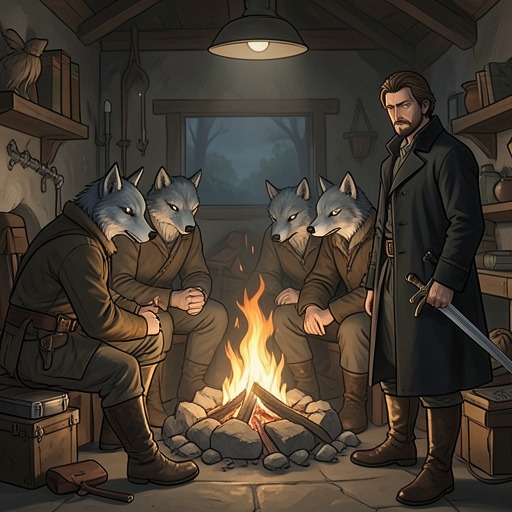
At the Samsa ranch, Adrienne’s confinement becomes less a matter of isolation than of competing male claims. Wilder says she must stay until his child is born, and Lycell threatens that after she gives birth to Wilder’s pup, she will be his to take. Adrienne answers by identifying herself as Wilder’s mate and insisting that Lycell leave. The declaration surprises her as well as Lycell, but it gives her a way to invoke the brothers’ own hierarchy against his immediate threat.
That hierarchy does not resolve her lack of control. Wilder acknowledges that he and his brothers made a pact to share the human woman he chose, then says he is having second thoughts about Adrienne. He offers to let her return home only after she has his child. She rejects the premise that she is pregnant and tells him she wants to see her parents, adding that she does not want to be a prisoner. Wilder proposes that Drayton take her, because he distrusts Lycell, but Adrienne objects that no one will take her. She is not simply asking which brother may escort her: she is trying to keep the decision to leave in her own hands.
Wilder’s departure makes the conditions explicit. He says he will be gone until spring, when his pup is expected to be born, and instructs his brothers not to take Adrienne home before then. She protests that she cannot have children, throws a lamp at the door, and, when she realizes Drayton and Lycell can see her, shuts the door. Looking at her stomach, she notices that it seems larger, but still cannot accept Wilder’s account. The scene leaves her caught between a bodily change she can observe and a future other people have already announced for her.
Naming, Marriage, and Pack Authority
Adrienne’s resistance also concerns the terms in which the brothers recognize her. When Wilder begs forgiveness, she demands that he apologize for calling her a female as though it were her name. She gives her full name, Adrienne Ward, and says that she wants marriage. She ultimately says she wants to marry Wilder, Lycell, and Drayton. That answer complicates the brothers’ assumptions without erasing the imbalance around her: she articulates what she wants, while they continue to debate who has authority over the marriage and its consequences.
Wilder asserts that he is the Alpha male, that Adrienne is his mate, and that he will marry her. Drayton instead proposes letting Adrienne decide whom she prefers to marry, though he also says that her husband would determine the next steps for the good of the pack. Both positions make her choice consequential, but neither makes her wholly independent of the pack’s interests. The argument exposes the unstable boundary between her stated wishes and the brothers’ expectation that her marriage and pregnancy will serve collective purposes.
The same contest appears in the dispute involving Ramsey. He complains that Wilder broke a promise concerning his daughter and objects that a human woman has been allowed to dictate pack laws. Wilder answers that Ramsey has no authority to dictate to him and defends his treatment of Ramsey’s daughter. The exchange places Adrienne’s influence inside a wider conflict over whose rules govern relationships. Mena’s account supplies a contrast: she describes werefemales as living to serve pack males, with their standing dependent on an Alpha’s favor and their value tied to bearing pups. She sees human women as more independent and free. Her comparison makes Adrienne’s refusals significant, while showing that the restrictions imposed on her are part of a larger gendered order rather than an isolated disagreement.
Bane’s Cave and the Meaning of Law
Under Bane, the threat becomes physically unmistakable. He ties Adrienne’s hands behind her back and her ankles, then secures her waist to a crude chair made from tree branches. He leaves her ungagged and says she can scream if an animal comes into the cave, but warns that she will not be able to run or do anything else. His explanation turns the wilderness into another instrument of control: if he does not return in time, he says, the animals can eat her and he can eat them. Unlike Wilder’s conditional claims of protection, this confinement is enforced through bindings and an explicit threat of being left to die.
Wilder’s later account of werewolf law frames Bane’s abduction of an Alpha’s mate as an offense that must be punished. As head of a pack extending from the Americas to Russia, Wilder sees enforcing that law as his responsibility. Adrienne, meanwhile, is described as understanding werewolf customs only incompletely; generations of tradition have shaped Wilder’s sense of duty, but their force does not make the rules self-evidently acceptable to her. Her captivity therefore occupies a contested space between human expectations of personal choice, pack customs governing mates, and the violence that follows when those customs are breached.
Across the story, the stated reasons for keeping Adrienne change—from pregnancy and the safety of an heir, to the brothers’ shared arrangement, to Bane’s direct coercion, and finally to the enforcement of werewolf law. The constant is the dispute over whether protection, desire, or tradition can substitute for her consent. Adrienne’s repeated acts of naming her wishes, refusing an imposed escort, and challenging the brothers’ authority keep that question open, even when her ability to act on her choices remains constrained.