Adrienne Ward's infertility
Insatiable Box Set: Books 1-4Adrienne Ward's infertility begins as a medical verdict delivered after a sexual assault, but becomes much more than a diagnosis: it is a private wound, a source of fear within the Samsa brothers' reproductive order, and a claim about her future that the story later unsettles with a pregnancy. The conflict is not simply whether Adrienne can bear a child. It is also who gets to name what happened to her, what her body can do, and what obligations others believe that capacity creates.
Diagnosis and the concealed assault
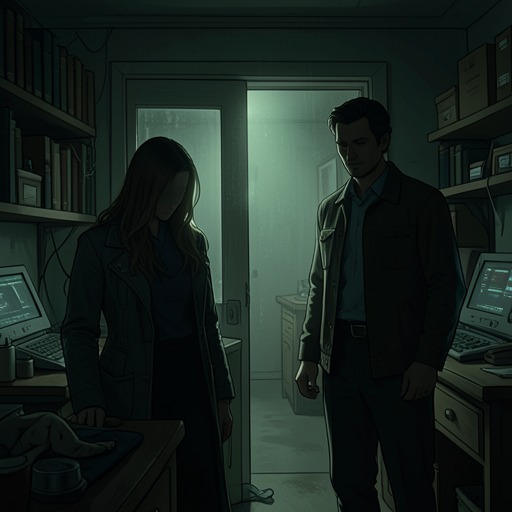
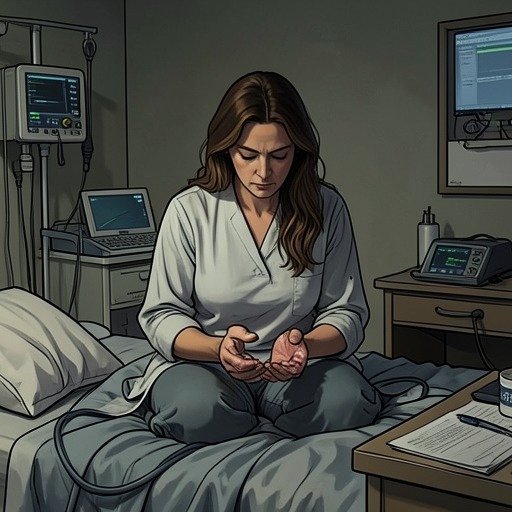
A year before her wilderness ordeal, Adrienne was assaulted in her apartment by two or perhaps three of Paul's fraternity brothers while Paul, her fiancé, slept in another room. The memory reaches her in fragments: she cannot recall the men's names or faces, but their voices remain unforgettable. Afterward, she woke in a hospital and heard a doctor tell her parents that she would never be able to have children. The diagnosis was communicated to both Adrienne and Paul, making infertility part of the aftermath of the assault rather than an isolated medical fact.
The people around Adrienne pressed the incident into silence. Paul and her parents wanted to avoid making trouble because the attackers' families were rich and powerful. Paul called it an incident, asked that they never speak of it again, and said he would still marry her that June. In an earlier confrontation, he had also questioned whether Adrienne had done something to invite the attack or dressed suggestively. He pleaded with her not to report the men because he belonged to their fraternity. Adrienne did not report them, against her better judgment; the silence protected the attackers and their social position while leaving her with the injury and its consequences.
The diagnosis helped make the engagement intolerable. Adrienne later connected the hospital news with her decision to leave Paul in the middle of the night and put distance between herself and the memories. Yet the harm did not stay in the past. When she is safe in a comfortable bed, recollection returns as restless unease and an inability to speak freely about what happened. Her infertility is therefore introduced through a medical pronouncement, but the narrative ties it to a wider pattern of secrecy, disbelief, and betrayal.
Infertility as a source of fear
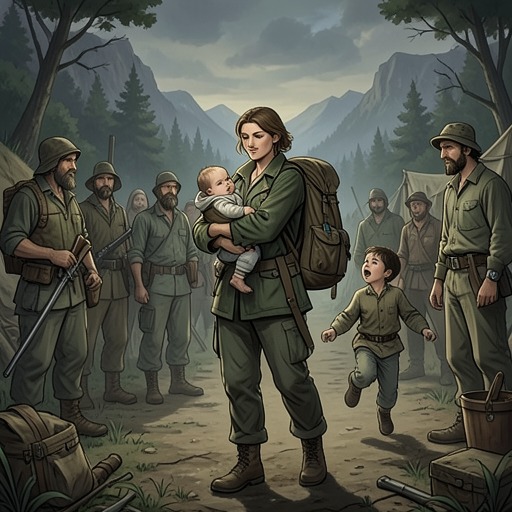
Adrienne's fear follows her into the cave where she meets Wilder. He explains that he will soon have to mate and that, because of the snow, she is the only female nearby. Adrienne hears this as a threat of sexual inevitability; she challenges his apparent lack of choice and points out that he himself has described her as too skinny. His disclosure that he is a werewolf does not immediately remove the danger she perceives. Instead, his reproductive expectations make the human medical diagnosis newly urgent: she worries about what the brothers will do when they learn that her body is barren.
Wilder's promises of provision and freedom to travel do not resolve that fear. Adrienne feels desire and love for him, but is frightened by the prospect of sharing him with his brothers and living in a cave as their sexual captive. She asks for fresh fruit rather than accepting his assurances as an answer to the larger problem. The diagnosis gives her a reason to fear that she will be judged not only as a person but by her ability to bear offspring in a family whose plans are bound up with reproduction.
The brothers' different attitudes sharpen the danger. Lycell tells Adrienne that after she gives birth to Wilder's pup, she will be his mate as well, and threatens that he will not treat her as gently as his brothers. Adrienne answers by asserting that she is Wilder's mate and carrying his child, although the claim surprises her as much as it does Lycell. Wilder later says he will stay away until spring, when his pup is born, and tells her that she would have to leave the child behind if she chose to go. Adrienne replies that she cannot be pregnant because she is unable to have children. Wilder refuses to accept her statement and expects to find his offspring when he returns. Their disagreement reveals a central contradiction: Adrienne speaks from the diagnosis and the history attached to it, while Wilder treats his certainty about her pregnancy as stronger evidence than her own account of her body.
Telling Drayton and revising the diagnosis
Adrienne does confide in Drayton. She tells him directly that she cannot have children and explains that she was injured in college and that a doctor said she could never have a child. She says she tried to tell Wilder, but could not, and that he kept insisting she was pregnant. Drayton does not understand why she describes herself as unable to have a child; he distinguishes human children from werewolves, but Adrienne explains that pregnancy works the same way for her. Her account gives the diagnosis its full context: it is not a casual fear or a refusal to imagine motherhood, but something a doctor told her after an injury.
Drayton responds by sitting with her and holding her as she cries. Adrienne experiences the comfort as immediate and powerful, a feeling of peace and safety in his arms. The scene contrasts the earlier demand that she accept Wilder's interpretation with an exchange in which she is able to disclose the source of her belief and receive care. Drayton later tells her that he wants and loves her and looks forward to her having a child. His hope does not erase the diagnosis, but it places her infertility inside a developing relationship in which pregnancy is anticipated rather than treated only as a medical impossibility.
The contradiction becomes harder to sustain as the story presents Adrienne as carrying Wilder's child. Her body is described as changing in preparation to feed his pups, and Wilder treats the pregnancy as real before Adrienne can believe him. The evidence does not explain how the original diagnosis was reached or medically revised. What it does show is a clash between the doctor's earlier pronouncement and the pregnancy recognized by the werewolves, with Adrienne initially caught between them. Her disbelief is inseparable from the experience that produced the diagnosis and from her fear that a pregnancy would bind her more tightly to the brothers' expectations.
Reproductive power and Adrienne's choices
Infertility also matters because the werewolf world assigns females value through reproduction. Mena reflects on having lived under her father's rules and under the laws governing werefemales, whose lives depend on their Alpha's favor and whose worth is measured by bearing pups. She had been expected to marry a more powerful Alpha, Drayton, but instead fell in love with Robert. Against that background, Adrienne's insistence that Drayton will not decide where she goes is more than a personal disagreement: it displays an independence Mena has not been accustomed to seeing in human women. Adrienne's own story likewise refuses to make reproductive capacity a substitute for consent.
Mena's later pregnancy makes a revealing contrast. She had also been thought sterile, but tells Adrienne that Robert has been giving her an experimental drug he was working on and that she is now pregnant. The novel gives Mena a specific explanation for her changed fertility; it does not provide the same medical explanation for Adrienne's pregnancy. Keeping the two cases distinct matters: Mena's serum does not establish that Adrienne received treatment, nor does it explain the earlier doctor's verdict. Instead, the parallel places individual diagnoses within the wider werewolf fertility crisis while preserving the uncertainty around Adrienne's body.
That uncertainty has stakes beyond private hope. When Bane's followers learn that Mena is pregnant, one of them threatens that her and her pups' safety depends on her behavior and refers to a special plan for her. Mena knows that fertile females in their group may be raped, passed among werewolves, and forced into repeated pregnancies to build the pack; pups may also be killed. The threat shows what fertility can mean under coercive rule: not simply a possibility of motherhood, but a resource others may seize. Adrienne's fear of being treated as a breeding body is grounded in the same brutal logic, even where her relationships with Wilder and Drayton include affection.
Adrienne's eventual demand to be married to Wilder, Lycell, and Drayton makes her voice and terms explicit. She requires Wilder to apologize and stop addressing her as though female were her name, then says she wants marriage to all three brothers. This does not make the earlier pressure disappear, but it marks a change in how she states her wishes: she names herself and declares what arrangement she wants, rather than leaving the brothers to define her place solely through mating and pregnancy. Her infertility diagnosis remains part of the history she carries, while the story's pregnancy reverses its apparent finality. The gap between those facts keeps the central question alive—not only what Adrienne's body can do, but whether that knowledge and its consequences belong to her.