Adrienne escapes the hotel and reunites with Wilder
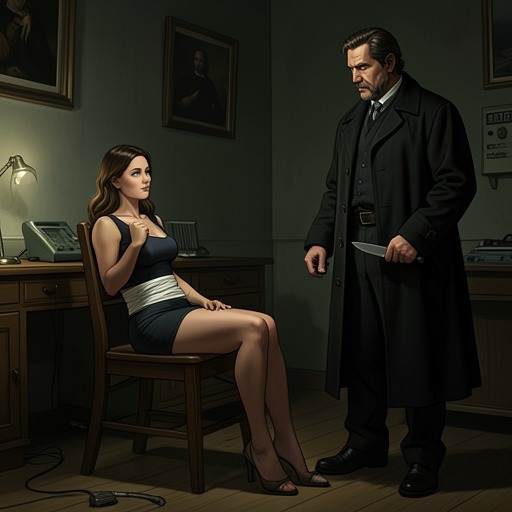
Insatiable Box Set: Books 1-4Adrienne escapes the hotel and reunites with Wilder in a sequence where freedom is won through immediate risk but cannot yet become safety. Bane leaves her alone after declaring that he intends to find another woman and warning that he will eventually take Adrienne into the Alaskan wilderness, where he believes she will have no choice but to accept him or other wild werewolves. His departure creates the opening she needs, yet his control remains materially present: he has removed every cord from the room’s telephone, preventing her from calling for help, and has made escape dependent on speed, secrecy, and access to his truck.
Causes and Background
Adrienne’s flight grows out of a larger pattern of coercion and isolation. Bane has abducted her and is pursuing her as a mate, while Adrienne is trying to return to the Samsa family compound and to the protection associated with Wilder. Her earlier escape from Paul had also begun with a reckless nighttime drive through dangerous conditions. She left because she could no longer endure Paul’s cold attitude after his frat brothers raped her and he, together with her parents, treated the assault as a secret. That earlier decision carried her into the snowy wilderness, where a road accident and the disappearance of her car left her isolated and forced her to walk through the forest. The hotel escape therefore repeats a pattern in which Adrienne’s resistance begins in confinement and proceeds through hazardous movement rather than through institutional protection.
The immediate situation is even more restrictive because Bane controls both communication and transportation. When Adrienne considers calling someone after he leaves, she discovers that the telephone has been stripped of its cords. His indifferent manner is consequently backed by practical power: he can leave the room while assuming that she cannot summon assistance. The hotel becomes a temporary private territory in which ordinary safeguards are suspended, and the truck outside represents both the means of escape and the possibility that Bane can pursue her again.
The Escape from the Hotel
Adrienne recognizes that Bane’s absence has produced a narrow opportunity and acts before fear can close it. She dresses hurriedly in soiled leather clothing and Ugg boots, takes food and a coat, and notices the truck keys in the living area. Her hands shake as she takes them. The details make the escape physical rather than abstract: clothing is pulled on under pressure, supplies are gathered for survival, and the keys become the decisive object that converts a locked room into a possible route away.
The journey through the hotel is marked by repeated interruptions and imagined danger. Adrienne expects Bane to smell her and come after her. The elevator stops on the third floor, weakening her knees until its empty doorway closes and carries her downward again. In the lobby, the blond desk clerk has been replaced by a young man who raises his head and makes a call as Adrienne passes. She cannot know whether he is contacting Bane, so the absence of certainty becomes another instrument of fear. Outside, melting ice makes her slip and slide, and the first truck she reaches is the wrong one. Only after searching in panic does she find the correct vehicle under a light.
At the truck, the possibility of freedom reaches its most dangerous point. Adrienne’s hands tremble as she puts the key into the door and opens it. Just as she climbs into the front seat, she hears heavy footsteps and sees a shadow behind her. The escape has carried her out of the suite but not beyond the reach of pursuit; the threshold between captivity and freedom is occupied by an unknown figure.
The Reunion with Wilder
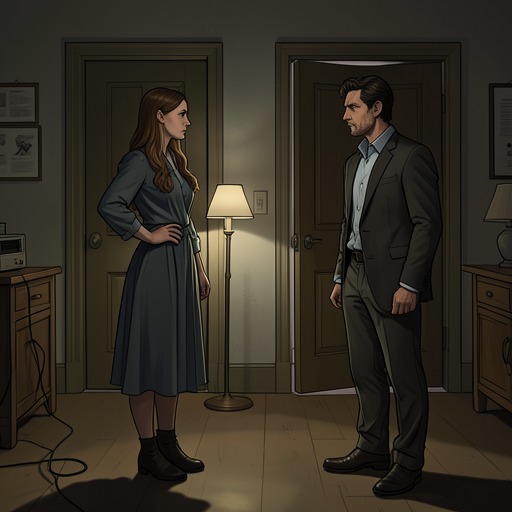
The figure is Wilder, whose voice Adrienne recognizes before she turns. His question about where she is going identifies him as the pursuer she has longed to find, and her response is immediate: she turns with tears in her eyes, embraces him around the neck, and holds his face, relieved that he has located her. The reunion reverses the emotional expectation of rescue. Adrienne anticipates warmth, but Wilder does not return the embrace. His arms remain at his sides, and his manner is cold rather than welcoming.
Wilder’s reaction changes the meaning of the reunion. He asks why Adrienne doubted that he would find her, then raises his nose to the wind and smells Bane’s presence on her. His disbelief is directed not only at the danger surrounding her but at the possibility that her account is incomplete. Adrienne tells him that Bane left her in the room and that she escaped at the first opportunity, yet Wilder’s blue eyes remain icy and unconvinced. She is shivering, and the bodily vulnerability that should call forth his protection instead meets his restraint.
The scene thus places two forms of pursuit against each other. Bane pursues Adrienne as an object of possession and threatens to remove her farther from human society; Wilder tracks her in order to recover her, but his recovery is complicated by jealousy, scent, and suspicion. Adrienne has escaped Bane’s immediate control, yet she has not recovered unquestioned security with Wilder. Her reunion is real, but it is emotionally fractured from the moment it occurs.
Consequences and Narrative Significance
Wilder orders Adrienne into the truck and says that he has a score to settle with Bane, but cannot kill him immediately because the police would become involved. His priority is to get Adrienne home quickly. This response establishes a conflict between personal retaliation and legal consequence: Wilder’s anger demands action, while the need to avoid police involvement forces him to postpone violence. Adrienne tries to reduce the crisis by insisting that Bane did nothing to her, but Wilder does not hear her; his attention remains fixed on Bane and on what must be done with Adrienne.
The value shift is therefore incomplete. Adrienne moves from direct confinement to physical escape, but freedom changes into dependence on Wilder’s judgment, and reunion changes into suspicion. The sequence also gains force from its recurrence of earlier escape imagery. Her first flight from Paul placed her on I-80 near Lake Tahoe in falling snow, where poor tires, a slippery road, and a six-thousand-foot elevation turned a two-hour drive from Sacramento, California, into three hours before the car tumbled into the earth. In the hotel, the threats are different but structurally related: surveillance, blocked communication, uncertain transport, and a pursuer who may appear at any moment.
The event also deepens the history Adrienne carries into the reunion. At the Lake Tahoe Hilton, she once recognized the voice of one of the men who had raped her, identifying him to Drayton while the men laughed and drank on the fifth floor. That memory makes the act of fleeing male-controlled spaces more than a simple change of location. Adrienne repeatedly attempts to reclaim movement and speech from men who have concealed violence, controlled access, or claimed authority over her body. Her escape from the hotel gives her movement again, but Wilder’s cold disbelief shows that even rescue can reproduce the instability of captivity when trust has been damaged.
The event ends not with a settled return but with an enforced departure. Wilder has found Adrienne, and Bane is no longer physically beside her, yet the danger remains active: Bane is alive, the threat of pursuit continues, and Wilder’s suspicion separates emotional reunion from complete reconciliation. Adrienne reaches the truck, but the larger struggle over her safety, credibility, and freedom is only entering its next phase.