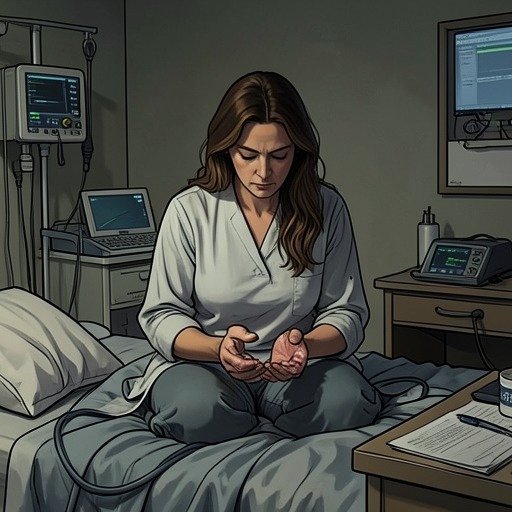
Adrienne gives birth to twin werewolf pups in the cave
Insatiable Box Set: Books 1-4Adrienne gives birth to twin werewolf pups in the cave at the point where pregnancy, danger, and family formation converge. The event confirms the physical consequences of her relationship with Wilder, makes the children central to the Samsa brothers' future, and changes Lycell through the shock of having to deliver and protect them without preparation or medical assistance.
Setting and Immediate Circumstances
Lycell is beside Adrienne in the cave while Wilder is absent. He tells her that the babies will arrive soon and intends to leave her there until the ordeal is over, offering the limited reassurance he can manage. His statement presents birth as something females simply undergo, but Adrienne's fear exposes how little either of them understands about the immediate practical demands of the delivery. The cave, already associated with cold, isolation, and dependence on Wilder's preparations, becomes an improvised maternity room rather than a temporary refuge.
The crisis begins when Lycell embraces Adrienne and she suddenly screams. At first he assumes that he has offended her and moves away, but she explains that the baby, or pup, is coming. Lycell immediately panics and asks her what to do. Adrienne's pain intensifies in her back, and her teasing observation that he will be equally helpless when he has a litter of his own pups makes him confront the possibility that the children might also become his. The birth therefore begins not only as a physical emergency but as a change in Lycell's understanding of his place beside Adrienne and the unborn children.
The Delivery and the Twins
Adrienne directs Lycell to find string and scissors or a sharp knife. He rushes toward the kitchen, retrieves string and a sharp knife, and then stands uncertainly, unable to reconcile the danger before him with his identity as something other than human. He recognizes that he is behaving like a man whose wife is in labor and briefly blames Wilder for leaving him to face the consequences. When a loud cry breaks the silence, he returns to Adrienne and takes part in the improvised delivery.
Adrienne is then shown holding two infants. Their human appearance initially makes it difficult to see that they will later turn into werewolves, but the children are identified as male pups. The twins are not merely proof that Wilder's prediction was correct; they make the reproductive future of the Samsa family tangible. Their arrival gives physical form to the inheritance, succession, and shared-mate disputes that have surrounded Adrienne since Wilder first explained that she would be carrying his heir and could not safely take the child away.
The material details of the birth emphasize both vulnerability and foresight. Lycell asks for help cutting the cords and says that the infants must be kept warm and clean. He fetches water, clean clothing, and blankets, while Wilder's chest supplies clothes for Adrienne and the babies, along with milk bottles. Lycell does not know what the bottles are, and Adrienne identifies them as feeding equipment. Wilder's decision to leave these supplies in the cave reveals that he had no serious doubt that Adrienne was pregnant and had expected more than one baby. His absence is therefore not evidence of indifference alone: the prepared chest shows that he had planned for the birth even though he was not present when it occurred.
Lycell as Reluctant Caregiver
The delivery reverses Lycell's earlier posture toward Adrienne. Before the birth, he threatens to take and defile her, to send her back to humans with a pup, and to tell Wilder that she had escaped. His threat treats pregnancy as a weapon of humiliation and control, and it makes clear that Adrienne knows she could not physically repel him. During the delivery, however, the same Lycell kneels before the sight of her holding the twins, hurries for blankets and water, and takes the pups from her so that they can be cared for.
His panic is important because it is not presented as practiced werewolf knowledge. He needs Adrienne to tell him what to do; he does not know how to deliver the baby; and he discovers that fear can make him act with the concern of a human husband. The newborns convert abstract desire into responsibility. Lycell's excitement at the prospect of having pups with Adrienne remains possessive and sexual, but it is joined by tenderness, a softened heart, and a broadened smile. His fear of losing Adrienne has already driven him to fight for her, and the birth clarifies that his attachment includes a feared future in which both she and the children could be lost.
Lycell's reaction also foreshadows his later relationship with the twins. He is no longer simply Wilder's rival or the brother who resents Wilder's claim. The cave forces him to protect the consequences of that claim, and the experience makes him imagine himself as a possible father. His thought that Adrienne might have his pups changes the emotional geometry of the family before any formal marriage arrangement is settled.
Consequences for Adrienne and the Samsa Family
The birth intensifies the conflict over Adrienne's status. Wilder has called her his mate and Alpha authority gives him a claim to marry her, while Lycell argues that she is carrying his pups and therefore should belong with him. Drayton later proposes that Adrienne should decide whom she wants to marry, and Adrienne demands marriage to Wilder, Lycell, and Drayton. The twins are thus born into a dispute that is simultaneously emotional, reproductive, and political. They strengthen Wilder's claim as the father of Adrienne's first children, but they also become part of the wider shared-family arrangement that Adrienne chooses for herself.
The event also contrasts two systems for defining pregnancy. Adrienne remembers that a human doctor had declared after her assault that she could never have children, and Paul had urged her never to speak of the matter while promising to marry her. The cave birth overturns that diagnosis in the most concrete possible way: she produces two children despite the human medical judgment of infertility. Later, Mena likewise becomes pregnant after Robert gives her an experimental drug intended to restore fertility. Together, these pregnancies establish reproduction as a force that unsettles both human medical categories and werewolf assumptions about female sterility.
The birth does not remove medical danger from the story. Later, when Adrienne's condition becomes critical, Wilder carries her wrapped in a blanket to an ambulance; a doctor observes that her pulse is low and insists that she should already be in the hospital. The contrast between the cave delivery and the later emergency care shows the limits of the brothers' improvised protection. The cave can shelter Adrienne and the twins, and Wilder can stock it with bottles and clothing, but it cannot replace professional treatment when pregnancy and childbirth threaten her life.
Narrative Significance
The twin birth is a threshold event: Adrienne enters the cave as a pregnant human woman under a werewolf's protection and emerges as the mother of two male children whose future is tied to werewolf identity, inheritance, and pack continuity. The infants' transformation into werewolves is deferred, allowing the scene to hold two identities at once: vulnerable human-looking babies and future members of the werewolf world. That delay mirrors Adrienne's own unstable position between human society and the Samsa family.
The event also gives care a more complicated meaning. Wilder's supplies represent planning and paternal expectation; Adrienne's instructions represent bodily knowledge under pressure; Lycell's frantic labor represents untrained but genuine responsibility. None of these forms of care is sufficient by itself, yet together they allow the twins to survive the isolated delivery. The scene's decisive consequence is therefore not only that two pups are born. It is that the brothers' competing claims are attached to living children, making family, desire, protection, and authority impossible to separate.