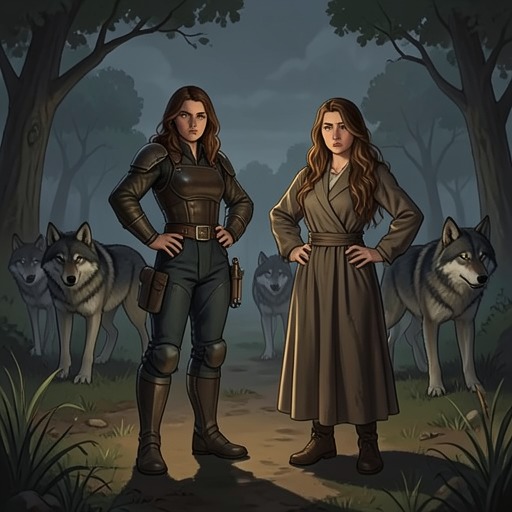
Adrienne–Lycell relationship
Insatiable Box Set: Books 1-4The Adrienne–Lycell relationship begins under the pressure of the Samsa brothers’ shared-mate system, where Lycell’s desire, the pack’s fertility crisis, and Adrienne’s own choices collide. What first appears as antagonism gradually becomes an intimate partnership: Lycell helps care for Adrienne and their sons, admits his jealousy and past coldness, and ultimately earns a place in the marriage Adrienne chooses.
Formation within the Shared-Mate Arrangement
Wilder’s plan for a family had been shaped by the scarcity of fertile werewolf females and by his determination to keep his brothers together. He and his brothers were triplet Alphas who had inherited territory jointly, and their pact ruled out displacing one another. The woman Wilder chose would therefore be expected to accept his brothers as mates; if Wilder died, the next brother in line would take her and marry her. This arrangement made Lycell a potential partner to Adrienne before the two had developed trust or affection, and it placed their emerging relationship inside a collective family and succession plan rather than a conventional courtship.
The earliest interactions between Adrienne and Lycell are marked by unequal power and explicit hostility. Although Drayton tells Adrienne that the brothers will not mate with her unless she wants them to, he warns that her scent is difficult for Lycell to resist, particularly because Lycell has never been with a female. Lycell later threatens to force himself on her, send her home, and tell Wilder that she escaped. Adrienne is frightened and recognizes that she could not physically repel him, but she refuses to be cowed into silence. At this point, Lycell’s presence represents the danger of a system in which her sexual availability is treated as part of the pack’s reproductive future, not a bond she has freely chosen.
The relationship’s emotional change is gradual rather than immediate. Adrienne remembers feeling indignation and outrage toward Lycell, yet later recognizes that his refusal to yield to her and her willingness to stand up to him had also made him intriguing. Their stubbornness becomes part of the attraction she eventually acknowledges, but it does not erase the coercive threats that preceded it. The distinction matters: the relationship’s later tenderness develops alongside a history of conflict over control, consent, and Adrienne’s right to decide whom she will marry.
Care, Jealousy, and the Turning Point
The relationship changes decisively when one of Adrienne and Wilder’s pups goes missing in the forest. As Adrienne fears having to return to Wilder with the news that they have lost a child, Lycell takes responsibility for finding him. He tells Adrienne to bring the other baby to the ranch along the path, then admits that his earlier coldness came from jealousy of her bond with Wilder. His apology gives their conflict a new shape: rather than using his strength to control her, he acknowledges how he has behaved and chooses to protect their child.
Lycell promises that he will find the missing pup, tells Adrienne that he loves her, and shifts into a tall, black-furred werewolf to track him through the trees. His confession comes as he leaves her with the other baby, making love inseparable from care and responsibility. Adrienne is still afraid to face Wilder, but trusts that Lycell will bring their child back if he can. The scene marks a change from attraction entangled with rivalry to a bond tested through shared parenthood and Lycell’s willingness to act for the family.
Afterward, Wilder notices Lycell’s scent on Adrienne and challenges her about it. Adrienne tells him that she and Lycell made love, and defends Lycell when Wilder insists that he cannot love: Lycell, she says, cared for her and the boys when Wilder had left her. Her response establishes that Lycell’s place in her life is not simply an extension of Wilder’s arrangement. She recognizes his care through what he has done, even when the brothers’ competing claims make that recognition difficult.
Recognition and Chosen Marriage
Adrienne’s acceptance of Lycell becomes explicit in the terms she sets for her future. When Wilder kneels and asks what would earn her forgiveness, she insists that he apologize, stop reducing her to the generic label of a female, and recognize her by name. She also says she wants marriage—not only to Wilder, but to Lycell and Drayton. Asked what changed her mind about sharing a life with his brothers, she identifies Lycell as the reason. Her decision makes the relationship more than an outcome imposed by the brothers’ reproductive arrangement: she names Lycell as someone she wants, and asserts that choice in her own voice.
That choice does not remove the brothers’ contest over marriage. Wilder claims authority as the pack’s Alpha and argues that he will marry Adrienne because she is his mate; Lycell counters that she is carrying his pups and that he should be the one to marry her. Their disagreement shows how affection, parenthood, and pack rank pull in different directions. Adrienne’s stated preference offers a personal answer to a dispute the brothers initially frame as a question of authority and succession.
Lycell’s tenderness becomes most visible in the aftermath of separation and danger. When he returns, Adrienne runs to embrace him. He carries her upstairs to see the boys, who have missed him so intensely that three of them would not eat. He tells her that he missed her more than they did and that he thought he would die if he died; she answers that she loves him. His careful kiss to her hand and her spoken declaration turn what had once been an antagonistic attraction into acknowledged love. The reunion also gives their bond a domestic measure: it is expressed not only through desire, but through the children’s attachment and the relief of being together again.
The narrative links this intimacy to Lycell’s altered conduct. Adrienne later hears that, when she refused to sleep with him, he rode his horse through the night—not to seek another woman, as he had threatened, but to find a way to control himself. She also observes him with his sons and recognizes that he is different. His earlier threats remain part of their history, but the later episodes present restraint and caregiving as actions through which he changes. Lycell himself describes Adrienne as the mother of his pups and the woman who made him feel like a man; he believes that without meeting her he might have become as heartless and womanizing as Bane. The relationship thus marks a shift in his self-understanding as well as in Adrienne’s affections.
Shared Family and Narrative Significance
The relationship’s eventual place in the household is visible in Adrienne’s hopes for a double wedding. She welcomes Mena and Robert into the home and offers to help prepare gowns, flowers, and a guest list for the ceremonies. Wilder recognizes that this is the first time since Adrienne arrived at the ranch that she seems truly happy, and resolves to give her the wedding she wants. Lycell’s bond with Adrienne is therefore situated within a family she is actively helping to shape, rather than only within the brothers’ original reproductive plan.
Adrienne’s choices also register against the sharply different expectations Mena has known. When Drayton tells Adrienne that he will take her, she refuses; Mena watches in amazement, having been raised under her father’s authority and the rules governing werefemales, whose lives were organized around serving male pack members and bearing pups. Mena’s contrast makes Adrienne’s insistence on choosing her own marriage consequential beyond her relationship with Lycell. Their shared household offers a different model of belonging, one in which a woman’s stated wishes can alter the marriages and alliances around her.