Adrienne’s car accident
Insatiable Box Set: Books 1-4Adrienne’s car accident is the decisive opening catastrophe of her wilderness ordeal and the first major break in the life she had been trying to leave behind. Driving east on I-80 near Lake Tahoe after abandoning Paul and their marriage obligation, she is caught in heavy snow, poor visibility, a dangerous mountain elevation, and a road her inadequate tires cannot safely manage. The crash destroys her familiar Honda, cuts her off from the highway, and leaves her dependent on instinct and endurance in a landscape where ordinary human protections have disappeared.
Causes and Setting
Adrienne begins the drive in a mood of release. The full moon seems to announce a new life, and she travels with the music loud, humming and swaying because she believes she is finally free from Paul’s coldness and from the marriage she no longer wants. Yet the journey is made under conditions that steadily narrow her choices. The route from Sacramento, California, toward Lake Tahoe should take two hours, but the elevation, snowfall, slippery road, and lack of snow tires extend it to three. A dense forest borders the narrow highway, darkness removes the street lighting, and the snow accumulates faster than the windshield wipers can clear it.
The danger is intensified by distraction and neglect. Adrienne’s phone rings repeatedly, apparently because Paul has noticed her disappearance, but she refuses to answer and turns toward the purse while driving. She remembers too late that she never changed the wiper blades. As large flakes obscure the road, she passes a sign without reading it. The accident therefore emerges from a chain of personal defiance, emotional agitation, inadequate preparation, and hostile weather rather than from a single isolated mistake.
The Collision
When Adrienne briefly turns her head after the phone rings, a large buck crosses the road with a wolf close behind it. She manages only an exclamation before everything loses focus and becomes dark. Her old gray Honda strikes the deer or something associated with the crossing, and the vehicle is permanently disabled. The car carries the weight of her earlier life: it had served through high school, taken her to movies, carried friends to school, and later been used by Paul after his Toyota failed. Its destruction is consequently more than a mechanical setback. A familiar object that had functioned almost like a friend is removed from her possession at the exact moment she is trying to make herself independent.
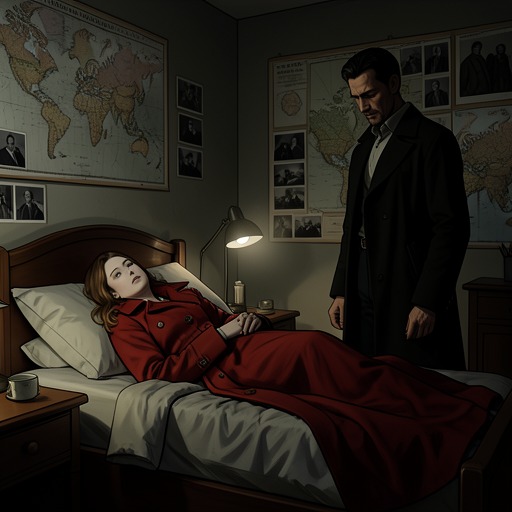
Adrienne regains consciousness with the Honda angled near a ravine, broken and helpless, teetering on its right side. She has only a slight knee bruise from the steering wheel and some stiffness, so she initially believes that the outcome could have been worse. The apparent survival, however, conceals a more serious reversal: the car is not merely damaged but positioned within a landscape from which escape will be difficult, and the road that seemed to offer freedom has become the entrance to isolation.
Stranding and Wilderness Ordeal
Adrienne cannot simply open the damaged vehicle and walk away. The driver’s window will descend only a few inches, so she removes a shoe and pounds at it, but the glass slips from its gears without opening far enough. She then climbs over the steering wheel and out through the front window, carefully holding the raised hood and sliding down until her feet reach the ground. The escape from the car is physically awkward and precarious, establishing the accident as a sequence of survival problems rather than a completed event.
Once outside, she sees a pool of blood and panics. She cannot identify a route through the dense forest and realizes that climbing back to the highway is impossible. Her phone is still in the car, so she turns back, only to watch the Honda tumble and sink deep into the earth. The disappearance destroys the last practical link to help. Adrienne responds by forcing herself into motion: under the large moon, she tells herself that she can see, that she must not be afraid, and that a house may be nearby.
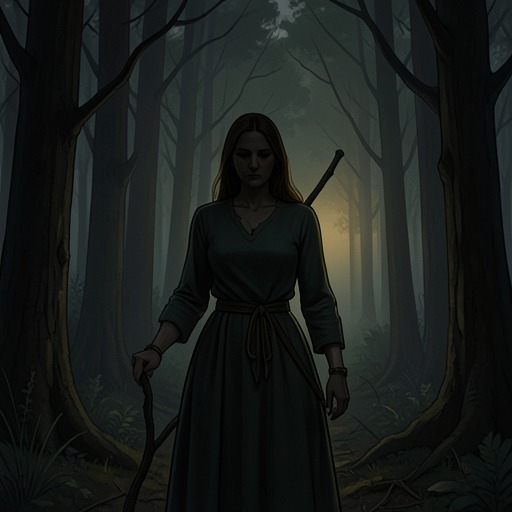
She follows Indian trails without knowing where they lead while the temperature falls. Her clothing—a skirt over exercise pants, a jean jacket over a cotton shirt—is layered but insufficient for the season and elevation. After roughly three exhausting hours, hungry and cold, she makes a bed from leaves and pine limbs and covers herself with more leaves beneath a tree. Ants, forest noises, and the distant growling and calling of a wolf prevent genuine safety or rest. The accident has thus transformed a deliberate flight from Paul into exposure to weather, animals, darkness, and the possibility of death.
Consequences and Narrative Significance
The crash initiates Adrienne’s contact with Wilder and the werewolf order that will later claim authority over her body, pregnancy, movement, and relationships. Wilder eventually frames her status as his mate and argues that leaving while pregnant would endanger the child, revealing the collision’s larger consequence: Adrienne’s escape from one form of human obligation leads into a competing system of werewolf law and possession. The language of freedom remains unstable from this point forward, because the road she chose to recover autonomy becomes the route by which she enters another society’s rules.
The accident also becomes the first link in a recurring chain of isolation and pursuit. Adrienne later identifies one of the men who raped her as she hears his voice at the Lake Tahoe Hilton, showing that the escape from Paul had been motivated not only by marital dissatisfaction but by the concealment of sexual violence by Paul and her parents. In another later flight, she sees a large white Ford pickup following her and Mena toward the Samsa compound; the memory of the earlier nighttime journey gives pursuit on the road an especially grave meaning. When Bane confines her, ties her to a crude chair, and threatens to leave her as food for animals, the earlier forest ordeal is echoed in a more deliberate captivity.
Adrienne’s later hotel escape repeats the accident’s basic pattern under altered conditions. Bane has removed the telephone cords, but she seizes food, a coat, and the truck keys and moves toward the lobby despite trembling hands and fear that he will detect and punish her. The first escape was accidental and disorienting; the later one is purposeful, yet both depend on movement through spaces controlled by stronger forces. The car accident therefore functions as both plot trigger and structural rehearsal: it introduces the novel’s pursuit-and-escape pattern, places Adrienne at the intersection of human and nonhuman danger, and begins the chain of decisions through which a reckless departure becomes the gateway to a new family, a new law, and continuing conflict over who may claim her future.
Interpretive Importance
As a reversal, the accident turns apparent liberation into vulnerability. Adrienne believes that leaving Paul will restore control, but the snow, failed equipment, distracted driving, ravine, and vanished vehicle strip away the protections she assumed would remain available. The scene’s bodily details—slowing wipers, cold air, shivering, hard breathing, and trembling—make danger arrive as physical intensity before it can be organized into a stable explanation. Her repeated effort to reassure herself keeps the scene from becoming passive: fear is present, but so is improvisation.
The episode also establishes the novel’s central tension between human judgment and werewolf law. Adrienne’s decision is reckless in recognizably human terms, while the later werewolf world interprets her body and relationships through inherited rules that she only partly understands. Wilder describes those laws as internalized across generations and treats the protection of a mate and unborn pup as an obligation stronger than ordinary human morality. The accident is the point at which Adrienne leaves the jurisdiction she knows without yet understanding that another jurisdiction is waiting beyond the forest. Its significance lies not simply in the wrecked Honda, but in the way the wreck converts a private act of refusal into the first movement of a much larger struggle over autonomy, protection, reproduction, and belonging.