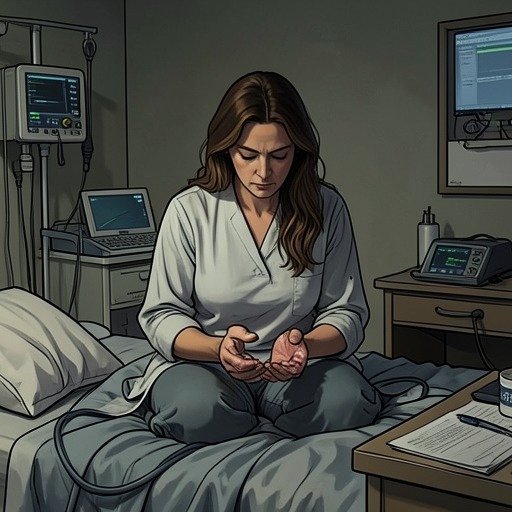
Adrienne’s critical postoperative condition
Insatiable Box Set: Books 1-4Adrienne’s critical postoperative condition turns a dangerous birth into a prolonged vigil: an emergency cesarean saves her six pups, but her own life remains uncertain for weeks. The crisis concentrates the story’s concerns with pregnancy, bodily vulnerability, and who gets to make decisions about Adrienne’s body, before her eventual awakening restores her voice to the family gathered around her.
The crisis and its stakes
Adrienne’s condition becomes alarming when Lycell reports that she was turning blue, her eyes rolled back, and she felt cold. Wilder carries her downstairs wrapped in a blanket, while the others wait for medical help. The doctor arrives by ambulance, checks her pulse at her neck, and finds it dangerously low. He says she should already be in the hospital; the attendants place her on a gurney and take her away, with Lycell following.
At the emergency entrance, Dr. Wells explains the immediate danger to Drayton: Adrienne must undergo a cesarean at once or she will die. The pups are small, as expected for werewolves, and he cannot promise that they will survive. Drayton tells him to do what is necessary. The choice is urgent and stark: the operation offers the pups a chance, but Adrienne’s life is also at risk.
The crisis carries particular weight because Adrienne had previously been told that she could never have children. After she was raped by Paul’s friends, a doctor told her and Paul that she was unable to bear children. Paul and Adrienne’s parents suppressed the matter rather than pursue an investigation, and Paul insisted that they never speak of it again. Her later pregnancies therefore stand in sharp contrast to the diagnosis that shaped her understanding of her future. The emergency does not erase that earlier harm; it places her reproductive life under a new, immediate threat.
Surgery and uncertain survival
Drayton remains at the hospital while Dr. Wells prepares to operate. Wilder arrives and finds him waiting with his hands to his face, fixed on the operating-room door. When Dr. Wells returns, he can say that the pups are fine for now and look healthy. He cannot give the same reassurance about Adrienne: she is in severe pain, and carrying all the pups has taken a heavy toll. She has been sedated, and the doctor does not know whether she will live.
Wilder’s response makes the difference between the babies’ provisional safety and Adrienne’s uncertain future impossible to ignore. He demands to know whether she will survive, then regains control when Drayton takes hold of his arm. The moment briefly makes the brothers’ usual strength seem inadequate: they can summon help and authorize treatment, but neither action lets them determine what will happen to her.
The vigil in critical care
Adrienne remains helpless, sedated, and motionless in the critical care unit for weeks. Wilder stays beside her day and night, holding her hand, talking to her, and pacing the tiled floor. The vigil marks a visible change in him: lines deepen near his eyes, he loses weight, and his handsome face begins to show the strain. When she dreams, he climbs into the bed beside her and holds her, continuing to speak to her even when she cannot answer.
His repeated appeals frame the bedside as both a place of care and a plea for her return. Wilder says he cannot live without her and reminds her that they need her. He begins to call the pups children, a change he recognizes in himself as he speaks. He also tells her that Lycell has stayed awake caring for the pups because he does not trust anyone else with his children. The account thus divides the family’s response between tending the babies and keeping watch over Adrienne, whose survival remains unresolved.
Awakening and the return of her voice
After weeks in critical care, Adrienne slowly opens her eyes and tells Wilder that his incessant talking will not let her sleep. Her first response is wry and direct, and Wilder immediately understands that she is alive and may recover. When she confirms that she expects to live, she grounds that hope in the pups and in the life still ahead of her.
Her first urgent question is whether she has lost the babies. Tears well in her eyes as she reaches for her stomach. The question brings the emotional and medical stakes together: surviving the operation matters to her, but so does knowing what happened to the children she carried. Her awakening does not make the preceding danger disappear; it lets her learn about it and speak for herself again.
Reproductive danger and bodily autonomy
The episode sits within a wider struggle over who may decide Adrienne’s reproductive future. Before the emergency, Wilder had proposed that Adrienne give her pups to Mena, whom he believed sterile. Adrienne rejects that plan, asking whether he had acted deliberately and telling him that a mother should not have to surrender her children. She insists that Wilder stop controlling their lives and ask Drayton and Lycell what they want. The exchange shows that pregnancy is not only a medical condition in this family: it is also a matter of parenthood, consent, and contested authority.
Later, Adrienne tells Wilder that respecting her right to say no is essential, invoking the men who raped her to make the boundary unmistakable. That later confrontation is not a consequence of the cesarean alone, but it sharpens the significance of her return to consciousness: after an episode in which doctors and relatives act under extreme pressure to keep her alive, her capacity to speak and decide remains central. The crisis is a turning point not because it resolves the history of violence surrounding her body, but because Adrienne survives it and again asserts a future of her own.