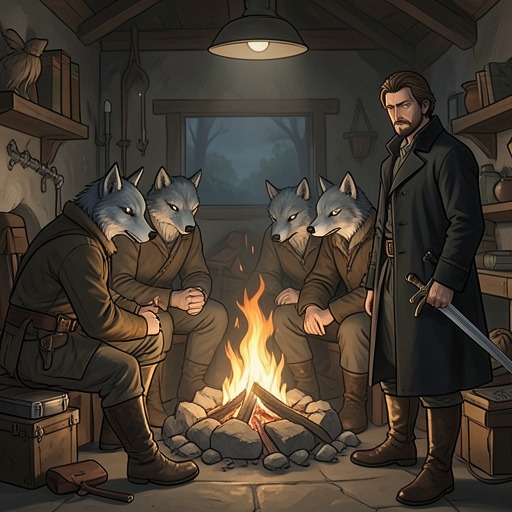
Alpha hierarchy among werewolf packs
Insatiable Box Set: Books 1-4Alpha hierarchy among werewolf packs is a system of rank and territorial authority, but the Samsa family shows that Alpha status does not always translate into unquestioned command. Wilder leads the pack and is expected to enforce its laws, yet his brothers are also Alphas, and their pact of unity makes governance depend on negotiation as well as hierarchy. The tension between those principles shapes both the family’s domestic arrangements and its response to threats beyond its territory.
Rank, Territory, and Brotherhood
Wilder and his triplet brothers, Drayton and Lycell, inherited their territory equally from their father. All three are Alpha wolves, and they swore to remain together rather than displace or exclude one another. Their agreement gives the brothers a shared basis of authority, but the story also identifies Wilder as the head Alpha and places him at the center of decisions affecting the wider pack. His brothers’ equal status therefore coexists with a leadership order in which Wilder is expected to direct policy.
That arrangement is not merely a division of land. Wilder’s search for a family is shaped by his brothers’ inseparability: the woman he chooses would have to accept them, and the brothers agree to trust his judgment as head Alpha. The same compact establishes a succession expectation: if Wilder dies, the next brother in line would take his mate and marry her. Their unity thus extends from territorial rule into mating, inheritance, and the continuity of the pack.
The underlying pressure is demographic as well as political. Wilder has not found a compatible female werewolf, and most werefemales are described as sterile. Because the brothers are triplets and all are Alphas, the plan is for one fertile female to bear their pups rather than for the brothers to divide or dissolve their alliance. Wilder had established a council to address declining reproduction among the clans he policed. He refused to capture human women, fearing that such kidnappings would expose the werewolves to human retaliation; instead, he hoped that money and the brothers’ appeal would attract women willing to join the pack. The hierarchy is consequently tied to a deliberate effort to manage population without destroying the solidarity on which its leadership rests.
Wilder’s Authority and Its Limits
Wilder’s authority is expressed most plainly when he declares himself the pack’s Alpha male and identifies Adrienne as his mate, insisting that he will marry her. Yet that claim does not settle the question of who has power over her future. When Adrienne says that she wants to marry Wilder, Lycell, and Drayton, the brothers must confront how their shared arrangement can function without turning the Alpha pact into a contest over possession.
Wilder eventually proposes shared decision-making: the brothers will form a council, and two votes can override one. He also recognizes a limit specific to Adrienne. Because she is the mother of the pack, she has the deciding authority over whom she chooses to sleep with and whom she chooses to marry, even though she cannot marry all three brothers. This concession marks a significant adjustment to the original hierarchy. The brothers retain collective governance, but Adrienne’s choices are not simply absorbed into Wilder’s status as head Alpha.
The settlement is precarious. Lycell believes Adrienne will choose him because she is pregnant by him and because he has remained near the ranch, cared for its livestock and land, and built relationships with the local townspeople. His confidence exposes the competition that shared rule is meant to contain. Wilder’s proposal makes voting a mechanism for resolving disagreement, while Adrienne’s distinct decision-making authority prevents a majority vote from deciding her marriage for her.
Pack Law and Political Disputes
The hierarchy is tested when Lycell kills a rival werewolf at Lycell’s reckless, lust-driven party. The dead wolf had controlled extensive territory in Oregon, and his pack is left without Alphas. Wilder treats the killing not only as a personal or sexual conflict but as a governance crisis: leaderless packs have no laws, and he orders Lycell to take over the territory. Drayton intervenes when Wilder and Lycell begin arguing, insisting that the absence of leaders and law is a greater problem than which brother slept with Adrienne. The confrontation shows that Alpha power carries responsibility for the order of other packs, not only command within one’s own household.
A separate dispute with Ramsey, Mena’s father, reveals the limits of Wilder’s ability to enforce his wishes even within his own family. Ramsey accuses him of breaking a promise that Mena would marry one of the brothers and of allowing a human woman to influence werewolf law. Wilder answers that he had no right to dictate whom his Alpha brothers would mate with; both refused Mena, and their equal standing means he cannot compel them. Ramsey counters that a leader unable to control his brothers may not be obeyed by the other packs. Wilder’s response—that the brothers have equal status in his pack—makes explicit the conflict between a centralized model of Alpha authority and the brothers’ founding pact.
The conflict has consequences beyond rank. Wilder tells Drayton that mating with Mena is necessary to prevent war, not because of love, and says the Samsa forces are not strong enough to face the Alaskan and Oregon packs. Later, he tells Robert that he sanctions Robert and Mena’s marriage and welcomes Robert continuing as the family’s doctor, while linking the couple’s security to his effort to reach Oregon with his sons and stop an uprising. These negotiations show marriage, medical service, and military cooperation operating alongside formal Alpha authority as means of stabilizing alliances. The proposed matches are not presented as a single settled rule; they are contested arrangements shaped by the threat of war and by the choices of those involved.
Law, Protection, and the Reach of Rule
Wilder’s position also entails enforcing norms inherited through werewolf custom. He has learned the law from his father and is now responsible for a pack described as extending from the Americas to Russia. From this perspective, Bane’s kidnapping of an Alpha’s mate is an offense against the werewolf order, not simply a private act of hostility toward Adrienne. Wilder frames the conflict as one in which he must hunt the pursuer and stop Bane from claiming her. The law gives his personal pursuit a public dimension: the head Alpha is expected to defend the bonds and boundaries on which pack authority rests.
Yet the novel distinguishes the existence of law from its uncomplicated acceptance. Adrienne embraces some werewolf customs but does not fully understand them, including the rules that Wilder regards as fundamental. The hierarchy is therefore sustained through inherited norms and leadership obligations, while remaining difficult to translate across human and werewolf expectations. Its most consequential tension is that it seeks unity through rank, kinship, and reproductive planning, but must repeatedly make room for equal Alpha brothers, unstable interpack alliances, and Adrienne’s expressly recognized choice.