Bane takes Adrienne north to Alaska
Insatiable Box Set: Books 1-4Bane takes Adrienne north to Alaska as both captor and would-be mate, converting her abduction into a flight from the Samsa brothers and a direct test of their power. The journey begins after Bane separates Adrienne from Mena and announces a change of plans: Mena has been taken back toward Alaska by her father’s pack, while Adrienne will be moved to a place Bane calls safe. The word conceals the central fact of the episode. Adrienne is not being escorted to safety; she is being removed from the people who might recover her.
Causes and Background
Bane’s decision grows out of his fixation on Adrienne and his hostility toward the Samsa family. He knows that Wilder, Lycell, and Drayton will pursue her, and he deliberately presents that pursuit as a contest in which the Samsas’ settled, luxurious way of life will become a weakness. He believes they have been softened by sleeping and eating in comfort and no longer know how to survive in the wild. Taking Adrienne therefore serves two purposes: it hides her from the Samsas and lures them into terrain where Bane considers himself strongest.
The stakes are heightened by Adrienne’s pregnancy. Wilder has already declared her his mate and insisted that he will marry her, while Lycell has argued that her pregnancy with his pups gives him a claim. Wilder’s account of werewolf custom is even more absolute: because Adrienne is pregnant or will be pregnant with his pup, he says she may leave him but cannot take the child, since the child could be targeted as his heir. Bane’s seizure of her thus challenges not only a personal relationship but a system of inheritance, mating, pack authority, and protection.
Adrienne’s earlier encounter with Wilder establishes the contrast that governs the journey. In the wilderness, Wilder risked his life against a female bear to protect her, carrying her unconscious body back to the cave as he would carry a wolf pup. Bane, by contrast, repeatedly makes protection conditional on obedience. He claims that Adrienne must live as he lives or die, and he threatens to abandon her to wolves if she cannot keep walking. His version of safety is inseparable from captivity.
The Abduction and Departure
Bane first announces that the two of them will travel alone. When Adrienne asks whether anyone else will accompany them, he answers that it will be “Just you and I,” making isolation part of his plan. He then frames the journey as a test of the Samsas: they will have to find Adrienne and take her from him, and that will not be easy. The imagined rescue becomes, in Bane’s mind, evidence of his own strength rather than proof that Adrienne has been deprived of her freedom.
His treatment of Adrienne makes the coercion explicit. In the cave he ties her hands behind her back, binds her ankles, and fastens her waist to a crude chair made from branches. He refuses to gag her only because her screams might alert him if a wild animal approaches. The threat is calculated: if he fails to return, he says, the animals may eat her while he eats them, turning her possible death into a grotesque expression of possessive revenge. Even when he later allows her to move, the underlying arrangement has not changed; she remains under physical and psychological compulsion.
The immediate vehicle is a rusty, battered Chevrolet truck with remnants of red paint. Adrienne resists, backing into deep snow and saying that she cannot go. Bane orders her into the truck and tells her that resistance is useless. His anger at her refusal is presented as an injury to his authority: he believes that, as a werewolf feared by the forest, he is being mocked when a human woman does not obey him.
Adrienne finally enters the truck not because she accepts Bane’s claim but because his threats awaken memories of the sexual assault she suffered during college, when Paul’s intoxicated friends overpowered her while Paul lay unconscious nearby. Their earlier command that she remain still and silent echoes through Bane’s warning that he could force her. Faced with the possibility of renewed violence, she chooses outward compliance as a means of avoiding immediate danger. Bane misreads that survival decision as evidence that she can be broken and may eventually love him.
The Road North
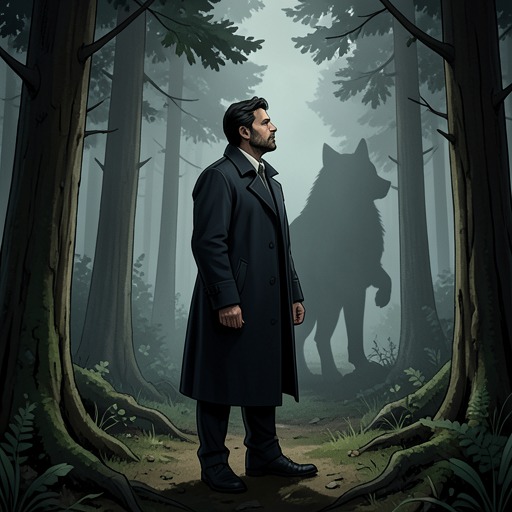
Bane starts the truck with a loud bang from the exhaust, startling Adrienne, and drives north. The journey is precarious from the beginning: the old vehicle jerks and sputters, making it doubtful that it can reach Alaska quickly. Yet Bane’s destination is not tentative. He intends to carry Adrienne toward the far north, close to the end of the continent, where the Samsas will struggle to locate her and where he can attempt to convince her that she has no alternative but to accept him and bear his pups.
Bane’s private calculations reveal the scale of his rebellion. He knows that taking a pregnant woman will bring three werewolves and her children after him, and he understands that the pursuit could continue to the ends of his days. He also recognizes that he may be cast out of the werewolf community if he does not destroy or kill the Samsas. Nevertheless, his desire for Adrienne overrides the cost to his pack. The destination is chosen not merely as a hiding place but as a geography of exclusion, a northern refuge where distance, snow, and isolation can replace legitimate consent.
The trip also exposes the contradiction in Bane’s self-conception. He insists that he does not normally force a female and prefers her to be receptive and willing, yet his conduct has already involved abduction, restraint, threats, and compelled travel. He imagines that careful treatment for a short time might lead Adrienne to love him, while admitting that such restraint is not his nature. His nature, as the narration presents it, is wild and uncontrollable; his fantasy of voluntary affection rests on the very coercion that makes genuine choice impossible.
Pursuit and Competing Laws
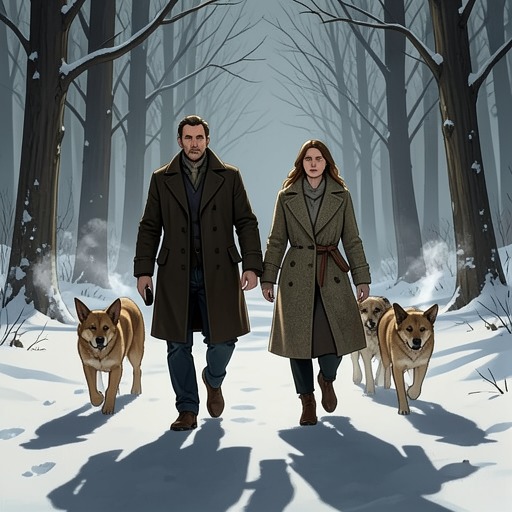
Wilder responds as an Alpha whose mate has been taken. He abandons concern over sentiment and follows Bane’s trail, shifting into wolf form after running through the woods so that he can travel faster, conserve strength, and use his thick white fur as camouflage in the snow. He follows frozen riverbanks because game is plentiful there and because Bane may use rivers to confuse pursuit. Wilder recognizes the tactic and continues tracking Adrienne’s scent despite exhaustion and lack of sleep.
The pursuit is dangerous for every participant. Lycell, distracted by thoughts of Adrienne, fails to smell or hear a black bear before it attacks him; the bear is defending its territory rather than simply hunting him, and it strikes him across the chest before Drayton can warn him. The wilderness is therefore not an empty backdrop to Bane’s escape. Its animals possess territory, hunger, speed, and sensory advantages that repeatedly redirect the human-werewolf struggle.
Wilder eventually realizes that Bane is heading for Alaska, where rumors suggest he has been building a compound. He had dismissed the possibility because he believed only werewolves born and raised in the far north could endure its severe winters. That earlier mistake gives Bane a temporary advantage, but it also confirms the extremity of his plan. Wilder describes the conflict through the laws inherited from generations of werewolves: Bane has kidnapped an Alpha’s mate, and under werewolf law he must be punished. The chase consequently becomes a legal as well as physical contest, governed by the principle that Wilder must hunt the pursuer and that survival may require killing or being killed.
Consequences and Significance
Bane’s northern flight shifts the value at the heart of the story from unstable attachment to open captivity. Before the departure, Adrienne is already entangled in the Samsa brothers’ claims, marriages, pregnancies, and shared family arrangement. Once Bane takes her toward Alaska, those competing claims become an interstate-style pursuit between packs, with Adrienne’s body and unborn children treated as the ground on which authority is measured.
The event also exposes the conflict between several normative systems. Adrienne is subject to human ideas of consent and personal freedom, the Samsa brothers’ rules concerning mates and heirs, Bane’s law of the wild, and the broader werewolf laws that require an Alpha’s mate to be protected and an abductor to be punished. No single system gives her uncomplicated security. Wilder’s protection is tied to mate ownership and inheritance, while Bane’s supposed protection is inseparable from threats. The journey makes visible how a rule can claim to safeguard a woman while simultaneously restricting her power to decide.
Its final consequence is the escalation of the Wilder–Bane rivalry. Bane intends to carry Adrienne beyond the Samsas’ reach, persuade her to submit, and have his own pups, while Wilder follows her scent through snow, rivers, hunger, and exhaustion. Adrienne remains the immediate target of rescue, but the journey also makes her the symbolic center of a struggle over Alpha legitimacy, pack law, reproduction, and the boundary between human and werewolf morality. Alaska is therefore not simply the destination of an escape. It is the remote stage on which Bane attempts to remake captivity as courtship and on which Wilder’s duty to pursue, protect, and punish is transformed into a near-total confrontation.