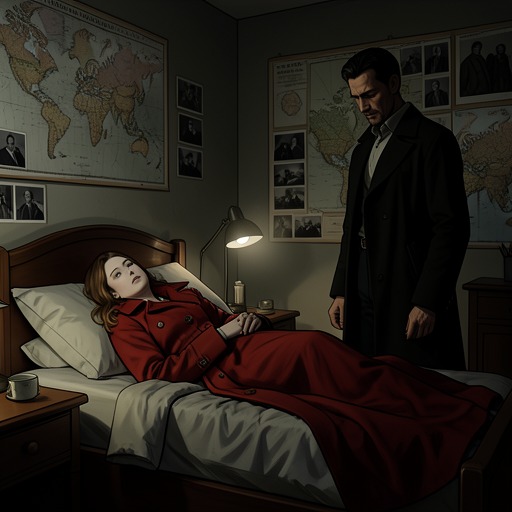
Paul
Insatiable Box Set: Books 1-4Paul is Adrienne’s high-school sweetheart, college companion, fiancé, and ultimately former fiancé. Their relationship appears socially conventional—childhood familiarity, shared college years, an engagement, and a planned wedding and honeymoon in Hawaii—but the narrative steadily exposes the emotional and ethical failures beneath that arrangement. Paul’s importance lies less in any single confrontation than in the way his passivity, sexual judgment, and protection of privileged friends help define the life Adrienne eventually abandons.
Identity and Background
Paul meets Adrienne in high school after she uses a deliberately provocative prom prank to obtain a date. She tells him that the student with the largest penis in the senior class would receive a sexual favor, though not necessarily from her, and later admits that the claim was only a prank. They date during their senior year and attend college together, eventually sharing an off-campus apartment. This long history gives their engagement the appearance of stability, while also making Paul deeply embedded in the social world from which Adrienne later escapes.
Paul’s sexual expectations are restrictive from the beginning of their adult relationship. He believes Adrienne should remain a virgin until marriage and advises waiting, a position that she experiences as an imposed moral script rather than mutual intimacy. When he finally gives in to her wishes, the experience confirms her doubts: she feels no sexual satisfaction, recognizes that they have little in common in bed, and is criticized for being too aggressive. He refuses her request for oral sex while expecting her to perform it for him. The imbalance is therefore not merely a matter of incompatible desire; it shows Paul treating sexual restraint as a standard for Adrienne while accepting sexual service from her.
Relationship with Adrienne
The engagement becomes untenable because Paul offers neither emotional recognition nor meaningful protection. Adrienne’s mother has planned the wedding, and Adrienne considers the prospect of a Hawaii honeymoon, but she realizes that a pleasant honeymoon is not a sufficient reason to marry someone. One night, after Paul again insists on waiting until marriage, she looks at him lying in sailboat-patterned pajamas, packs her few clothes into an overnight bag, and leaves their apartment through fresh snow. The small domestic image makes the rupture concrete: the conventional future is not destroyed by a public argument but abandoned in a quiet act of withdrawal.
Paul notices her disappearance and calls her. Adrienne refuses to answer, shouting at her purse as though confronting him directly. Her anger is sharpened by the sexual frustration and emotional coldness that have accumulated during their relationship. The departure is not an impulsive rejection of intimacy in general. Later events show that Adrienne can experience lust, need, love, and profound attachment with Wilder, but Paul’s relationship with her has taught her that socially approved commitment can still contain loneliness and control.
Paul also fails Adrienne when she is threatened by his fraternity brothers. Instead of asking what the men had done or offering unconditional support, he asks whether she did anything to make them attack her and suggests that she may have dressed suggestively. His response converts the danger posed by the attackers into an accusation against Adrienne. That moment becomes part of the larger pattern through which he protects male privilege at her expense.
The Assault and the Concealed Crime
Paul’s most consequential role concerns the assault by his fraternity brothers. Adrienne allows Paul to host a beer party at the apartment despite disliking his arrogant, wealthy friends because she wants to please him. Paul becomes drunk and passes out in a spare bedroom. Later, two or perhaps three men enter Adrienne’s bedroom and rape her. The uncertainty about the number of attackers and the darkness of the room do not lessen the event; they show the fragmented conditions under which Adrienne survives and remembers it.
Paul does not immediately take her to the hospital. He remains in a drunken stupor and brings her there only after a substantial delay. He then contacts her parents and helps arrange a marriage intended to prevent her from testifying against his friends. Paul and Adrienne’s parents accept the argument that naming the perpetrators would ruin Adrienne’s life as well as the lives of the wealthy young men. The assault is thus transformed into a private secret, and marriage is presented as damage control rather than as Adrienne’s freely chosen future.
Adrienne later remains angry with her parents for suppressing the investigation, but Paul’s responsibility is especially direct: he hosted the men, failed to protect her, delayed medical care, and participated in the agreement that silenced her. She describes the assault to Drayton as the reason she believed she could not have children. She did not recognize the attackers’ faces, but she recognizes one by his voice after entering a hotel elevator. When she identifies the man at her parents’ home, Paul is present and reacts with horror. His presence links the earlier concealment to the later recognition, making the supposedly buried crime impossible to keep private.
Conflict, Control, and Contrast
Paul’s conduct establishes the human form of the coercive control that the novel later places beside werewolf claims of mating, protection, and reproduction. He does not abduct Adrienne or openly threaten her with physical violence in the supplied episodes, yet he participates in pressure that limits her choices: sexual abstinence is imposed as a condition of the relationship, her assault is hidden, and marriage is arranged as a means of preventing testimony. The narrative therefore contrasts the respectable appearance of his engagement with the harm concealed inside it.
This contrast also explains why Adrienne’s later insistence on consent is so forceful. When she tells a werewolf to respect her right to say no or become no better than the men who raped her, Paul’s earlier failures remain the moral reference point. Her demand is not an abstract romantic preference; it is a boundary formed through betrayal by the man who was supposed to be her partner and through the adults who chose silence over justice.
Paul’s relationship with Adrienne is consequently marked by an attachment loop in which social commitment does not produce security. Their shared history, engagement, and planned honeymoon suggest permanence, but his coldness and judgment make departure increasingly necessary. Adrienne’s later fear of being a captive audience in Wilder’s cave shows that she remains alert to the possibility that a new relationship may reproduce old powerlessness. The difference she perceives in Wilder is that he is patient, understands her, and loves her, whereas Paul’s presence is associated with delay, blame, concealment, and sexual dissatisfaction.
Later Confrontations and Narrative Role
When Adrienne returns to her parents’ home with Drayton’s assistance after nearly a year away, Paul opens the door and sees her alive. His horrified expression turns her return into a confrontation with the past he helped suppress. He attempts to ask Drayton whether Adrienne has told him what happened, despite her mother’s effort to signal him to stop. The question is revealing because it places the burden of disclosure back into Adrienne’s hands while exposing Paul’s awareness that the secret is now circulating beyond the family arrangement.
Paul later reappears in a hotel room connected to Adrienne’s captivity. She enters with Mena, sees Paul and then Wilder and Lycell, and hears the voice of another man in the room. The voice triggers recognition before visual certainty: Adrienne wonders whether her ears are deceiving her, but realizes that the attacker is the man she remembers. This recurrence shows how the assault remains an active trauma rather than a closed episode. The memory returns as a bodily and perceptual threat, and Paul’s presence makes the old network of fraternity, silence, and male authority visible again.
Paul also remains part of the psychological background when Adrienne faces Bane. Watching Bane’s face brings back the sickening recurring nightmare of the night Paul was drunk while his friends attacked her. The memory has followed her throughout her life with Paul and helps explain why she left him on the night her broken-down car carried her toward the werewolf world. The narrative’s decisive contrast is not that the later world is free of coercive danger; it is that Adrienne reads Wilder as different because he is patient and responsive to her, while Paul is inseparable from the original betrayal.
Significance and Ending
Paul’s ending is defined by displacement rather than redemption. Adrienne leaves him, discovers that the engagement was built on concealment, identifies one of his friends as an attacker, and forms relationships that she understands as more emotionally satisfying than her conventional partnership. Even when the story later depicts shared mating, pregnancy, and pack obligation as sources of belonging, Paul remains the negative measure against which respect, desire, and protection are judged.
His character embodies the novel’s critique of respectable arrangements that conceal violence. The wedding and Hawaii honeymoon promise a polished future, but the relationship rests on incompatible sexuality, victim-blaming, and a bargain designed to preserve wealthy men’s reputations. Paul is therefore not simply an unsuitable former boyfriend. He is the human representative of a social order that calls silence protection, calls control commitment, and asks Adrienne to preserve the comfort of others after she has been harmed. Her escape from him is the first decisive refusal through which she begins to reclaim authority over her body, testimony, and future.