Samsa council voting rule
Insatiable Box Set: Books 1-4The Samsa council voting rule is the governing arrangement Wilder establishes to keep his brothers’ shared authority from becoming a source of division. Its majority principle—two votes override one—replaces Wilder’s sole command in collective decisions, while Adrienne retains the final say over her intimate and marital choices.
Origins and Authority
The rule grows out of the brothers’ longstanding unity. Wilder, Lycell, and Drayton are triplets and Alpha wolves who control the territory they inherited from their father equally. They have sworn to stay together; none is willing to displace or drive out another. Their pact also shapes succession: the brothers agreed to accept as a mate the female Wilder selected, trusting his judgment as head Alpha, and for the next brother in line to take and marry her if Wilder died.
That inherited solidarity is tested by the clan’s reproductive crisis. Most female werewolves are sterile, and Wilder wants a strong pack without abducting human women and risking discovery and destruction. He convenes a council to consider the shortage, and his strategy is to draw women through the prospect of money and the brothers’ courtship rather than capture them. The shared plan makes unity a practical necessity: a family meant to reproduce and govern together cannot depend indefinitely on one brother’s unchecked authority.
Adoption of the Majority Rule
The immediate dispute concerns Adrienne’s place within the brothers’ relationship. Wilder initially asserts that he is the pack’s Alpha, that Adrienne is his mate, and that he will marry her. Lycell counters that she is carrying his pups and argues that he should marry her. Drayton urges that Adrienne decide whom she wants to marry, recognizing that human women attach importance to marriage. The disagreement exposes the limits of treating Wilder’s senior authority as a substitute for agreement among the brothers.
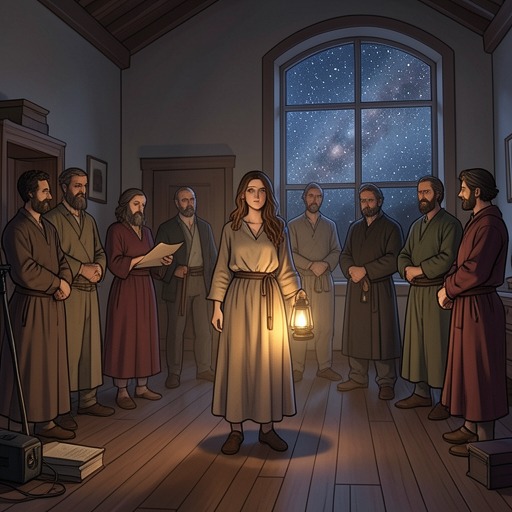
Wilder proposes that they share all decision-making from that point onward through a council, where two votes will override one. The rule therefore gives each brother a voice but does not require unanimity: a divided council can still act by majority. It is a change in their internal political order, not merely a declaration that the brothers are emotionally united. Lycell’s prior reaction to Wilder touching his shoulder underscores how unusual the change is: werewolves do not ordinarily touch one another, and Alpha males maintain personal space as a sign of mutual respect. The council’s shared authority asks the brothers to move beyond that established distance and negotiate as equals.
Adrienne’s Reserved Choice
The majority principle has a defined boundary. Wilder acknowledges that Adrienne, as the mother of their pack, has the top decision over whom she wants to lie with and whom she wants to marry; she cannot marry all three brothers. Her consent and preference in these personal matters are not presented as another question to settle by a two-to-one vote. The rule thus distributes power on two levels: the brothers govern together, while Adrienne decides the intimate and marital choice at the center of their arrangement.
That distinction gives practical force to Adrienne’s own demands. She insists on being addressed by her name, Adrienne Ward, and says that she wants to marry Wilder, Lycell, and Drayton. Her request changes the terms of the relationship, but the brothers’ council does not erase her agency by converting it into a matter for their majority. The rule’s significance lies partly in this separation between a council’s collective authority and an individual’s authority over her own choice.
Political Consequences and Limits
The brothers’ decisions occur amid threats extending beyond their household. Ramsey, Mena’s father, protests that Wilder has broken a promise by sending Mena back and argues that no one will mate with her; he also objects to a human woman influencing Samsa law. Wilder rejects Ramsey’s claim to dictate to him, but the wider danger shapes the response: he tells Drayton that he will have to mate with Mena to keep the werewolves from war, since their forces are not strong enough to face the Alaska and Oregon packs. The episode shows the political pressures surrounding decisions about marriage and pack survival, though it does not establish that the two-vote procedure is used to make this particular decision.
Wilder later tells Robert that he approves of Robert and Mena marrying when Drayton and Adrienne marry, and welcomes Robert remaining as their doctor. He also links the couple’s security to his effort to reach Oregon with his sons and stop an uprising. These decisions show the pack’s alliances and family arrangements expanding beyond the three brothers, but the evidence does not say that either marriage is decided by a recorded council vote. The rule’s clearest stated operation remains its general procedure for shared decision-making, paired with Adrienne’s reserved choice.
The rule marks a shift from hierarchy toward negotiated governance without abolishing the brothers’ Alpha status or their shared obligations. Wilder remains responsible for enforcing werewolf law, while the brothers’ council constrains how authority is exercised among themselves. Its design is both political and familial: majority rule offers a way to act despite disagreement, and Adrienne’s separate authority prevents that mechanism from deciding the very relationship the brothers are organizing their household around.