Waterfall behind the cave
Insatiable Box Set: Books 1-4The waterfall-hidden cave is the decisive enclosed setting of Adrienne Ward’s first sustained encounter with Wilder. Concealed behind a waterfall near the lake, it initially appears to Adrienne as a chance refuge from freezing nights and the white wolf tracking her, but it gradually reveals itself as Wilder’s inhabited home. Within its chambers, human domestic arrangements and predatory wilderness coexist: the cave protects, feeds, and shelters Adrienne, yet it also places her inside Wilder’s territory, his reproductive plans, and the laws of the Samsa family.
Discovery and Physical Setting
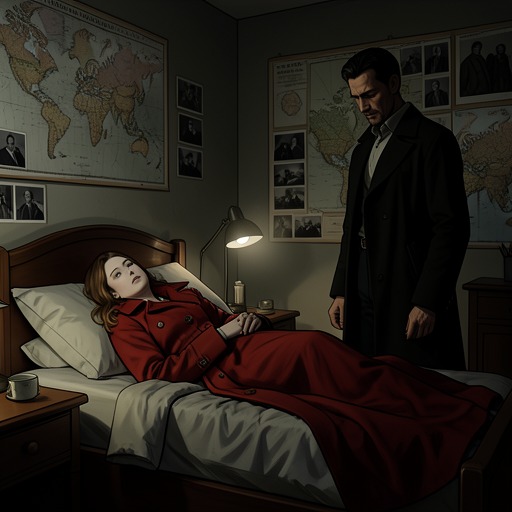
Adrienne reaches the cave after crossing dangerous wilderness in search of water. From behind a boulder near the lake, she sees the waterfall and Wilder, in his white-wolf form, standing above it and howling. Remembering that waterfalls sometimes conceal cave entrances, she follows the sound because exposure to the cold has become untenable. She enters cautiously with a stick, aware that a bear, bats, or wolves might occupy the chamber, but the need for protection outweighs the danger. The entrance conceals more than a natural hollow. In the main chamber, Adrienne finds the embers of a human-made fire and collapses onto a large black bear rug. As daylight enters, the cave becomes legible as a deliberately organized dwelling. It contains cups, plates, spoons, matches, antibiotics, pain pills, iodine, and a large first-aid kit. Its spaces are divided like rooms in a house, including bedrooms, a more elaborate room furnished with animal skins, handmade chairs and tables, a dressing table, an LCD lamp, books, and a cedar chest filled with men’s clothing. A meeting room or dining area contains a large table and eight chairs, while a wooden smokehouse preserves ducks, pigs, squirrels, rabbits, venison, and bear meat. The cave therefore functions not as a temporary den but as a self-sufficient household and a center of pack life.
Refuge, Care, and Domestic Labor
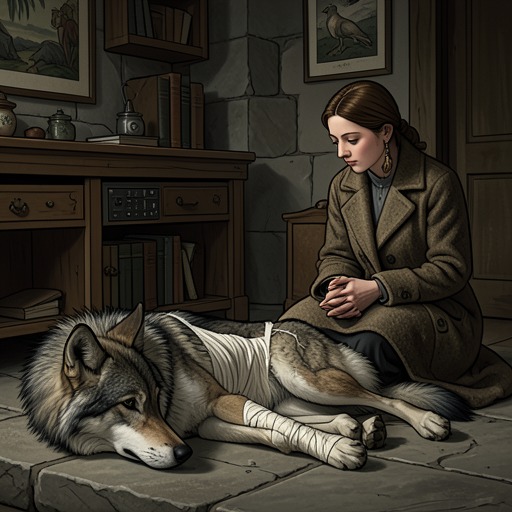
The cave’s first narrative function is survival. Adrienne uses its fire, food, medicines, clothing, and animal pelts to endure the wilderness, while Wilder’s wounded body makes her knowledge of the supplies immediately useful. She debates whether treating the white wolf will make him turn on her, yet she uses the antibiotics, pain medication, iodine, and first-aid materials to keep him alive. The cave converts Adrienne from exposed traveler into caretaker, even as she remains uncertain whether the person she is nursing is an animal, a man, or something more dangerous. That uncertainty becomes the cave’s governing tension. Wilder can sleep on the bear rug and appear helpless, but he remains the Alpha who owns the space and knows its exits. Adrienne attempts to escape by drugging his water, breaking through frozen water at the cave opening with a hammer, wrapping furs around her feet, and entering the snow. The threshold thus marks a struggle between shelter and autonomy. Her departure is not simply a movement from inside to outside: it is an attempt to leave a domestic system whose apparent safety has become inseparable from Wilder’s authority. The escape fails when wilderness and weather expose Adrienne’s vulnerability. Wilder, already injured, carries her back to the cave in his jaws after rescuing her from a bear and finding her unconscious in the snow. He transports her as he would a wolf pup, an image that makes the cave resemble both a nursery and a territorial den. The act is protective, but it also places Adrienne within a hierarchy in which Wilder’s strength, pack status, and knowledge of the landscape determine who may enter, leave, or be protected.
Reproductive Household and Family Law
Inside the cave, Wilder explains the reproductive logic that structures his household. As triplet Alpha wolves, Wilder, Lycell Samsa, and Drayton Samsa have sworn to remain together and to govern their inherited territory equally. Because most werefemales are sterile, Wilder has searched for a fertile female who could bear pups for all three brothers. The cave is consequently the material setting of a family strategy that joins intimacy to population recovery, succession, and territorial defense. Wilder tells Adrienne that she is his mate and that pregnancy makes departure dangerous. He claims that she may leave him, but cannot take the child because the Ari Kara clan might discover the pregnancy and assassinate the heir. His distinction between freedom and custody exposes the cave’s contradictory status: it is presented as a place Adrienne may leave, while the pregnancy is used to make leaving practically and legally impossible. The cave’s walls do not need bars to become confining; the reproductive order supplies the restraints. Wilder’s plans extend beyond one pregnancy. He imagines Adrienne bearing multiple litters for each brother, estimating that two or three pups with each brother every seventy days could produce separate packs, and that repeated pregnancies could rapidly make the Samsa territory too strong to challenge. His desire to cease being a lone wolf and possess a mate and family is therefore inseparable from a demographic program. The cave is where private longing, Alpha succession, and pack expansion become one domestic arrangement. The same arrangement later becomes a matter of explicit marital choice. Adrienne eventually declares that she wants to marry Wilder, Lycell, and Drayton, explaining that Lycell changed her mind. Wilder identifies himself as the Alpha and insists that he will marry her because she is his mate, while Lycell claims that his own pups make him the proper husband. The cave has already established the physical and reproductive foundation for this dispute: its rooms hold the food, clothing, medicines, and intimate history through which the shared-mate household is imagined.
Birth, Confinement, and Transformation
The cave becomes a birth chamber when Lycell takes Adrienne there because it is the safest nearby place. Wilder has prepared for the delivery before leaving, filling a large chest with clothing for Adrienne and the babies or pups, as well as milk bottles. Adrienne gives birth to twins, and Lycell cuts the cords, brings water, clean clothes, blankets, and bottles, and helps keep the newborns warm. His transformation from demanding and sexually indifferent brother into a caring uncle is revealed through the practical labor the cave requires. Snow prevents Adrienne, the twins, and Lycell from returning to the ranch for a month. During that prolonged isolation, the cave functions as a temporary family compound. The twins grow strong and well fed under Lycell’s care, while Adrienne begins to accept that the reproductive arrangement is no longer an abstract proposal but her lived existence. She describes it to herself as something like surrogacy, though more intimate, and the cave becomes the place where that rationalization is tested against motherhood, dependence, and commitment. The cave also retains the memory of Wilder’s absence. Adrienne wonders where the father of her pups has gone and fears that he may have abandoned her after discovering that he did not want to share her. Yet Wilder’s prepared chest shows that he anticipated the birth and expected more than one infant. The objects left behind make his presence persistent even when he is physically absent: the cave stores his plans in clothing, bottles, pelts, furniture, and food.
Contrast with Other Werewolf Spaces
The cave’s domesticity provides a standard against which later spaces are measured. The enormous ranch house appears as a working estate capable of holding five families, with a swimming pool, stables, horses, and German Shepherds guarding its perimeter. A small house on the ranch contains a bed, books, chairs, a tea set, and a quiet retreat associated with the brothers’ human mother. By contrast, the cave is less publicly respectable but more directly shaped by Wilder’s own body, labor, and pack obligations. It is home constructed from cedar, animal skins, preserved meat, fire, and secrecy. Bane’s cabin offers another distorted parallel. Its heated wooden floor, oil lamps, fur rugs, boulder fireplace, and handmade furniture resemble the cave’s fusion of comfort and wilderness, but its emptiness and guarded entrance emphasize captivity rather than family preparation. Bane’s later cave, where Adrienne is tied to a crude branch chair and threatened with being eaten by animals, turns the same general shelter form into an overt instrument of terror. Across these spaces, caves and cabins are never neutral scenery: they encode who controls food, warmth, movement, sexuality, and protection. Wilder eventually drives Adrienne to a newly built forest home, a large cabin illuminated by LED lamps in a snowy clearing. That relocation does not erase the waterfall-hidden cave’s importance. The new residence is an attempt to reproduce its shelter while changing its scale and conditions, moving the household from the concealed original den into a more deliberate forest dwelling. The cave remains the formative prototype of Wilder’s home: part refuge, part nursery, part council space, and part territorial claim.
Narrative Significance
The waterfall-hidden cave concentrates the novel’s central contradiction between human autonomy and werewolf belonging. Adrienne enters it to escape exposure, predators, and the cold, but inside she encounters a social order that defines her through matehood, fertility, inheritance, and pack survival. The cave’s supplies make it hospitable; its hidden entrance makes it private; its rooms make it domestic; and its ownership makes that domesticity political. Its repeated association with fire, animal pelts, preserved meat, medical care, childbirth, and family planning gives the location an unusually complete material vocabulary. Nothing essential to the Samsa household is merely spoken of there: food is stored, wounds are treated, clothing is prepared, infants are delivered, and future packs are imagined. The setting therefore makes visible how the werewolf world reproduces itself—through controlled space as much as through mating. At the same time, Adrienne’s movements through the cave preserve an unresolved resistance. She treats Wilder, drugs him, escapes through the frozen opening, returns through rescue, questions his laws, rejects pregnancy before accepting its consequences, and later chooses marriage on terms that include all three brothers. The cave does not produce a simple conversion from captive outsider to willing member of the pack. It is the enclosed arena in which protection, coercion, desire, motherhood, and choice repeatedly collide.