Wilder–Hunter relationship
Insatiable Box Set: Books 1-4The Wilder–Hunter relationship brings Wilder’s private history into the next generation: he names Hunter after the hunter he once was, then must guide a son who is growing rapidly toward adulthood but is not yet prepared to share his father’s dangers. Its defining scene comes during the search for Adrienne Ward, when Wilder refuses Hunter’s request to accompany him against Bane and sends him back with Devin instead. The separation is protective, but it is also an assertion of paternal authority, delivered through words and a forceful hand on Hunter’s shoulders.
Origins and Family Context
Wilder’s fatherhood is rooted in the family he had long wanted. He and his brothers, all triplets and Alpha wolves, had agreed to remain together rather than divide the territory they inherited from their father. Their plan for a family was shaped by the scarcity of fertile female werewolves and by Wilder’s insistence that he would not capture human women to solve the pack’s declining numbers. When Adrienne Ward became his mate, the arrangement that had once been a difficult plan became the setting in which Hunter and Devin were born.
The narrative links Wilder’s sons to a change in their father. Looking at Hunter during the preparations to find Adrienne, Wilder remembers the self he saw in the boy before meeting her: a being caught between man and beast, driven by both, whose unchecked impulses might have left him a bloodthirsty hunter. Adrienne, the account says, tamed that nature and gave him his sons. Hunter’s name therefore carries a double meaning: it recalls Wilder’s former identity while marking the child who will inherit, but need not simply repeat, it.
The Search for Adrienne Ward
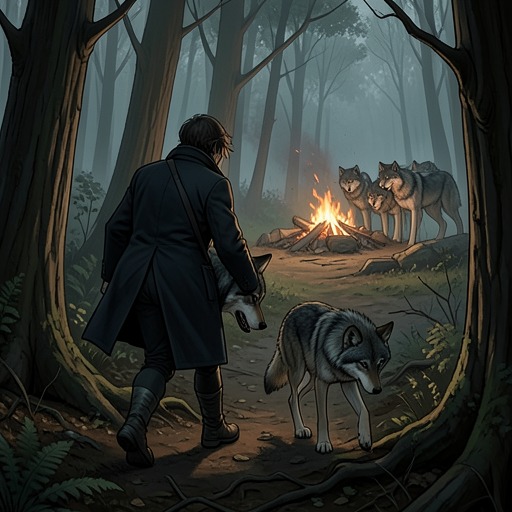
When the family is trying to bring Adrienne home, Drayton urges Wilder to return her to them, acknowledging that his own need for her is shared. Wilder accepts the responsibility of going after her, and the narration describes his transformation into a lone hunter with a single purpose: to kill or be killed. At that moment he looks at Hunter, connecting the dangerous self he is becoming again with the son who bears the name of his past.
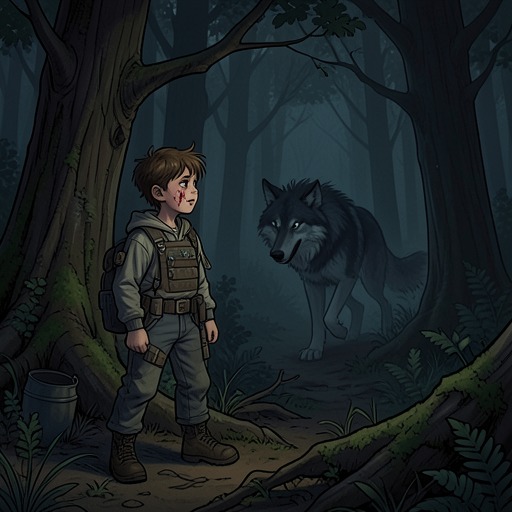
Hunter asks to go with him. Wilder refuses, telling him that he has to learn to listen and that Bane is an adversary for which he is not prepared. He directs Hunter to go with Devin and take Drayton home, while Wilder searches for Adrienne alone. The order separates father and son at the precise point when Hunter wants to join his father’s danger; Wilder makes the distinction between wanting to fight and being ready to face this particular opponent.
The refusal is physical as well as verbal. Wilder puts his hands on Hunter’s shoulders, turns him toward the path Devin and Drayton have taken, then hits and pushes him hard. Hunter understands the gesture. The narrative notes that he has felt his father’s strong hand before, on occasions when he tried to venture alone into the woods. The repeated pattern presents Wilder’s touch as a means of stopping a dangerous departure, though here it also makes the cost of his decision unmistakable: Hunter is physically turned away from the rescue he wants to join.
Protection, Discipline, and Growing Up
Wilder frames the separation as temporary rather than as a denial of Hunter’s future. He tells his son that he will have his own time to fight, endure hardship, love, and experience sexual passion; for now, Hunter must take his uncle home and wait for Wilder to bring his mother back. The charge combines an instruction to obey with an assurance that adulthood and its experiences will come. Hunter walks slowly, measuring each step and looking back, but Wilder has already disappeared from the clearing.
The narration underscores the gap between Hunter’s physical growth and his emotional and sexual maturity. He is already a foot taller than Devin and is growing quickly, yet he has not reached Wilder’s height or matched his strength and cunning. Though close to maturity by werewolf years, he is still a young teenager in human years; he has no yearning for a mate and does not yet understand the sexual passion Wilder mentions. His bewilderment gives the parting its generational edge: Wilder speaks from knowledge Hunter cannot yet possess, while Hunter can register the command and absence without fully grasping the future his father describes.
What the Bond Carries Forward
Wilder’s actions reveal a father who sees both resemblance and risk in Hunter. The son’s name and early stature recall Wilder, but the father’s decision is not to treat resemblance as readiness. He keeps Hunter away from Bane, assigns him the safer return journey with Devin and Drayton, and leaves to search for Adrienne himself. In doing so, he assumes the danger rather than letting his son prove himself through an encounter he judges premature.
The scene leaves the relationship suspended between closeness and separation. Hunter understands the physical rebuke and obeys, but looks back as he goes; Wilder’s disappearance turns a direct instruction into a parting without resolution in the moment. His promise that Hunter will have time to fight and love places the boy’s future beyond the immediate rescue, while the name Hunter and Wilder’s own memories suggest that the father fears the path his son might inherit as much as he recognizes their likeness.