Black Sea
Interview with the VampireThe Black Sea marks the eastern limit of Louis’s first great vampire quest: a destination imagined as the route to ancient knowledge, but reached through darkness, uncertainty, and the failure of inherited explanations. Its shores open the way to Varna, the Carpathians, and the rural communities where Louis and Claudia hope to discover what creatures like themselves are, how their condition began, and whether it can ever end.
Route and Setting
Louis turns toward the Black Sea after deciding that Europe may provide what New Orleans cannot: an origin, a history, and perhaps an answer to the suffering imposed by vampiric existence. Claudia proposes that they begin in central and eastern Europe, where vampires are believed to be most prevalent. Their plan is to travel toward the Black Sea, dock at Varna, and continue through the countryside of the Carpathians in search of beings who might possess knowledge accumulated over centuries.
The approach to the Black Sea is part of a longer maritime passage. As the ship leaves the Atlantic route, crosses the Straits of Gibraltar, and enters the Mediterranean Sea, Louis’s imagination repeatedly confronts the difference between mortal memory and vampire perception. He wants the Mediterranean waters to be blue, but sees them only at night as black waters off Italy and Greece. When he lowers a lantern toward the surface, the light reveals only its own reflection. The sea becomes a visual emblem of a quest that promises illumination while returning darkness.
The Quest Beyond the Shore
The Black Sea is not an isolated setting but the threshold of an itinerary. Claudia’s books describe eastern European vampires through travelers’ accounts by priests and scholars, including customs in which the remains of a vampire are burned, the heart staked, and the head severed. Guided by these texts, she plans a journey that will take them from the glittering capitals of Europe toward Varna and then into the Carpathians.
The journey is materially shaped by Claudia’s determination. At Varna she insists on a luxurious black coach with leather seats large enough for a band of travelers, although Louis and Claudia use its magnificent compartment chiefly to transport an ornately carved oak chest. The coach and the trunks of fine clothing express Claudia’s inheritance from both makers: from Louis, the value of money, and from Lestat, a passion for spending it. The expensive equipment contrasts with the primitive villages they seek, joining modern mobility and wealth to an old folklore of burial grounds and walking corpses.
Louis reaches the Black Sea carrying two conflicting desires. He wants knowledge that might explain why such suffering exists and how it might be ended, but he also longs for the monumental remains of mortal civilization. He imagines Athens, the Acropolis, the Parthenon, and the ancient Greeks as the monuments of people who could not die in the same sense as the living dead. The Black Sea therefore stands between two kinds of antiquity: the enduring achievements of mortal culture and the degraded supernatural existence Louis fears he may share.
Eastern European Discoveries
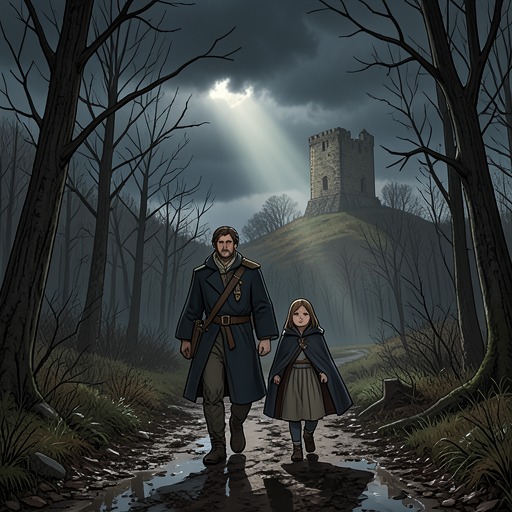
The search through Transylvania, Hungary, Bulgaria, and the surrounding countries repeatedly frustrates the expectation that the Black Sea region will contain articulate, ancient counterparts to Louis and Claudia. In village after village, the vampires they find are mindless corpses. Some are observed only from a distance, with wagging heads, stooped shoulders, and rotted clothing. In one hamlet, a woman dead for only a few months flees through the forest in a white burial gown stained with dried blood, her fingers packed with grave dirt and her eyes empty of thought.
These creatures provide no secret knowledge and no explanation of vampiric origins. They embody despair rather than wisdom. Their condition forces Louis to distinguish between their own conscious, reflective existence and another form of undeath that has been reduced to automatic movement. Claudia treats the discovery as evidence that they must continue searching for those who can explain the difference. Louis, however, experiences it as a collapse of hope: the Black Sea route leads not to a community of teachers but to corpses without language, memory, or answers.
The encounters also revive Louis’s fear that Lestat may have been the only vampire capable of conscious life like theirs. Although Louis believes that he and Claudia killed Lestat, the empty nights of eastern Europe make him think of Lestat repeatedly. The prospect that Lestat alone possessed the necessary wisdom or power becomes increasingly disturbing, because the apparent death of the one person who might have explained their condition leaves the travelers without a credible source of knowledge.
Symbolic and Narrative Significance
By the time the Mediterranean waters become, in fact, the waters of the Black Sea, the geographical transition has become an emotional one. Louis’s hope beats faster as the mountains of eastern Europe approach, yet the destination is attached to a question he cannot answer for himself: why this suffering was permitted to begin and how it might be brought to an end. He admits that he lacks the courage to end his existence without first receiving that answer, making the Black Sea the site toward which his moral and existential crisis is directed.
The region also exposes the limits of the vampire legends that have guided the quest. The books Claudia treats as a kind of Bible preserve accounts of rituals and sightings, but the living evidence offers only mindless bodies and recurring despair. Folklore supplies categories—burial, staking, severing, burning—without supplying an intelligible history. The Black Sea thus converts inherited myth into an encounter with material horror, revealing how little traditional knowledge can explain about Louis and Claudia themselves.
The Black Sea’s importance continues even after the travelers leave its immediate route. The eastern European quest fails to provide the answers they seek, and Claudia eventually insists that they bypass Vienna and go directly to Paris, where they may find their own language and people. The movement westward does not erase what the Black Sea has revealed: that the search for origins can produce more uncertainty, that immortality may exist in radically different forms, and that knowledge promised by ancient landscapes may deepen rather than resolve the vampire’s exile from humanity.