Children of Satan
Interview with the Vampire“Children of Satan” is the expression Louis uses to test whether vampiric existence has a religious explanation. In his conversation with Armand, the phrase becomes a crisis of interpretation: if vampires are Satan’s children, their violence might belong to a cosmic order; if they are not, then their immortality and their killing remain terrifyingly without external meaning. Armand’s answer turns the expression against the myths that sustain it, insisting that vampires are not the offspring of a devilish power but beings forced to confront their own consciousness and choices.
The Question of Origin
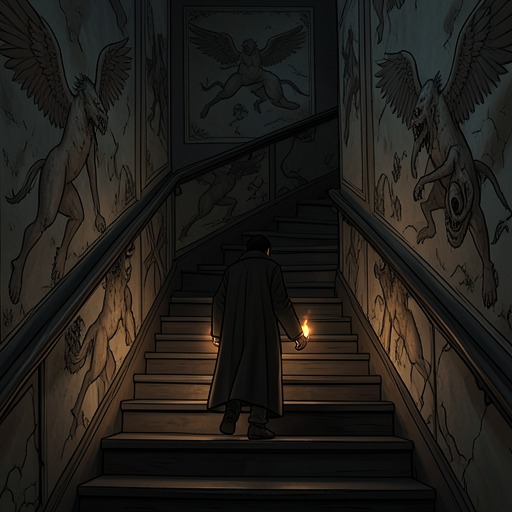
Louis raises “Children of Satan” while looking at a medieval image of the devil in Armand’s room. He asks whether Satan, or some satanic power, gives Armand his authority as a vampire and as the possible leader of the group. Armand answers that neither Satan nor the other vampires supplies that power. When Louis presses the question of whether they are “the children of Satan,” Armand responds by questioning the premise itself: if God made the world and also made Satan, then Satan remains God’s child, and vampires would likewise be God’s children rather than a separate demonic species.
The exchange separates vampiric identity from inherited supernatural allegiance. The expression sounds like an explanation, but Armand treats it as a name imposed on the unknown. His logic removes the clean opposition between divine and satanic origins: there are no independent “Children of Satan” because Satan’s power, if Satan exists, would still derive from God. The phrase therefore fails to provide Louis with the religious distinction he wants.
Evil Without a Devil
The expression becomes inseparable from Louis’s fear that vampirism has made him irredeemably evil. He admits that he has killed repeatedly and will kill again, including the mortal Denis whom Armand offered him. Louis cannot accept Armand’s suggestion that evil has degrees in the same way goodness does; for him, evil is a dark and empty condition, without consolation. The phrase “Children of Satan” gives that despair a theological shape, but it does not relieve it.
Armand instead asks how anyone becomes evil in an absolute sense. He challenges the assumption that one sin creates a person who is as evil as a revolutionary tribunal or a cruel Roman emperor. When Louis argues that the taking of a single human life is real evil, he grounds that judgment not in Satan but in the value of mortal existence. If God does not exist, humans possess the highest consciousness Louis can recognize, and every second of a human life may be all that person has. Under that logic, the vampire’s crime is not demonic obedience; it is the conscious destruction of another finite life.
Armand’s Rejection of the Myth
Armand’s final response is physical as well as intellectual. He kneels before Louis, holds his head, and declares that the ideas of “Children of Satan” and “Children of God” arise from disappointment and bitterness. He argues that Louis and the other vampires have made themselves into gods and devils because they cannot bear the absence of a higher explanation. He then tears the image of the devil from the wall and throws it into the fire, reducing the emblem that had supported Louis’s speculation to burning material.
This rejection does not calm Louis. Instead, it breaks something inside him. Louis objects that he and Armand are immortal, ageless beings who rise nightly to feed on human blood, while Claudia sits in the room as a child vampire no less demonic in appearance than they are. For Louis, such facts make fantastical explanations seem possible, not absurd. Armand’s claim that there is no meaning therefore produces not consolation but a deeper shock: the vampire’s condition may have no divine author, satanic purpose, or hidden moral structure.
Meaning After the Expression Fails
The phrase also marks the collapse of Louis’s search for an external authority. He had traveled through eastern Europe seeking vampires who could explain what creatures like himself were, only to find mindless corpses rather than wise ancestors. In Paris, he turns to Armand, whom he regards as a four-hundred-year-old master vampire, hoping that age will yield religious or metaphysical knowledge. Armand tells him that he has no knowledge of God, no knowledge of the devil, and has never known a vampire who has spoken with either.
When “Children of Satan” is stripped of its explanatory force, Louis is left with a freedom that feels like abandonment. His response is to leave Armand’s room, while Claudia’s gesture silently encourages him to continue. The expression therefore functions less as a doctrine than as a failed shelter. It gathers Louis’s questions about creation, sin, immortality, and the value of life, then exposes the loneliness beneath them: neither Satan nor God can be summoned to take responsibility for what the vampires do.
Thematic Significance
“Children of Satan” is opposed by the phrase “Children of God,” but the narrative refuses to settle the matter through a simple reversal. Armand’s reasoning makes the two expressions part of the same human effort to classify the supernatural. Both offer inherited identities; both promise that vampiric existence belongs to a larger order. Louis wants such an order because his own feelings—his sympathy, guilt, love, and horror at killing—cannot be reconciled with the fact of his predation.
The expression’s decisive significance lies in its failure. It does not define the vampires, explain their powers, or absolve their violence. Instead, it exposes the distance between religious language and lived experience. Louis remains a creature who must kill, who can love other vampires, and who suffers because consciousness does not remove responsibility. Armand’s destruction of the devil image makes that condition visible: the emblem burns, but the question survives inside Louis, deprived of both a cosmic enemy and a cosmic justification.