Claudia's attack on Lestat
Interview with the VampireClaudia's attack on Lestat is the central reversal in the household's struggle for control: Claudia turns the rituals of feeding, hospitality, and parental devotion against the vampire who has dominated her and Louis. By presenting Lestat with poisoned children, she creates the conditions for his incapacitation, then attacks him with a knife and her teeth. Louis does not prevent the assault, helps dispose of the remains, and briefly believes that the destruction of Lestat has made them free. The later sight of Lestat alive converts the apparent victory into a deception and leaves the consequences of the attack unresolved.
Causes and Preparation
Claudia's plan grows out of an enduring conflict with Lestat's authority. He calls himself her father, insists that she needs him, and demands that she stop questioning him and searching for other vampires. His possessive protection therefore functions as confinement: he claims to provide everything she needs while refusing to answer the questions through which she seeks knowledge and independence. Claudia identifies that contradiction directly, arguing that he knows little and detests her questions because they expose his ignorance.
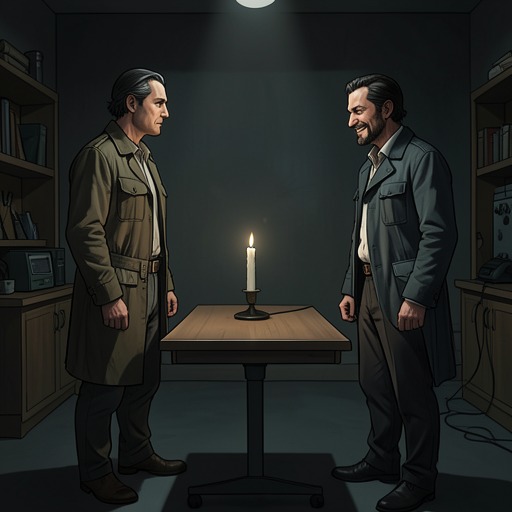
The immediate preparation is disguised as reconciliation. Claudia tells Lestat that she wants peace and presents the gift as an attempt to end their hatred before Louis leaves them both. She has found two orphaned boys, apparently made helpless by sleep and brandy wine, and arranges them on velvet cushions beside a meal served on the household's best china. The scene imitates a domestic entertainment, but its objects expose the violence beneath the manners: the stained tablecloth, greasy plates, half-full bottle, and untouched throats turn the language of hospitality into a trap.
Claudia also understands Lestat's appetite and vanity. She flatters him by offering what he wants most, a precious feeding moment, and invokes the language of innocence while directing him toward the children. Lestat is drawn to the beautiful darker boy, whom he compares to an angel, and invites Claudia to feed beside him. The apparent gift thus reverses the ordinary hierarchy between parent and child: the supposed daughter becomes the host, the planner, and the person who controls the father's access to blood.
The Attack
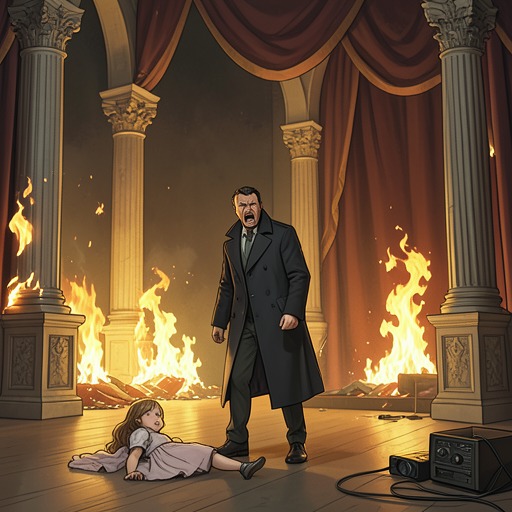
Lestat feeds first, embracing one boy tightly and drinking until the child's body withers. Claudia lies beside the unharmed second child, maintaining the appearance of innocence while waiting for the poison to take effect. The change in Lestat is initially mysterious. He stares upward, shivers, and becomes unable to move; when he calls for Louis, Claudia orders Louis to remain back and asks whether he dislikes the taste of children's blood.
Lestat attributes his paralysis to excessive absinthe, but Claudia identifies the full mechanism: the children have been poisoned with absinthe and laudanum. She calls him a demon and answers his plea to be placed in his coffin with the promise that she will put him there forever. From beneath the pillows she produces a kitchen knife. Louis protests, but Claudia's violence has already exceeded his ability to act. She cuts Lestat's throat, then drives the knife into his chest as blood pours over his shirt, coat, and the carpet.
The knife does not immediately end the assault. Lestat struggles, calls repeatedly for Louis, and reaches toward the weapon. Claudia then attacks him with her own mouth, clamping both arms around his neck and drinking while he tries to throw her off. The attack combines calculated poisoning, physical mutilation, and the intimate act of feeding. Its horror lies partly in this convergence: Claudia destroys Lestat by turning the very appetite and bodily intimacy that structure vampire life into instruments of revenge.
Louis's Complicity and the Disposal of the Body
Louis is appalled and paralyzed, but his refusal to intervene does not leave him innocent. After Claudia withdraws, Lestat's body shrivels before them. The skin wrinkles and whitens, the bones emerge, the flesh of the nose dries away, and the clothes collapse around what remains. The eyes continue to stare until the irises roll upward and the whites grow dim. The spectacle makes Lestat's apparent destruction visible as a grotesque transformation from living vampire to a nearly weightless skeleton-like remnant.
The room itself records the cost of the attack. Blood darkens the woven flowers of the carpet and stains Claudia's dress, white shoes, and cheek. Claudia immediately turns from revenge to concealment, insisting that Louis help remove the body and deal with the dead children. She also has to correct her own earlier mistake: the bones of the mother and daughter she killed remain heaped in the kitchen stove. Louis scrapes them into a sack, hitches the horse, quiets the groggy coachman, and drives the hearse away from the city toward the Bayou St. Jean and the swamp beyond Lake Pontchartrain.
Claudia wraps Lestat's remains in a sheet and covers them with chrysanthemums, giving the corpse a sweet, funereal scent. Louis carries the bundle into dark water as dawn approaches and releases it beneath the slimy surface. The disposal is both practical concealment and a symbolic burial. In the water, Louis recognizes that what he is surrendering is not merely a body but the transformation and mystery that had defined his existence. He feels an overpowering impulse to descend with Lestat and let everything disappear, but Claudia calls his name from the distant shell road, drawing him back.
Apparent Liberation and Its Cost
After the burial, Claudia embraces Louis inside the coffin and repeatedly tells him that she loves him and that they are free of Lestat forever. The declaration gives the attack its immediate emotional result: a household organized around Lestat's coercive knowledge and appetite appears to have been replaced by a bond founded on shared action and shared guilt. Yet Louis cannot accept the moral logic of the victory. When Claudia searches Lestat's belongings and complains that there is no clue to who made him or where he came from, Louis answers that if Lestat deserved to die, then they deserve to die in the same way every night of their lives.
The attack therefore liberates Claudia and Louis from Lestat's immediate presence while binding them more tightly through responsibility. Claudia's claim that they are free is set against Louis's recognition that they have reproduced the violence they condemn. The event is not a clean emancipation but a transfer of power: Claudia gains initiative, Louis becomes her reluctant collaborator, and the household's violence continues under a new arrangement.
Reversal and Narrative Significance
The apparent destruction of Lestat is later exposed as incomplete. Louis follows another vampire through a shabby New Orleans neighborhood and discovers a house where a stooped, shivering blond vampire sits beside a fire, dependent on animal victims and complaining that others have abandoned him. The profile, hair, and eyes unmistakably identify the figure as Lestat despite his altered voice, bent posture, and ruined condition. Lestat recognizes Louis when the window opens and frantically asks that he be admitted.
This later recognition changes the meaning of the earlier attack. The swamp burial was not the end of Lestat but the end of Louis and Claudia's confidence that violence could settle their relationship. The scene's deepest reversal is consequently not only physical survival but epistemic failure: Louis believed that he had witnessed the final extinction of Lestat, while the narrative later shows that the corpse was not proof of final death. Claudia's revenge remains decisive because it breaks Lestat's old dominance, but it does not erase him. Instead, it creates a new uncertainty in which liberation, guilt, fear, and the possibility of renewed conflict coexist.