Claudia's creation
Interview with the VampireClaudia's creation is the event in which Louis and Lestat transform a gravely ill child into a vampire, establishing the unnatural family that governs the next phase of their existence. Lestat discovers the girl in a ward for starving children and orphans of plague and fever, then leads Louis to her while presenting the rescue as an act of compassion. Beneath that appearance, however, Lestat has selected her as a victim and as the “child” he wants that night. The creation therefore begins in a collision between rescue, appetite, manipulation, and the need to keep Louis beside him.
Causes and Background
Lestat brings Louis to the child after reminding him that his pain will end if he does what his nature demands. Louis is still struggling with the moral and physical shock of killing, but the sight of the girl reawakens the hunger he had felt when he first encountered her beside her dead mother. Lestat insists that Louis wants her and that his earlier hesitation was weakness rather than mercy. The child’s beating heart, her feverish warmth, and her helpless condition become the focus of Louis’s divided response: he wants her life to continue, yet he also desires the blood that sustains it.
The setting intensifies the contradiction. The ward contains rows of wooden beds, a single candle, a nurse, and children brought in by ships, many too young to identify their dead mothers. Lestat pays the doctor and allows him to assume that they are taking the girl as her father. He then carries her through the night wrapped in a white blanket, making the theft look like a paternal removal from danger. The transaction places Claudia between human abandonment and vampire possession before she has any power to understand either.
What Happens
Louis finally takes the girl in his arms and drinks from her. He tells himself that death may be better for her than continued sickness and abandonment, but recognizes that these are false justifications: he wants her. He drinks until he is overwhelmed by the killing and expects her heart to slow, yet Lestat tears him away before she dies. The interruption leaves Louis stunned and weak, while the child remains alive at the threshold between mortal illness and vampire existence.
Lestat immediately completes the transformation. He cuts his wrist and gives the blood to the child, calling her Claudia and urging her to drink so that she will become well. She fastens onto him with unexpected force, growling and refusing to release his wrist; Lestat is visibly pained and finally pulls away, warning her that she must not drink after a heart has stopped. He then summons a young slave boy, kills him from behind, and teaches Claudia to drink from the fresh corpse while watching the boy’s chest. The boy dies within seconds, and Lestat instructs Claudia to stop before the heart ceases, presenting the rules of her new appetite at the very moment he creates her.
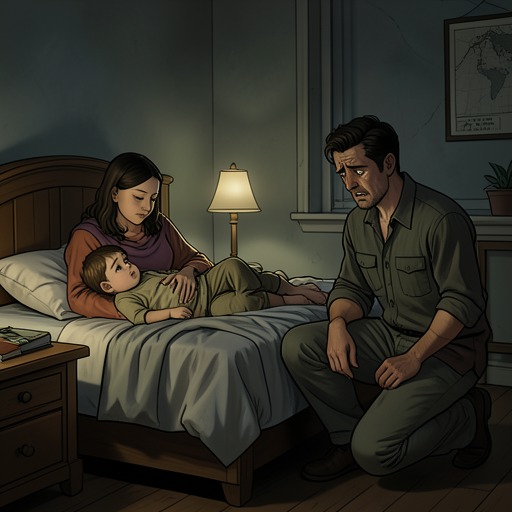
When Claudia asks where her mother is, Lestat declares that she is their daughter and that she will live with them. He places her on Louis’s lap, combs her hair, and tells her that her mother has left her with them so that they can make her happy. Claudia initially rejects the new designation, insisting that she is her mother’s daughter, but Lestat closes the bedroom door, locks it, and defines the household as a new family: Claudia is to be Louis’s daughter and Lestat’s daughter. He also uses her transformation to prevent Louis from leaving, making the creation both a supernatural birth and an act of coercive domestic arrangement.
Immediate Consequences and Family Structure
Claudia awakens with the cold fire of a vampire. Her body retains the rounded form and beauty of a child, but her eyes already possess an adult quality, and her hunger immediately exceeds the sentimental language Lestat uses around her. She asks for more blood from the dead, and Lestat postpones the feeding until the following night. The bodies of the women and the slave boy are placed together in the bed and described to her as sick and dead, giving her first lesson in vampiric life a stark equation between feeding and death.
For Louis, the event creates a bond of guilt and tenderness. He remembers that he has effectively killed Claudia once already by draining her, yet she survives to embrace him, kiss him, and draw him into a relationship that the narrative names in deliberately unstable terms: “Father and Daughter. Lover and Lover.” He becomes her companion and pupil-master, teaching her music, painting, and knowledge, while she shares with him a quiet understanding that cannot include Lestat. Lestat, by contrast, claims the parts of Claudia’s existence that he shares with her: he takes her into the streets for the hunt, seduction, and kill, then waves to Louis beneath the window as though the family’s division of roles were ordinary.
The creation also fixes Claudia’s physical condition. Years pass, but her body never grows beyond the child in which she was made. Her mind, however, is a vampire’s mind and develops toward adulthood. She becomes increasingly articulate, intellectually forceful, sensual, and difficult to read, while still possessing the doll-like face, small body, and voice that make others treat her as a child. Her permanence turns age into a structural contradiction: she is socially performed as a daughter and dressed as a doll, yet she can challenge Lestat’s predictions, demand books, devise thefts, and understand killing as more serious than art or music.
Wider Plot and Thematic Significance
Claudia’s creation becomes the hidden cause of the household’s later rupture. Her attachment to Louis deepens as her separation from ordinary human sympathy becomes clearer, and she clings to him despite what he has done or failed to do because he remains the closest link to human feeling available to her. At the same time, the fixed child-body intensifies her frustration and makes her dependence on Louis and Lestat permanent in outward form even as her consciousness grows beyond theirs. The event thus produces intimacy and imprisonment at once.
The creation also explains the later search for other vampires. Claudia wants knowledge of her own kind and believes that central Europe may contain answers about their origins, while Louis longs for a broader understanding of what they are. Their journey leads through the Carpathians and other parts of Eastern Europe, where they encounter mostly mindless dead creatures rather than beings capable of explaining conscious vampiric life. The failure of that search makes Claudia’s creation seem even more singular and terrible: she is not merely another vampire, but a deliberately fashioned child whose intelligence has no natural model among the revenants they find.
The same contradiction is echoed in Paris, where the Théâtre des Vampires turns killing into public spectacle. Louis and Claudia attend by invitation from Armand, entering a theater whose human audience watches vampires stage Death, fear, and consumption as entertainment. The performance exposes the boundary between representation and reality: the actors wear masks and manipulate scenery, but the vampires’ predation is genuine. Claudia’s creation has already established that same unstable structure in private, where parental language disguises appetite and a dying child is made into a permanent performer of childhood.
The consequences extend beyond Claudia’s immediate household. After Claudia and Madeleine are destroyed in Paris, Louis leaves the theater and later learns from Armand that Lestat survived the fire and returned to New Orleans. That revelation draws Louis back toward the city and toward the source of the family he had lost. When the story is finally told to the young interviewer, its effect is itself a consequence of Claudia’s creation: the listener hears the event as the beginning of an extraordinary life and asks to be made a vampire, while Louis responds with anger and despair. The creation therefore remains the point at which wonder and damnation become inseparable, generating the family Louis loves, the child who can never grow, and the chain of longing that survives her destruction.