Conscious death
Interview with the VampireConscious death names the condition in which killing is neither accidental nor unconscious but deliberately perceived, staged, and shared. The phrase gives supernatural death a distinctive moral and aesthetic form: the victim is not merely extinguished, and the killer is not permitted the shelter of numbness. In Louis’s account, conscious death is at once a vampire’s power, a theatrical performance, and a source of unbearable responsibility.
Definition and Contrast
Louis distinguishes conscious death from the ordinary human fate of what he calls “Unconscious death.” Mortals die without possessing the vampire’s intimate awareness of the act; their deaths are governed by illness, violence, and chance, while the vampire can approach death as an intentional presence that knows its victim and chooses the moment of contact. The distinction therefore concerns more than physiology. It separates an impersonal mortality from a death made lucid, interpersonal, and dramatically charged.
The phrase also exposes the vampire’s dependence on the mortal imagination. The vampire can call himself Death, but the meaning of that title is produced through the victim’s recognition and fear. Conscious death requires a witness who understands what is happening, even if that understanding is manipulated. It is thus both a mode of killing and a structure of power: the victim’s awareness intensifies the vampire’s control, while the killer’s awareness makes the act morally inescapable.
The Théâtre des Vampires
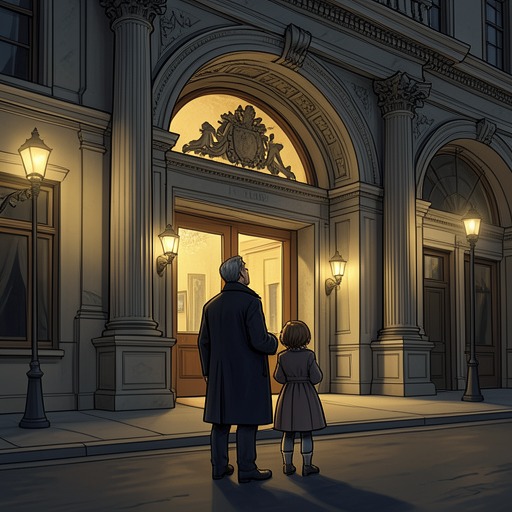
The Théâtre des Vampires turns conscious death into public entertainment. After Armand gives Louis a card inviting him and Claudia to the theater, they enter a space where human spectators believe they are watching an illusion. The theater is by invitation only, its audience entirely mortal, and its vampires hidden in plain sight among the costumes, lighting, music, and conventions of performance. The stage therefore does not represent death from a safe distance; it disguises an actual killing as drama.
The opening spectacle presents Death in a dark wood, carrying a silver scythe and wearing a skull mask. The figure moves with calculated grace while the audience responds with gasps, laughter, sighs, and applause. The performance repeatedly shifts the audience’s position: spectators laugh at the old woman and the beggars who pursue Death, then become fascinated by the threatened young woman. What appears to be an allegory gradually reveals itself as the vampires’ actual social ritual, with theatrical framing used to normalize the mortal victim’s destruction.
Seven vampires surround the woman, including three women whose pale bodies and black clothing contrast with her golden hair and human skin. Their circle makes her death visible as a composition, almost a tableau, while their still faces present appetite as discipline. The audience’s response supplies the theater’s moral distortion. Human viewers applaud the scene because they believe it is fiction; the vampires exploit that belief to turn murder into an aesthetic event and to make spectators participate in the spectacle without understanding what they are endorsing.
Seduction, Awareness, and Killing
The master vampire first confronts the woman with an argument that combines terror and logic. He tells her that death may already be inside her through sickness, or waiting outside in the form of a murderer, and insists that age cannot guarantee her future. When she refuses to choose another person to die in her place, the scene makes her innocence part of the spectacle. She is forced to defend life while the vampire converts every possible answer into evidence against her.
The killing becomes explicitly conscious when the vampire declares, “We are conscious death.” He presents himself not simply as an executioner but as Death made aware of its own identity, and he recasts the victim as a “bride” who might know what it means to be loved by Death. The language is seductive because it offers intimacy where there is only domination. Her fear, tears, and hesitation are treated as signs of beauty, and her growing helplessness is made to appear as consent.
The phrase “No pain” introduces another form of manipulation. A second vampire, later identified as Armand, interrupts the master vampire’s performance with a calm promise that the woman will feel no pain. The promise subdues the theater and draws the victim toward him; she repeats the words and gives herself over in a state of languor. Yet Louis perceives the contradiction beneath the promise. The woman is not spared consciousness; she is rendered vulnerable by a false consolation that makes her surrender seem peaceful.
The vampires then pass her from one to another before the enthralled audience. Louis tastes her blood and experiences hunger, passion, weakness, and torment simultaneously. The killing is communal, but the victim remains visibly individual: her body, breath, tears, and heartbeat preserve the human presence that the performance claims merely to imitate. When she is finally left on a black bier in the painted forest, the stage image restores the appearance of fiction, even though the audience has witnessed an actual death.
Louis’s Moral Resistance
Louis cannot occupy the detached position the theater demands. He reaches for Claudia’s hand during the performance, feels anger at the master vampire’s treatment of the woman, and recognizes that the victim is being forced to argue for the sanctity of life against an opponent who controls both logic and violence. His sympathy does not prevent him from desiring the woman, which makes conscious death especially troubling: awareness does not purify appetite, and compassion exists beside the impulse to kill.
After the performance, Louis realizes that he could descend to the empty aisle, seize an usher, and consume him as the girl was consumed. He wants to do so and wants nothing at the same time. Claudia’s warning to be patient interrupts the movement from perception to action, but it does not erase the desire. Conscious death therefore includes the killer’s knowledge of his own divided will: Louis sees the connection between the theater’s staged murder and his own capacity for violence, even while rejecting the theater’s pleasure in making violence beautiful.
His response contrasts with the theater vampires’ collective composure. They treat the human victim as material for an art form, while Louis experiences her death as an invasion of his body and conscience. The theater’s audience applauds when the scene ends, but Louis remains with the taste of the girl on his lips and the memory of her heartbeat. The applause marks the social success of the performance; his confusion marks its ethical failure.
Theology, Power, and Consequences
Conscious death also shapes Louis’s later discussions with Armand. Louis asks whether vampires are “the children of Satan,” seeking a religious explanation for the cruelty he sees in himself and in the theater. Armand rejects the idea that vampires derive their power from Satan and argues that, if God created Satan, then Satan’s power ultimately comes from God. This reasoning does not console Louis. It places the vampire’s violence within a larger moral order without removing personal responsibility.
Louis insists that he is evil because he has killed repeatedly and will kill again. Armand challenges the idea that evil is a single abyss entered through the first sin, contrasting degrees of evil with degrees of goodness. Their discussion clarifies why conscious death matters to Louis: he cannot use supernatural nature, Satan, or theatrical convention to make killing morally neutral. Because he feels the victim’s fear and his own hunger, each death becomes an accusation as well as an act.
Armand recognizes this difference when he says that Louis suffers in the theater and in the killing of Denis, dying inwardly whenever he kills as though he deserves to die. Louis’s sympathy is therefore not simply kindness; it is a form of self-punishment that binds perception to guilt. Armand’s detachment attracts Louis precisely because it seems to promise knowledge without moral evasion, yet Louis’s inability to acquire it preserves the conflict at the center of his identity.
Legacy of the Concept
The concept reaches beyond the theater into the conditions of vampire existence. Louis becomes fully a vampire when he shuts the blinds of Paul’s oratory, locks the door, and enters the satin-lined coffin, recognizing that his feeling toward his dead brother has changed into a complete and terrible intensity. His transformation is not merely a supernatural initiation; it is a passage into a life where death must be repeatedly perceived, managed, and enacted. The coffin, the locked room, and the theater all make consciousness spatial: the vampire is enclosed with the consequences of what he is.
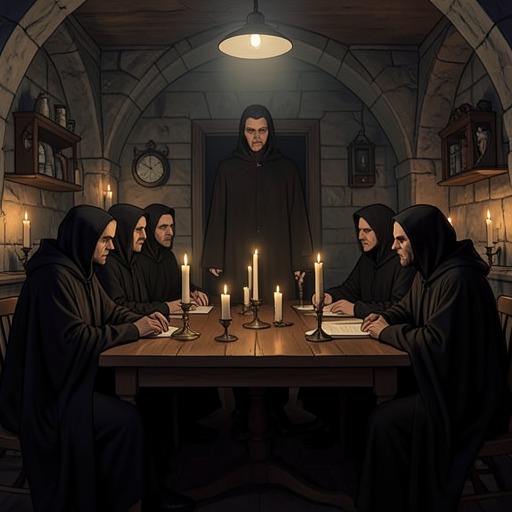
The same logic governs the underground theater, where Armand leads Louis and Claudia through a hidden door into a ballroom surrounded by images of death, hell, and fallen angels. The murals make visible the theological and historical imagination surrounding the vampires, but Armand insists that a picture is only a picture. The theater’s art can frame killing, and religion can provide language for it, yet neither image nor doctrine can finally decide what the act means for Louis.
Louis’s later destruction of the Théâtre des Vampires completes his rejection of conscious death as spectacle. Before dawn, he boards the theater’s doors from outside, enters Armand’s deserted cell, and spreads kerosene through the lower rooms, the ballroom, the cells, the stage curtain, and the lobby. The empty theater preserves the scene’s central irony: the institution that made real death look imaginary is destroyed through an act that strips away performance and leaves only consequence. Conscious death survives as a moral problem, but not as the theater’s triumphant art.
At the end of Louis’s recorded account, the boy responds to the story by demanding the power to see, feel, and live forever, asking to become a vampire immediately. Louis reacts with rage because the boy has heard conscious death as adventure rather than condemnation. His final act is to bite the boy, apparently attempting to force the meaning of the story into the body of a listener who has mistaken lucidity for liberation. The episode confirms the concept’s final paradox: conscious death can be described, performed, and argued about, but its full meaning cannot be received safely from the outside.