Damnation
Interview with the VampireDamnation is the spiritual condition through which Louis interprets vampiric existence and his own actions. It begins as a fear that becoming a vampire has placed him beyond God’s mercy, develops into a sustained crisis over the morality of killing, and culminates in his conviction that he is damned in his own mind and soul. The concept is therefore both theological and psychological: it names the fate Louis imagines for the vampire, but also the inward sentence he continues to pronounce upon himself.
Definition and First Recognition
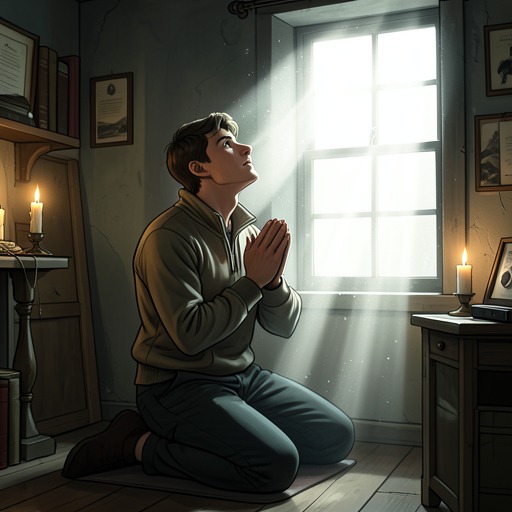
Louis does not initially receive a formal doctrine of damnation from Lestat. Instead, he derives it from the experience of becoming a creature whose survival requires the taking of life. After Lestat has instructed him in the practical conditions of vampiric existence, Louis retreats to his brother Paul’s oratory, carries in his coffin, and recognizes that he has become fully and completely a vampire. The setting joins religious imagery, death, and enclosure: he places himself before the images of the saints, shuts the blinds, bolts the door, and locks himself into the coffin until morning. His transformation is thus marked not by liberation but by a deliberate withdrawal from the human and sacred world.
The experience of killing intensifies that judgment. Louis distinguishes between the swift, almost unconscious death he inflicts as a vampire and the slow decay of Lestat’s father, whose living corpse remains lucid beneath the ravages of time. The contrast makes death appear in two forms: the victim whom vampiric killing leaves apparently peaceful, and the body visibly resisting its own disappearance. Louis’s pity for the old man does not restore his human position; it makes him more conscious of the distance between human suffering and the detached efficiency of the vampire.
Moral Conflict and the Nature of Killing
Louis tries to protect himself from the full moral meaning of vampirism by beginning with animals. He tells the boy that he once regarded this choice as aesthetic rather than moral: animal death offered him an intermediate experience, allowing him to approach human death gradually. Yet he later recognizes that the distinction cannot hold. His judgment that “all aesthetic decisions are moral” means that every choice of victim expresses a conception of the good, even when the chooser calls it taste, refinement, or artistic necessity. The issue is not whether a decision is aesthetic or moral, but which morality it serves and how it conflicts with the morality of society.
This reasoning does not free Louis from guilt. He sees the moral evasions of the artist who treats wrongdoing as an inevitable sacrifice and then imagines morality as a glass world shattered by one act. The image explains his own terror: he fears that becoming a vampire has broken the boundary separating him from grace, after which despair and irresponsibility might follow. He compares his sense of damnation to Judas after his betrayal, suggesting that the belief in condemnation may arise before any external judge pronounces it.
Lestat offers the opposite interpretation. In the darkness of New Orleans, when Louis is tormented by the knowledge that killing alone silences his longing, Lestat urges him to do what his nature requires. He presents vampiric violence as a natural law and declares that evil is a point of view. Immortality, in his account, grants access to feasts beyond mortal conscience; the vampire becomes a dark angel, an inhuman being wandering through the world rather than a soul confined to a conventional hell. Louis is briefly mesmerized by this argument because it promises an end to pain, but its power depends on replacing moral judgment with nature and appetite.
The seduction fails to resolve the contradiction. Louis knows that killing brings him peace, yet he also knows that animal blood gives only vague dissatisfaction and that human blood produces the complete physical relief of the kill. His question is not simply whether killing is forbidden; it is whether the desire to kill proves that his nature itself is evil. The vampire’s appetite becomes evidence against the vampire, while the revulsion he still feels becomes evidence that some human moral awareness survives.
Damnation as an Existential Condition
Louis’s crisis resembles an encounter with death that cannot be completed. He wishes to die, even imagining death as sweet and calm, but his body continues to demand blood. His immortality removes the ordinary human possibility of resolving despair through mortality: he can neither return to being human nor escape the consequences of continuing to exist. Damnation therefore becomes an endless condition rather than a final sentence. He is condemned to live through the question of whether his life is worth preserving.
The most concentrated expression of this crisis occurs during his night walk with Lestat. Louis asks whether he is from the devil and whether his very nature is that of a devil. For one brief moment, however, the confusion and pain disappear as he hears the wind and the Mississippi River. The relief is immediately understood as temporary, something that will vanish and leave him more desperately lonely in its absence. Lestat then turns that fragile stillness into a doctrine of surrender: Louis should not turn away from the nature that causes his suffering, but embrace it.
That moment does not produce genuine conversion. It produces submission under pressure. Lestat leads Louis toward a human victim while promising that the pain will end, using the same authority that once persuaded Louis to become a vampire. Louis later understands that he was enchanted and led. Damnation is thus connected not only with killing but with the loss of authorship over his own actions: Lestat’s philosophy supplies the language, but Louis’s terror and hunger make the decision possible.
Religious Search and Failed Confession
Louis repeatedly seeks an authority capable of naming or explaining his condition. After Lestat’s destruction and his separation from Claudia, he enters the Saint. Louis Cathedral, a place associated with Paul’s funeral and with the religious world he had avoided since his brother’s death. The return is significant because he no longer fears that entering sacred space will destroy him. Instead, he longs for something that might happen there, some reason for fear or some sign that the old religious order still possesses power over him.
He finally enters the confessional and tells the priest that he has committed murders, fed on human life for seventy years, and is an immortal, damned vampire. The confession is not a disguise or an attempt to terrify the priest; it is Louis’s attempt to submit his experience to a recognized spiritual judgment. The priest rejects it as a sport or joke and accuses Louis of sacrilege. When Louis reveals his teeth and asks why God allows him to exist, the priest calls him a devil. Louis then kills him at the Communion rail.
The scene destroys the possibility of receiving damnation from the Church. The priest cannot understand the confession, and Louis’s demand for an answer turns into violence when the religious authority responds with contempt and panic. The church’s candles, saints, rosary, confessional, and Communion rail remain present, but none supplies mercy or explanation. Louis leaves with the question intensified: if God exists and permits the vampire to live, then divine justice is either inaccessible or terrifyingly incomprehensible.
Bodies, Contamination, and the Material Form of Guilt
Damnation repeatedly acquires a physical form through blood, corpses, coffins, and fire. The dead young woman whose body Morgan sees lying on a table becomes an object of communal fear when men later exhume her, drive a stake into her breast, and sever her head. Morgan cannot accept the violence done to Emily, while Louis recognizes the scene as an image of the human attempt to control unexplained death through ritual mutilation. The event shows how competing communities identify different sources of pollution: the suspected vampire, the corpse, the grave, and the violence used to cleanse them.
Louis himself participates in such acts of containment. After Claudia and Louis destroy Lestat, Claudia wraps Lestat’s remains in a sheet and covers them with chrysanthemums. Louis carries the almost weightless body into the waters of Bayou St. Jean and releases it into the swamp before dawn. He also disposes of the remains of the mother and daughter Claudia has killed by burning them in the old kitchen stove. These acts are practical attempts to prevent discovery, but they also resemble improvised rites of purification. Fire, swamp water, darkness, and the coffin become competing destinations for bodies that cannot be allowed to remain within domestic or social space.
The coffin is both shelter and prison. Louis first uses it to complete his transformation, later experiences it as the necessary condition of survival, and eventually lies sealed inside one while the vampires of the Théâtre des Vampires imprison him. In that confinement he hears bricks being laid around the coffin and imagines waiting through successive nights for rescue. The physical enclosure makes damnation architectural: the condemned body is buried alive, deprived of daylight, and forced to inhabit the consequences of its identity.
Final Meaning in Louis’s Self-Judgment
Louis’s mature understanding of damnation is stated most directly in his confrontation with Armand. He explains that he sought love and goodness in what was, from the beginning, living death. He had already known the answer before reaching Paris: the first human life taken for his craving was also his death. Yet he refused to accept that knowledge because, like every creature, he did not wish to die. He therefore searched for other vampires, for God, for the devil, and for a hundred names that might provide a different explanation.
Armand seemed to offer what Louis wanted: power, beauty, and freedom from regret. But Louis concludes that Armand was a destroyer, even more ruthless and cunning than himself. Instead of delivering Louis from guilt, Armand showed him the depth of coldness he would have to attain in order to end his pain. Louis accepted that model, and the passion that once animated him was extinguished. Damnation here is not simply punishment for an act; it is the progressive hardening by which a person tries to survive knowledge of the act.
Louis ultimately refuses Lestat’s and Armand’s naturalization of evil. His conclusion is that no external figure can persuade him out of what he knows: he is damned in his own mind and soul. The judgment is devastating because it cannot be overturned by religious denial, vampire philosophy, immortality, or companionship. Damnation names the permanent conflict between Louis’s capacity for feeling and the life sustained by killing; it is the condition in which conscience survives, but no longer believes that survival itself can be innocent.