Daytime Coffin Rule
Interview with the VampireThe Daytime Coffin Rule governs the vampire’s existence between night and dawn. A vampire may possess extraordinary senses and strength after sunset, but daylight imposes a deathlike sleep in which the body must be protected from the sun inside a coffin or an equally secure enclosure. The rule therefore turns survival into a nightly race against morning and makes the sleeping vampire dangerously dependent on locks, walls, concealment, and trusted arrangements. For Louis, it marks the point at which vampirism ceases to be an exhilarating awakening and becomes a disciplined condition of life-in-death.
Definition and Physical Necessity
The rule is first presented through Lestat’s failure to prepare adequately for Louis’s transformation. As Louis’s human body dies and his vampire body becomes fully active, Lestat realizes that he has made no provision for him and tells him that they will have to share a coffin. The coffin itself briefly becomes the focus of Louis’s remaining terror, but the fear is rapidly altered by his conversion. His old dread of enclosed places does not disappear as a remembered fact; rather, it loses its present force, leaving him aware that he is recalling a human fear he no longer truly possesses.
Lestat explains the rule in physical terms: if Louis remains exposed when dawn arrives, the sun will destroy the blood Lestat has given him throughout his tissues and veins. Daylight is therefore not simply uncomfortable or dangerous; it attacks the substance of the vampire’s transformed body. The first shelter is a coffin near the ramparts of New Orleans, and the immediate practical problem is not whether Louis wants to sleep there but whether he can survive without doing so. Lestat’s instruction that Louis climb into the coffin on top of him converts the rule into an enforced bodily arrangement, combining protection from the sun with the intimacy and distaste of forced proximity.
Louis’s First Daytime Shelter
Louis’s first experience of the rule culminates at Pointe du Lac. After the quarrel over whether he and Lestat should sleep in the same room, Louis rejects Lestat’s warnings and carries his own coffin down the brick stairs. He places it in his brother Paul’s oratory, before the prie-dieu, then closes the wood blinds over the small barred windows and bolts the door. The shelter is thus both a practical refuge and a charged memorial space: Louis addresses Paul while recognizing that his new condition has altered his relation to grief. He feels nothing for Paul’s death in the former human manner, yet also feels the sorrow of the loss with unprecedented intensity. Locking himself into the coffin completes the transformation, making the daytime enclosure the material sign of his becoming a vampire.
The rule also explains why Lestat insists that the two vampires share a bedroom. Separate rooms, he argues, would mean separate security and a greater chance of being noticed. Louis refuses, but his refusal does not abolish the danger; it forces him to create an alternative enclosure. The exchange reveals the rule’s social consequences. A fledgling vampire cannot simply choose a private routine according to human preference. The approach of dawn reorganizes rooms, relationships, and authority, giving the more experienced vampire leverage over the newly transformed one.
Security, Travel, and Vulnerability
The coffin is not only a bed but a transportable instrument of concealment. Lestat teaches Louis that vampires can travel by ship while their coffins are carried as though they contain the remains of loved ones being sent elsewhere for burial. Because no one would willingly open such a coffin, the rule becomes compatible with long-distance movement and secrecy. The same logic governs their use of trusted businessmen and after-hours arrangements: vampire life depends on human systems that can preserve privacy while remaining ignorant of the truth.
Yet the daytime coffin is never completely safe. Louis later reflects that closing the lid resembles going under an anesthetic on an operating table. A casual mistake by an intruder could mean death, and the sleeping vampire cannot reliably defend himself. He worries that Lestat, who rises before him and understands the mechanics of their condition better, might nail the coffin shut or set it on fire. The rule therefore creates an asymmetry between nocturnal power and diurnal helplessness. The vampire who dominates the night may become an immobilized body once the lid closes.
This vulnerability governs Louis’s flight from New Orleans. After the fire and his separation from Lestat, Louis waits all night on the deck of the French ship Mariana while Claudia remains locked in their stateroom. The ship leaves before dawn, passing the piers of Freniere and Pointe du Lac as the light begins to rise. Louis must reach the cabin before daylight overtakes them; the danger of morning is intensified by exhaustion, uncertainty, and the knowledge that Lestat may have survived. Even when the ship has carried them miles away, the rule does not provide emotional safety. The coffin or cabin can protect the body while the memory of Lestat continues to occupy the mind.
Confinement and the Politics of Shelter
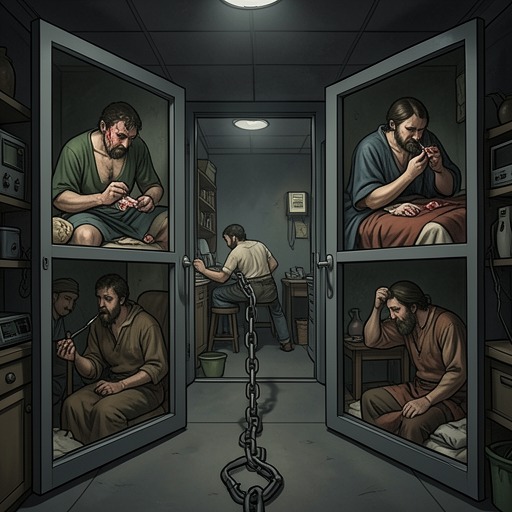
The Daytime Coffin Rule repeatedly turns architecture into an instrument of control. When Louis and Lestat bring their coffins to Freniere, Babette gives them a ground-floor storage room where wine is aged and promises that no one will enter until nightfall. She then locks the door again from outside. Her response transforms the shelter Louis requested into a temporary dungeon. The vampires require a protected daytime space, but the person who controls that space can also imprison them within it.
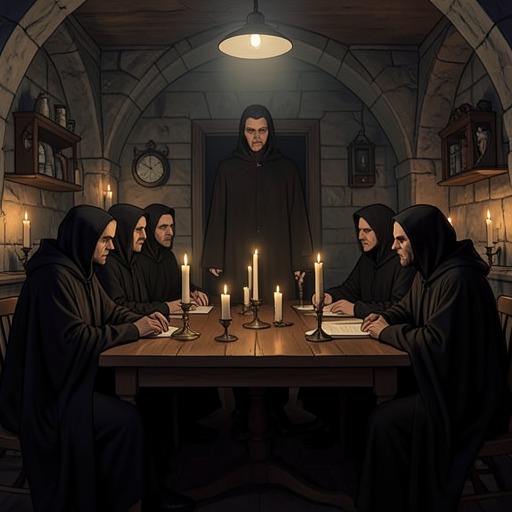
The same tension appears in Paris beneath the Théâtre des Vampires. The theater’s underground rooms, cells, and coffins create a communal version of the rule, allowing vampires to retreat from the human audience and remain concealed through the day. Armand leads Louis and Claudia downward through a hidden door into an ancient subterranean ballroom, where murals of death and damnation surround the vampire community. The theater is therefore divided into a public nocturnal surface, where vampires perform before humans, and a concealed daytime interior, where their bodies must be hidden and immobilized. Its theatrical power depends on this spatial separation: the human spectators see an illusion of death, while the vampires rely on literal coffins and underground chambers to survive.
The rule also magnifies the danger of the theater’s execution of Claudia and Madeleine. Louis lies sealed in his coffin while he hears Madeleine’s cries and fears that Claudia’s cries may join them. The coffin is carried down stairs, set near water and earth, and gradually enclosed by newly laid bricks. His refuge has become a tomb within a tomb. He tries to reason that Armand will return the following night, but the approach of daylight and the possibility that no rescuer will come turn the ordinary sleep of a vampire into panic. The rule makes rescue temporally specific: help must arrive before the next day’s helplessness is complete, or the enclosure may become permanent.
Reversal, Escape, and Significance
Louis later reverses the rule’s logic against the Théâtre des Vampires. Before dawn, he obtains a small scythe, hires a carriage and driver, and waits until the theater is closed and its vampires have entered their coffins. With only about fifteen minutes before daylight, he nails the theater’s doors shut from outside, then enters Armand’s cell and finds the coffin gone. He pours kerosene over the wooden doors, the cells, the ballroom furnishings, the draperies, and the theater itself before setting the building ablaze. The timing is essential: the vampires’ daytime immobility allows Louis to attack a community that would be far more difficult to confront at night.
The rule thus operates as both protection and trap. It preserves vampire secrecy, enables travel, and gives the transformed body a reliable shelter from the sun; at the same time, it produces dependence on architecture and leaves the sleeper exposed to betrayal, imprisonment, fire, or burial. Its recurrence also clarifies the contrast between human and vampire time. Humans ordinarily move through day and night without the body being sentenced by the sunrise. Vampires organize every night around the next period of enforced stillness, so that dawn is simultaneously a deadline, a danger, and the beginning of a suspended existence.
The rule remains central even at the end of Louis’s account, when the boy asks to be made a vampire. Louis’s story has shown that the promise of immortal perception and power is inseparable from the coffin: the body must sleep by day, surrender its agency, and trust hidden spaces or companions. The boy hears adventure and freedom in the narrative, but Louis responds from the knowledge that every nocturnal expansion conceals a corresponding daytime vulnerability. The Daytime Coffin Rule is therefore one of the clearest material expressions of vampire immortality’s contradiction: endless life is sustained through repeated contact with helplessness, confinement, and the threat of destruction.