Evil is a point of view
Interview with the Vampire“Evil is a point of view” is an expression used by Lestat to persuade Louis that vampiric violence need not be understood through mortal or Christian morality. Its force lies in its ambiguity: it can sound like liberation from guilt, but the novel repeatedly places that liberation beside corpses, grief, coercion, and the destruction of those who violate supernatural or human boundaries.
Definition and First Formulation
The expression appears when Lestat is leading Louis toward the killing of a child in a ward filled with starving orphans. Louis is exhausted by longing and pain, while Lestat presents vampiric appetite as the natural answer to that suffering. He tells Louis that evil is a point of view and joins the claim to a larger vision of immortal beings who kill as God kills: indiscriminately, taking both the rich and the poor. Vampires become, in his formulation, dark angels moving through the world rather than beings confined to a conventional image of hell.
The phrase therefore does more than deny that killing is wrong. It relocates the judgment itself. Mortal conscience becomes limited, while vampiric perception is presented as a higher or wider knowledge of life and death. Lestat immediately turns this metaphysical argument into practical persuasion: he wants a child, calls himself almost maternal in his desire, and guides Louis into the ward. The expression is thus embedded in manipulation as well as philosophy; Lestat uses it to make a specific act appear inevitable, natural, and spiritually enlarged.
Conflict with Religious and Human Judgment
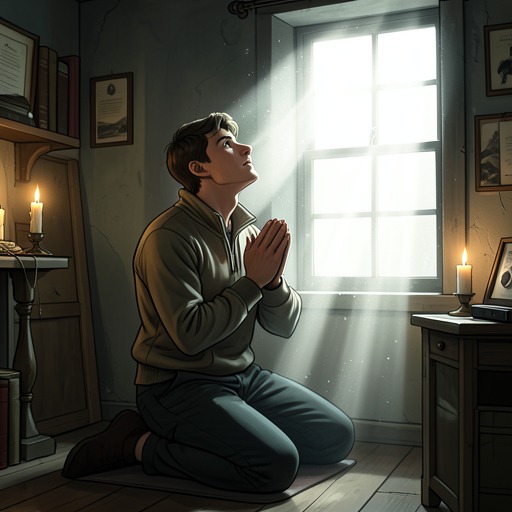
The idea has an earlier counterpart in Louis’s conflict with the priest after Paul’s death. Louis’s brother had believed that he received visions, but Louis had rejected the possibility because Paul was his brother and therefore, in Louis’s eyes, could not be a saint. After Paul falls to his death, Louis feels responsible because he had mocked him, refused to believe him, and withheld kindness. The family, police, and priest all treat the unexplained argument and death as grounds for suspicion, while Louis silently accepts the feeling that he has killed his brother.
The priest offers a competing explanation: Paul was possessed by the devil, and the devil threw him down the steps. Louis reacts violently, driving the priest out through the back doors and nearly killing him against the kitchen wall. The priest’s certainty resembles Louis’s earlier refusal to entertain Paul’s sanctity. Both positions reduce an unsettling human experience to a ready-made category. Louis recognizes his own egotism in the priest’s contempt, yet he also rejects the priest’s preference for possession over goodness. The phrase “Evil is a point of view” emerges from this tension between religious condemnation, skeptical disbelief, and the possibility that moral judgment is shaped by the observer’s need for certainty.
Blood, Corpses, and the Limits of Perspective
The expression is tested by the physical reality of death. When Louis kills Daniel after the overseer discovers the vampires’ secret, the act is swift and consciousless from the victim’s perspective, but Louis is still confronted by blood, the knife in Daniel’s heart, and the danger of the enslaved people gathering into a mob. Lestat tells him to kill Lestat’s dying father as well, arguing that there is no time to lose. In contrast, the old man’s living decay horrifies Louis precisely because it is slow, lucid, and prolonged. Vampiric killing may be presented as clean or merciful, but the dying body reveals that no perspective can entirely erase suffering.
The same contradiction appears in the abandoned kitchen where Claudia has left the bodies of a mother and daughter. Their corpses lie together amid feces, insects, ants, gnats, and snail trails, while the stench of decay mingles with the honeysuckle. Lestat treats the murders as a dangerous breach of secrecy and discipline, whereas Louis insists that Claudia must be taught rather than merely ruled. The scene makes moral and practical boundaries overlap: the dead are not only victims but also a source of contamination and exposure, and the question of evil cannot be separated from the consequences of leaving bodies behind.
The destruction of Lestat’s remains intensifies the paradox. After Claudia attacks him and his body collapses into a blood-soaked, skeletal horror, Louis carries the nearly weightless remains into the swamp near Bayou St. Jean and releases them into dark water. The act is both disposal and emotional surrender. Louis feels drawn to descend with the body and let everything disappear, but Claudia calls him back and tells him that they are free of Lestat. The claim that evil is merely perspectival cannot prevent grief, dependence, or the need to interpret what has been done; freedom itself remains entangled with the corpse of the one who once defined their world.
Social and Supernatural Law
The expression also collides with collective rules. In the Théâtre des Vampires, the coven treats immortality as a conformist society with its own standards of acceptable conduct and performance. Its members discuss their killings without emotion and condemn one another for wasting opportunities to kill, frighten, or drive mortals mad. Their boredom is described as death, and cruelty becomes a shared measure of belonging. Yet even this community, which treats mortal life as entertainment, recognizes one act as an absolute crime: killing one’s own kind.
Santiago declares that any vampire who commits that crime will be hunted down and destroyed. His accusation places Claudia and Louis under immediate threat because they have concealed the identity of the vampire who made Claudia. The coven’s law disproves any simple reading of Lestat’s expression. If evil were only a private perspective, no common prohibition could possess authority; instead, the vampires establish their own moral order, complete with secrecy, punishment, and execution. Their code does not restore human ethics, but it shows that every community creates boundaries around violence, even one organized around predation.
Armand’s attempted rescue of Louis further exposes the difference between private conviction and institutional power. Armand can lead Louis out of the theater, but he says he cannot save Claudia because the others would rise against him. Louis refuses to leave her and returns with Armand, choosing responsibility over his own escape. The scene converts the phrase’s apparent freedom into a demand for choice: Louis cannot make Claudia’s fate morally neutral simply by adopting a different vocabulary for violence.
Interpretation and Narrative Significance
Across these episodes, “Evil is a point of view” functions less as a settled doctrine than as a provocation. Lestat uses it to transform appetite into philosophy, to make predation resemble divine action, and to relieve Louis of the human framework that produces guilt. Louis, however, continues to encounter the faces and bodies that resist abstraction: Paul’s shattered skull, Daniel’s blood, the decaying mother and daughter, the mutilated corpse described by Morgan, and Claudia’s imprisonment and execution.
The expression also helps explain the novel’s recurring contrast between what an act means to its perpetrator and what it does to the victim or witness. Morgan sees a corpse violently staked and beheaded in a cemetery and calls those who perform the ritual savages; he then asks Louis to protect Emily from the same supposed vampire punishment. His own account is shaped by horror, class, nationality, and the conviction that civilized men stand apart from the people around them. The scene demonstrates that moral perspective is never detached from social position, but it also refuses to make suffering unreal merely because judgments differ.
Louis’s final response is not a simple rejection of the expression. He remains fascinated by the possibility that vampirism offers a form of existence outside ordinary moral categories, yet his actions repeatedly return him to responsibility, attachment, and consequence. The phrase is therefore central to the book’s philosophical tension: it opens the question of whether evil is an objective property or a judgment imposed by a standpoint, while the narrative keeps showing that changing the standpoint does not abolish pain, fear, law, or the dead.