Fledgling vampire
Interview with the VampireThe fledgling vampire is the transitional state between human existence and mature Vampire identity: a newly changed being whose body is dead in human terms but newly alive through supernatural perception and blood. In Louis’s account, it is not a simple initiation but a violent interval of sensory awakening, ethical disorientation, dependence, and exposure to the institutions and conflicts of vampire society. The state determines how he first sees Lestat, Claudia, Armand, and the Théâtre des Vampires, while also explaining why the promise of immortal experience can appear magnificent to an outsider and unbearable to the one who has lived it.
Identity and Transformation
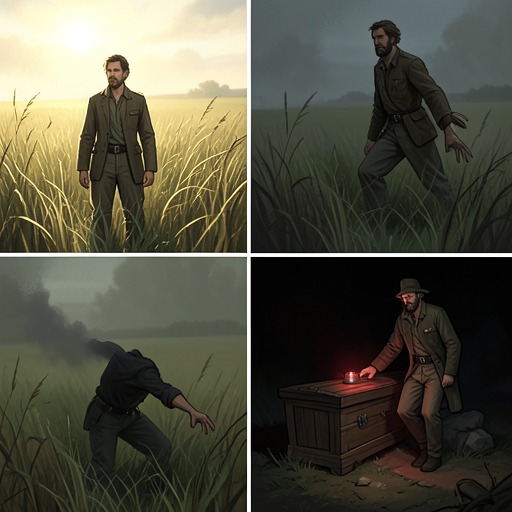
The condition begins when Lestat takes Louis to Pointe du Lac plantation and makes the transformation a sequence of acts rather than one instantaneous gesture. Lestat first kills the overseer in his sleep and requires Louis to watch the death as proof of commitment. Louis experiences this as the most difficult part of the change because, despite his indifference toward his own death, he retains a powerful regard for the lives of others. He must then help dispose of the body, an act that produces nausea rather than the laughter Lestat predicts. The dead man is left beside the river road with his coat torn, his money stolen, and his lips stained with liquor, creating the false appearance of robbery and leaving Louis painfully aware of the overseer’s wife and of the truth she will never learn.
Lestat completes the change by allowing Louis to drink from his bleeding wrist. Louis experiences the blood as a concentrated nourishment that joins body and mind around one vital source. The transformation becomes audible before it becomes fully intelligible: one pounding drum is Louis’s heart and the second is Lestat’s. When Lestat withdraws his wrist, Louis instinctively reaches for it and forces it back to his mouth. This first exchange establishes the fledgling’s dependence on the maker while also revealing the new state as an altered relation to vitality itself; the fledgling does not merely receive blood but perceives the living body as an overwhelming system of rhythms.
The New Senses and the Death of the Human Body
After drinking from Lestat, Louis sees him as radiant rather than merely luminous and discovers that every surrounding object has changed. Colors and shapes seem newly available, the buttons on Lestat’s black coat become absorbing objects, and laughter separates into metallic peals that initially overlap with the sound of the heart. The moon on the flagstones captivates Louis for nearly an hour, while the night among the cottonwood and oak trees becomes a chorus of beckoning sounds. Such perception is both enchantment and danger: Lestat has to order him to leave the trees, attend to his body, and avoid losing his way in the night.
The fledgling’s body undergoes a simultaneous expulsion and death. Human fluids are forced out, the body aches, and Louis must preside over the destruction of his human organism while remaining fully alive as a Vampire. His former fear of enclosed spaces also changes. He realizes that the terror of confinement is no longer present experience but a remembered habit, like pain felt in a limb that has been lost. Near dawn, Lestat places him in a coffin, and Louis lies face-down on him without the dread that confinement once produced. When he wakes, his body is dead, though the cleansing of unwanted matter continues; the fledgling therefore occupies a paradoxical condition of bodily death and supernatural animation.
The end of the human body also changes Louis’s relation to Lestat. Before transformation, Lestat is overwhelming, handsome, and nearly spellbinding. Afterward, the gap between them narrows enough for the spell to break. Louis discovers that he does not like Lestat at all, even though he remains weaker and less experienced. Lestat’s constant chatter, once powerful, becomes boring and disheartening. This reversal is one of the fledgling state’s first psychological shocks: newly acquired perception does not simply add wonders to human experience but rearranges attachment, authority, and desire.
Ethics, Killing, and Vampire Society
The fledgling state does not erase Louis’s moral resistance. His first required death leaves him unable to laugh at killing, even when he later becomes its regular cause. That resistance distinguishes him from the vampires who treat human life as material for entertainment. In the Théâtre des Vampires, killing is placed inside a theatrical system: a human audience watches a staged allegory of Death while the performers are actual vampires and the apparent drama conceals real predation. The performance turns fear, beauty, laughter, and death into a single spectacle, making the fledgling confront the distance between his own unease and the coven’s cultivated appetite for display.
The theater’s stage presents Death as a masked figure with a scythe, followed by vampires who surround a mortal woman. Seven vampires close around her, and the audience responds with gasps, sighs, and approving laughter as the woman pleads against dying. The scene is not merely an illustration of vampire life; it is a rehearsal of the social logic the fledgling is being asked to accept. The mortal becomes a prop, the vampire becomes an actor, and the spectators become consumers of an execution disguised as art. Louis’s passion and confusion intensify because the performance makes the kill aesthetically seductive while exposing its cruelty.
Below the theater, the fledgling encounters a more explicit collective code. The vampires speak of missed opportunities to kill or frighten humans as waste, and they pressure one another to treat immortal existence as a conformist club. Santiago identifies the cardinal crime as killing one’s own kind, a violation punishable by the destruction of the offender. The rule places a legal boundary around the coven even as the vampires display almost no comparable concern for human victims. Louis’s position as a fledgling is therefore institutionally vulnerable: he is being trained into a society whose prohibitions protect vampires from one another while its daily practices normalize violence against mortals.
Fledgling Dependency and Relationships
The newly changed Vampire remains dependent on the maker, but that dependence is unstable. Lestat controls the transformation, supervises Louis’s first nights, and teaches him through commands that are practical rather than compassionate. Yet the completed change diminishes Lestat’s authority in Louis’s perception. The fledgling is still weaker, but he is no longer wholly enclosed by Lestat’s glamour. This altered balance helps explain Louis’s later resistance to the world Lestat represents and his continuing search for another form of companionship.
Claudia occupies a different place in Louis’s fledgling existence. Louis creates her after confronting the grief and guilt of a woman mourning a dead child. He recognizes that her longing for power is bound to her knowledge of death’s finality, and he instructs her to hold fast, watch a distant light, and repeat that she will live as he brings her across. The act makes her a child Vampire, but it also turns Louis from dependent initiate into maker and guardian. His own incomplete moral education is thus reproduced in a new relationship, one that gives him responsibility while binding him to a being whose experience of childhood and immortality will never coincide.
Armand represents the fledgling’s hope of finding a more ancient and intelligible order. He first reaches Louis through an invitation to the Théâtre des Vampires, signed with the promise that neither he nor the other vampire will cause harm. Armand then guides Louis and Claudia beneath the theater into an underground ballroom covered by monumental images of death and damnation. The space transforms the fledgling’s entry into vampire society into a descent through art, law, and hidden history. Armand’s calm, remote authority attracts Louis precisely because it differs from Lestat’s noisy domination, although Armand’s warning that he cannot freely protect Claudia reveals the limits of that promise.
The limits become decisive when Armand rescues Louis alone from the theater’s sealed passages. Louis refuses to leave Claudia behind and returns despite Armand’s admission that he lacks the power to save her without provoking the coven. The fledgling’s state is therefore defined not only by dependence but by a rapidly developing capacity for loyalty and refusal. Louis may still lack mastery of his powers, yet he understands that Claudia’s fate makes retreat impossible. His return turns the fledgling from an observer of vampire society into an opponent of its judgment.
Narrative Function and Human Misreading
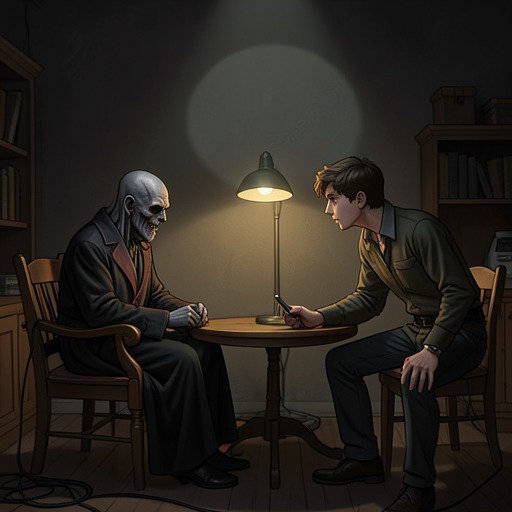
The fledgling vampire also structures the novel’s encounter between experience and representation. Louis tells the boy about transformation through a tape recorder, repeatedly acknowledging that words cannot reproduce the exactness of becoming a Vampire. The narrated experience is therefore both testimony and performance: the listener receives a carefully ordered account, while the speaker insists that its sensations exceed language. The boy’s response exposes the danger of that account. He hears passion, perception, and immortality more vividly than despair, and finally asks Louis to make him a Vampire.
The request reveals a fundamental misreading of the fledgling state. The boy treats the narrative as an invitation to extraordinary life, while Louis understands it as an account of bodily death, ethical burden, failed love, and destructive attachment. Louis tells the story in order, but its accumulated beauty repeatedly competes with its warning. The boy’s demand demonstrates how easily the spectacle of vampire existence can overcome the meaning Louis intends to convey, just as the Théâtre des Vampires turns actual killing into captivating entertainment.
Louis responds to the request with rage because the boy has heard the adventure while refusing its despair. He asks whether, after everything described, this is truly what the boy wants, then concludes that he has failed to communicate the meaning of human life and vampire existence. His final action makes the contradiction physical: rather than continue explaining, he seizes the boy and begins the transformation himself. The fledgling state thus closes the circle between narrated experience and renewed initiation. What began as Louis’s attempt to show why immortality cannot be separated from death becomes, through the boy’s desire, the beginning of another person’s passage into the same irreversible condition.