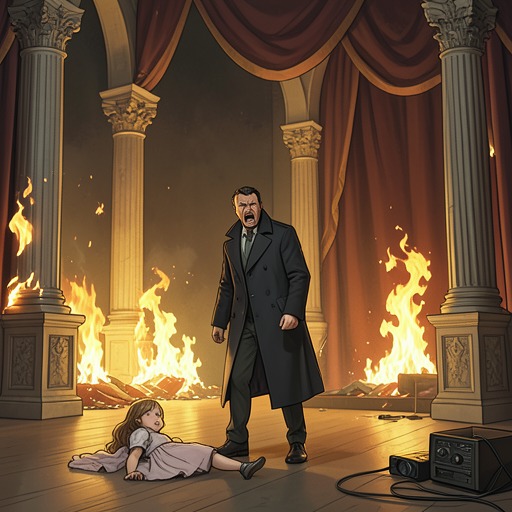
Louis burns Claudia and Madeleine's remains
Interview with the VampireLouis burns Claudia and Madeleine's remains as the final expression of his grief and revolt against the Théâtre des Vampires. After Armand rescues him from a sealed coffin, Louis discovers that he has been saved alone: Madeleine and Claudia remain in the theater's custody. The rescue therefore becomes a second abandonment, forcing Louis to confront the limits of Armand's protection and the destruction of the family he had tried to preserve.
Discovery of the Dead
Louis awakens buried inside a coffin after the vampires of the Théâtre des Vampires have confined him. Armand breaks through the brickwork and releases him, but Louis immediately realizes that Armand cannot or will not save Claudia. Armand insists that the coven would rise against him, while Louis refuses to leave without her. Their argument ends only when Armand leads him back into the theater's alley, where Louis sees that the rescue has not included Claudia or Madeleine.
Inside the theater, Louis finds Lestat among the vampires. Lestat pleads with him to return and carries a fragile object beneath his cloak; when Louis seizes it, he recognizes Claudia's yellow dress, torn and stained with blood. The dress converts suspicion into knowledge. Louis no longer confronts an uncertain fate or a theatrical threat but a material sign of Claudia's destruction. He crushes the dress against his chest while the vampires' laughter, candles, rain, and open doorway form a grotesque stage around him.
The Remains of Claudia and Madeleine
Through the doorway Louis sees the same kind of image that had remained privately associated with the murdered mother and daughter in the kitchen on Rue Royale: two bodies lying together beneath the rain. Now the figures are Madeleine and Claudia. Madeleine's red hair is mingled with Claudia's gold; Madeleine's blackened body still preserves the stamp of her living face, while her hand remains whole and grips the child. Claudia, described as ancient despite her child's form, has been reduced to ashes. The scene makes the theater's performance of death literal: the coven had staged mortality before human spectators, then enacted real destruction behind its doors.
Louis responds with an uncontrolled cry and attacks Santiago, pounding and twisting the vampire away from the ashes. Armand restrains him and forces him back toward the ballroom, while Lestat calls after him and claims that he must speak with him. Armand says that he could not prevent the deaths, but his explanation does not relieve Louis's grief. Louis cannot gather the bodies or carry them out; he is taken from the small graveyard in a state of physical and emotional collapse.
Preparation for Vengeance
After the deaths, Louis turns mourning into a practical plan. He obtains a small scythe, hires a carriage and driver with cash, moves his chest from the Hôtel Saint-Gabriel, and arranges to travel from Paris to Fontainebleau at dawn while maintaining the appearance of a delicate mortal invalid. The preparations depend on the same concealment and controlled access that govern vampire existence: the driver must not touch the carriage, the vampires must be asleep before Louis enters the theater, and the daylight hours must be used against them because they are confined to their coffins.
Louis approaches the Théâtre des Vampires shortly before sunrise, when he estimates that only fifteen minutes remain. He nails pieces of wood across its bolted doors, preventing anyone inside from emerging. He then carries two small barrels of kerosene into Armand's underground passage. Armand's cell is empty and his coffin is gone, but the furnishings remain, including the enclosed bed of the dead boy. Louis splashes kerosene over the exposed beams and the wooden doors of the other cells, moving through the subterranean structure where the vampires are presumed to lie sleeping.
Burning the Theater
Louis continues upward into the ballroom and pours kerosene over the horsehair chairs and draperies. He pauses at the yard where Madeleine and Claudia were killed, tempted to open the door and look again at their remains, but recognizes that they are dead and that reopening the scene would serve no purpose. He proceeds through corridors he has not previously explored, coats further doors with fuel, and reaches the theater itself. There he spreads the kerosene across the velvet stage curtain, padded chairs, and lobby draperies before the barrel is exhausted and a crude torch is drawn.
The burning is not an incidental act of destruction. It reverses the theater's own relation between spectacle and violence. The coven had transformed killing into a public performance, surrounding a mortal woman with masked vampires while the human audience watched, laughed, applauded, and then returned to the rain-soaked streets. Louis now turns the theater's architecture, props, furnishings, and backstage cells against the performers. The stage that displayed Death becomes the site of a real retaliatory fire, and the hidden spaces that protected the coven are treated as one connected structure of confinement and murder.
Meaning and Aftermath
Louis's revenge follows the execution of Claudia and Madeleine but also grows from the earlier pattern of his life as a vampire. He had once sealed himself in Paul's oratory and recognized that the death of his brother had finally stripped away his remaining human detachment. In Paris, the sealed coffin repeats that confinement in a harsher form: Louis is physically imprisoned while the people he loves are destroyed beyond his reach. His escape with Armand does not restore freedom; it gives him the limited freedom necessary to retaliate.
The action also exposes the difference between theatrical feeling and lived consequence. At the theater, the audience responds to the spectacle of a mortal victim with gasps, laughter, applause, and sophisticated conversation. Louis, however, tastes the girl's blood through the performance and feels his body pulled between desire, horror, and restraint. Later, Claudia's dress and ashes make the same violence undeniable. Burning the theater rejects the coven's ability to control the frame through which death is viewed: Louis refuses to remain an audience member, a captive, or a participant in its ritual. He becomes the destroyer of the stage itself.
The act cannot restore Claudia or Madeleine. Their destruction remains irreparable, and Louis leaves unable to carry their bodies from the place where they died. Its consequence is therefore not recovery but separation: the theater, its cells, its ballroom, and its public facade are marked for annihilation, while Louis's grief is converted into a permanent break with the Parisian coven. Later, when Louis tells his story to the boy, the boy hears the whole trajectory as an adventure of passion and longing that ends in despair; Louis rejects the idea that it could have ended otherwise. The fire belongs to that irreversible ending, the point at which love, guilt, and vengeance become inseparable from the destruction of the world that contained them.