Louis kills Claudia's mother
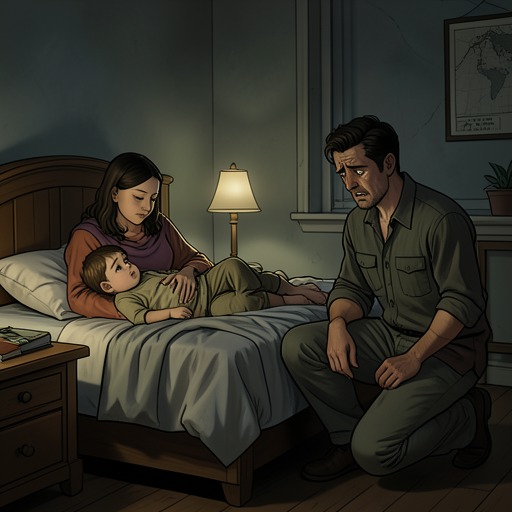
Interview with the VampireLouis kills Claudia's mother and drinks from the five-year-old Claudia in a scene that transforms his abstract fear of damnation into an irreversible human act. Driven into the streets by thirst, pity, and the question of whether his vampire nature makes him a devil, Louis enters a room where a dead woman lies beside her abandoned child. His attempt to understand the child's suffering collapses into hunger, and the killing becomes the decisive origin of Claudia's later existence as a vampire child.
Crisis Before the Killing
Louis's first child kill follows a period of spiritual and bodily extremity. He has spent four years without savoring a human, and his death wish has led him to neglect his thirst rather than accept what feeding means. As he walks through the dark streets of New Orleans, his veins seem threaded with pain and his temples throb, while he repeatedly asks whether he is damned and whether becoming a vampire has made him part of the devil's nature. His revulsion toward Lestat's killings and his pity for the suffering around him appear to contradict the violence that his body demands.
The crisis is sharpened by the alternatives available to him. Rats are abundant in the streets, and a nearby dog is howling, so Louis could have escaped the room, fed on an animal, and returned safely. Lestat has already taught him that animals can sustain vampires: he catches a field rat, cuts its throat, drinks its blood from a crystal wine glass, and explains that rats, chickens, and cattle are practical sources of nourishment when travel or secrecy makes human victims dangerous. Louis therefore enters the child's room not because no other food exists, but because pity, exhaustion, and hunger converge there.
The Dead Mother and the Child
The child is alone in a dark, cluttered room beside a mother who has been dead for several days. Trunks and packages suggest that the family had been preparing to leave before the plague arrived; the girl says that they must take a ship and that her father is waiting. She is no more than five, thin, dirty, exhausted from prolonged crying, and still trying to make Louis help the woman who can no longer be helped. Her face and desperate appeal confront him with a suffering that he cannot reduce to the categories of food or prey.
Louis responds first with attention and tenderness. He wonders why, if he is truly damned, he feels pity for the girl's gaunt face and wants to touch her small arms, hold her on his knee, and draw her head against his chest. In his reasoning, damnation ought to have erased compassion; if he is condemned, he thinks, he should hate the child and want only to turn her into food. The child's physical presence instead creates an ethical resistance that briefly seems stronger than his vampire nature.
That resistance breaks when Louis bends to the child's neck. He tells her that it will be only for a moment and that there will be no more pain, but the act immediately exceeds the restraint implied by those words. The child's heart beats with extraordinary speed and tenacity, refusing to slow as Louis drinks. He experiences the heart not as the pulse of an ordinary human or animal but as an insistent force, like a tiny fist refusing surrender. The intensity of the feeding overwhelms his attempted detachment.
Louis finally throws the child down, leaving her alive, and turns in horror toward the mother. Lestat appears at the window, laughing and taunting him for having been caught in the act. He enters, drags the mother's decaying body into a grotesque dance, and uses the scene to intensify Louis's shame and rage. Lestat then follows Louis across the streets and rooftops, calling after him that the child is still breathing and offering to return to make her a vampire. The threat makes clear that the girl's survival has not ended the danger; Lestat can convert Louis's failure into another form of possession.
Lestat's Return and the Second Feeding
The next night Lestat turns the unfinished killing into a deliberate lesson. After feeding from one of two women in their hotel parlor while the other remains unaware, he brings the still-living child back to the room. He places money on the bed before taking her from a doctor, preserving the appearance of an ordinary rescue, and carries her through the streets wrapped in a white blanket. The corpses of the two women remain in the hotel, one arranged in a coffin and the other left in her chair, while Lestat treats the child as the next object in his instruction.
Lestat does not mock Louis in the same manner as before. He argues that the girl's plump appearance and powerful will to live reveal what Louis wanted but lacked the strength to take. Louis resists, turns away, and remembers both the child's heart beating against his own and the mother's face at the moment of horror. He recognizes that his explanations about what would be best for the sick child are false consolations. He wants her, and Lestat's persuasion converts that desire into obedience.
Louis takes Claudia from the bed while she sleeps. Her cheek is hot against his, her gold hair brushes his wrists and eyelids, and her body still carries the perfume and vitality of childhood despite sickness and near death. He tells himself that killing her before she wakes is merciful, but he knows that this is another lie masking hunger. When she stirs, he decides that he would rather kill her than let her awaken and understand what is happening. Lestat guides him through the feeding, reducing the act to a small wound and a small throat, while Louis obeys.
The second feeding carries him further than the first. He bends over the bed and drinks until the child's heart again pounds with a stubborn rhythm that refuses to cease. The scene makes the violence both intimate and mechanical: Louis holds her as if protecting her, yet the embrace is also the means by which he drains her. Claudia's death is therefore not an accidental consequence of the first encounter but the result of Lestat's manipulation and Louis's surrender to the desire he had tried to deny.
Consequences for Claudia and Louis
The killing becomes the immediate precondition for Claudia's creation. Although the supplied scene centers on Louis's first feeding, later events show that Claudia survives as a vampire child and becomes Louis's companion and pupil. Her body never grows beyond the age at which she was transformed, while her mind develops into that of a vampire. The origin of this condition lies in Louis's decision to drink from her: his act takes her mortal life and establishes the permanent contradiction between her childlike form and adult consciousness.
The event also reorganizes Louis's moral self-understanding. Before entering the room, he treats pity as evidence that he may not possess a devil's nature. During the feeding, compassion and appetite coexist rather than cancel one another. He can feel the child's suffering, promise an end to pain, and still consume her. The killing thus defeats the hope that moral revulsion alone can separate him from vampire violence; it teaches him that pity may accompany, rather than prevent, the kill.
Claudia's later relationship with Louis preserves that contradiction. She becomes his daughter and pupil, but also the living reminder that he killed her and took her life in a fatal embrace. Their intimacy is marked by tenderness, instruction, guilt, and an unequal origin that Louis cannot undo. Years later, she remains physically a child while displaying an adult vampire's intellect, sensuality, authority, and appetite, making the first feeding the source of both her power and her confinement.
Recurrence and Narrative Significance
The episode establishes a pattern that recurs throughout Louis's life: human vulnerability is encountered through domestic objects and gestures, then transformed into predation. The abandoned room contains the signs of migration, family, illness, and failed departure; the hotel later contains beds, wine, candles, and carefully staged bodies. Against Lestat's practical lessons about crystal glasses, animal blood, travel, and luxury, the child's death reveals the intimate cost of treating feeding as a manageable household practice.
The event also foreshadows the later formation of Claudia's identity. She will become fascinated by dolls, clothing, miniature furniture, and the performance of adulthood, eventually creating a tiny world in which her arrested body can appear womanly and powerful. Her later insistence that Louis acknowledge what she has become is inseparable from the fact that he first made her through an act he regarded as both mercy and violation. The child he could not bear to see suffer becomes the immortal figure whose intelligence and anger expose the consequences of his choice.
As narrated by Louis, the killing is not presented as a simple origin story or a completed moral judgment. It is a remembered wound that returns through physical sensations, the child's heartbeat, the mother's decaying face, Lestat's laughter, and the repeated contrast between animal blood and human blood. Its decisive consequence is not only Claudia's creation but Louis's discovery that the vampire kill cannot be made harmless by pity, explanation, or elegance. Once he drinks from Claudia, the question of what he has become is no longer theoretical; it has a face, a body, and a continuing life bound to his own.