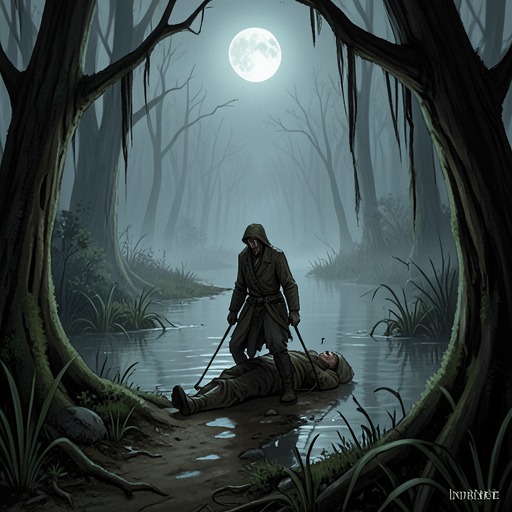
Louis leaves Paris after burning the Théâtre des Vampires
Interview with the VampireLouis leaves the Théâtre des Vampires in ruins after burning the Parisian coven that destroyed Claudia and Madeleine, but the departure does not liberate him from grief. It marks a decisive change in Louis’s relation to love, art, memory, and his own future: after the execution, he becomes more alone than ever, abandons the human heart as a source of meaning, and allows Armand to accompany him away from Paris toward Egypt and later New Orleans.
Causes and Background
Louis’s departure is prepared by a long search for knowledge that has already failed him. After leaving New Orleans, he and Claudia travel through central and eastern Europe in pursuit of vampires who might explain their origins. Claudia studies old accounts describing vampires as mindless corpses whose remains are burned, staked, and dismembered, while their journey carries them through Transylvania, Hungary, Bulgaria, and the Carpathians. The creatures they find offer no wisdom or fellowship. They are empty, decaying figures, and the search leaves Louis in despair rather than giving him a history or a community.
The failure of that quest redirects Louis and Claudia toward Paris. For Louis, Paris initially represents relief and almost forgotten happiness. He sees it as the mother of New Orleans, but unlike the fragile, flood-threatened colonial city, Paris appears whole, historical, and enduring. Its boulevards, cathedrals, theaters, cafes, and museums seem to preserve everything beautiful and essential. This promise makes the Théâtre des Vampires especially powerful: Louis enters it expecting revelation, yet finds a coven that turns murder into spectacle.
Armand first reaches Louis through an invitation to the theater, giving him a card bearing the name Théâtre des Vampires and asking him to bring Claudia. The theater admits human spectators who believe they are watching fiction, while the vampires perform genuine predation beneath masks and theatrical lighting. Death appears onstage with a scythe; the audience laughs at a helpless old woman and applauds the vampire performers. A human woman is then surrounded by seven vampires, displayed as a victim, and killed before the enthralled crowd. The scene exposes the theater’s governing principle: violence is made acceptable by framing it as entertainment.
What Happens in Paris
After Claudia and Madeleine are executed, Louis burns the Théâtre des Vampires. Two nights later, he returns to the site and finds a rain-flooded cellar reduced to scorched, crumbling brick and skeletal rafters. The grand subterranean ballroom has become rubble; the murals that once represented death and damnation survive only as fragments of painted faces and angelic wings. Newspapers report that few bodies were found and that costumes and clothing were scattered as though the vampire performers had fled. Louis is certain that most of the coven died, while the ancient vampires were completely obliterated.
The ruins also reveal the extent of Armand’s intervention. Louis had expected guards or ushers to protect the sleeping vampires, but Armand explains that those men were in his employ and that he dismissed them before Louis entered. Armand had known what Louis intended and nevertheless removed the theater’s human defenses. He does not seek revenge for the destruction of his fellows, despite having been their leader. His calm refusal to condemn Louis makes the departure morally uncertain: Armand has not simply survived the catastrophe but has helped make it possible.
Louis’s victory immediately becomes a form of desolation. Claudia is gone beyond reprieve, and Louis has less reason and less desire to live than ever. His grief does not arrive as an outwardly sustained torment; instead, he describes himself as numb, remote from pain, and unable to imagine telling his sorrow to any living creature. The absence of overwhelming emotion is itself a consequence of the violence. The destruction has not resolved his suffering but has exceeded his capacity to inhabit it continuously.
Armand, the Louvre, and Departure
Louis leaves the ruined theater and walks toward the Louvre, drawn by the possibility that art might offer solace without requiring him to destroy anything living. He has passed the museum many times, imagining what it would mean to move through its rooms and encounter its paintings as a mortal man. Now he seeks a transcendent pleasure that might obliterate pain and even make him forget himself. Armand follows him along the Avenue Napoléon, and Louis allows him to fall into step beside him without resistance.
Their conversation turns on betrayal, allegiance, and love. Louis asks whether Armand means to avenge the destroyed vampires, whether he despises him, and whether he has violated some rule binding vampires to their own kind. Armand answers each question negatively. His explanation for dismissing the guards is deliberately evasive: he says the theater belonged to him and that he was leaving Paris, but he also admits that this is the least true version of the reason. Louis cannot determine whether Armand has saved him, used him, or simply accepted the destruction as part of his own departure.
At the Louvre, Louis recognizes that Claudia had foreseen his capacity to love Armand because he had been able to love her. That recognition changes the meaning of his attachment. Love is not presented as redemption; it is a dangerous intimacy between beings who believe that no one else could understand them without seeking to destroy them. Yet Louis still accepts Armand’s arm and lets him come close. He then asks to enter the Louvre and remain among its treasures until dawn. Armand treats the request as simple and wonders why Louis waited so long, turning the museum into a temporary shelter after the theater’s destruction.
Louis and Armand leave Paris soon afterward by carriage, without ceremony. Louis does not choose Greece, the destination he had once imagined while crossing the Mediterranean, but Egypt. He wants to see the desert, the pyramids, and the tombs of kings; he hopes to meet grave-thieves who know more about the burial places than scholars and to enter unopened graves, examining their furnishings, paintings, and works of art. The direction of travel therefore changes from a search for vampires to a search among the dead, as if history and burial might offer forms of knowledge that the vampire world withheld.
Memory, Art, and Emotional Rupture
Before leaving, Louis returns to the Hôtel Saint-Gabriel to collect belongings belonging to Claudia and Madeleine and prepare graves for them in Montmartre Cemetery. He does not complete the task. The rooms have been arranged so neatly by the staff that Claudia and Madeleine seem capable of returning at any moment, and Madeleine’s embroidery ring remains beside her bundles of thread on a small table. Faced with these ordinary objects, Louis finds the intended burial meaningless and leaves without taking them.
His visit to the Louvre changes his relation to art. Once, paintings promised a deeper understanding of the human heart because they remained connected to the mortal hands that made them. After Claudia and Madeleine’s deaths, that connection is severed. The paintings seem dead and detached, like children turned to stone, like Claudia separated from her mother and preserved in pearl and hammered gold, or like Madeleine’s dolls. Louis does not condemn the human heart; he simply ceases to invest it with meaning. Art becomes beautiful but no longer intimate, capable of being reduced, like vampires and their possessions, to ashes.
The departure also carries a historical and geographical tension. Louis’s longing for Europe began in his mortal attachment to French language, literature, philosophy, and the memory of the French Revolution and Napoleon’s victories. The loss of Louisiana to the United States had once provoked his anger, and Europe seemed the origin of the culture that formed him as a Creole. Yet the Old World gives him neither belonging nor instruction. The Black Sea, the Carpathians, Paris, and the theater each promise access to origins, but each ends by revealing another form of darkness.
Consequences and Later Return
Louis and Armand eventually leave Paris for Egypt, and they later live for a long time in New York. Louis repeatedly postpones returning to New Orleans, even though Armand asks him to do so. The postponement suggests that the city remains bound to pain: returning might awaken the old unhappiness and longing that Louis has tried to suppress. Armand finally changes the situation by revealing a secret he had withheld since Paris: Lestat survived the destruction of the Théâtre des Vampires and escaped to New Orleans with assistance from two vampires made by the same master.
The revelation restores a feeling Louis had believed lost. He had not been driven by hatred of Lestat when he burned the theater; his immediate targets had been Santiago, Celeste, and the vampires responsible for Claudia’s death. Yet learning that Lestat lives makes Louis want to see him again. He and Armand return to New Orleans in late spring, and Louis recognizes the city as home through its warm pavements, familiar oaks, night sounds, old mansions, magnolias, honeysuckle, roses, and the wilderness of the Pointe du Lac plantation.
The return does not simply restore the past. In Rue Royale, Louis finds the former town house of himself, Lestat, and Claudia, its facade little changed and its French windows still opening onto balconies above the shop below. He senses Lestat there more strongly than Claudia, although Lestat is not present. The sadness that follows is no longer purely painful or passionate; it is rich, almost sweet, and binds Louis to the city. Thus leaving Paris becomes an incomplete ending. Exile carries him away from the ruins, but memory, desire, and the possibility of finding Lestat draw him back toward the place where his vampire life began.
Narrative Significance
The departure from Paris is an event of escape, revenge, and failed release. Louis destroys the theater’s physical world, but the act cannot destroy the structures that produced his despair: secrecy, theatrical violence, divided loyalties, and the inability of vampires to find a stable moral community. The theater’s public performances make murder look like art, while Louis’s private journey turns art into a substitute for grief; both movements reveal how representation can conceal and intensify violence.
The event also links several forms of movement. Louis travels from the plantation and New Orleans through the Atlantic world, the Mediterranean, eastern Europe, Paris, Egypt, New York, and back to New Orleans. These places do not merely form a route. Each recasts the question of what a vampire is: colonial survivor, European seeker, folkloric corpse, theatrical predator, historical witness, or displaced immortal. By leaving Paris with Armand, Louis abandons the hope that another vampire society can explain him, but he does not abandon the need for meaning. He carries that need into museums, tombs, cities, and finally the remembered landscape of home.